
Motion Control & Motors Blog
Fabrication Methods for Magnets & Motor Specification
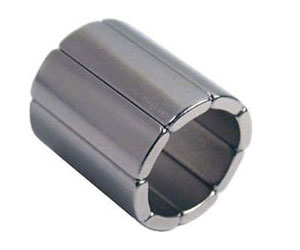 Magnets can be formed using one of two techniques: bonding or sintering.
Bonding involves mixing finely milled material with polymers or resins, compressing it into a shape, then curing it. Bonded magnets are generally isotropic, which means that they can be magnetized in a variety of orientations. The property makes them particularly well-suited to high-pole-count motors.
Anisotropic bonded magnets do exist. They offer higher remanence and energy products but are more difficult to manufacture. As a result, their application has been limited.
Sintering involves pressing the milled material into the desired shape under an applied magnetic field, which aligns the particles while they are being compressed. The compacted material is then sintered to densify it. The high degree of alignment introduced during this fabrication process creates a magnet with high maximum energy product. Sintered NIB magnets have a maximum energy product of 52 MGOe compared to just 10 MGOe for the bonded version. The magnetic orientation of sintered magnets is fixed during pressing and sintering. As a result, they are anisotropic and can only be magnetized parallel or antiparallel to the orientation direction. They are not a good fit for high-pole-count motors.
Certified Motion Control Professional Program
Strengthen Your Skills and Enhance Your Career
Become a Certified Motion Control Professional (CMCP) and join the elite group of system integrators, machine builders, manufacturers, end-users and others recognized in the industry for their professional knowledge and expertise.
It’s important to note that there is no cost-benefit to choosing bonded over sintered. The decision of which to use should be driven by the desired performance and end-user application.
This post is an extraction of an article written by MCMA Tech Writer Kristin Lewotsky, ‘What You Need to Know About Magnets to Specify the Right Motor.’ Click on the link to access the full article.
Recent Posts
- Emerging Technologies Driving Modern Motion Control Systems: Five Trends Reshaping Factory Automation
- Electronic Camming: Enabling Superior Flexibility in Advanced Motion Control Systems
- Electronic Camming: Enabling Superior Flexibility in Advanced Motion Control Systems
- How Electrification is Reshaping Motion Control
- Motion Control in Harsh Environments: Engineering for Extremes
- Next-Generation Motion Control: Integrating IIoT and Real-Time Data Analytics
- View All Motion Control & Motors Blogs