
Motion Control & Motors Blog
Brushless DC Motor Basics
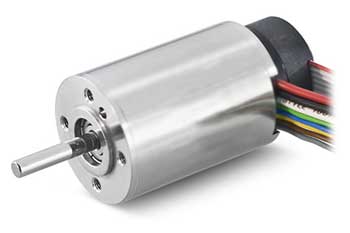 In any electro-mechanical motion control system, the motor is paramount for achieving performance. First developed in the 1960s, Brushless DC (BLDC) electric motors are beginning to supplant traditional brushed motors (around since the 1800s) because of the specific advantages they afford.
Compared to brushed motors, BLDC motors:
- Are more efficient;
- Suffer less mechanical wear;
- Produce a lower level of EMI;
- Last longer, with greater reliability.
In terms of performance, users can expect superior speed versus torque, high dynamic response, and a greater range of speeds. For these reasons, BLDC motors are rapidly gaining popularity in a number of industries, including aerospace, medical instrumentation, automation, and many others.
Basic Principles and Overview of BLDC Motors
BLDC motors are synchronous, with the magnetic fields generated by the rotor and stator both rotating at the same frequency. This helps prevent slippage observed in many high induction motors. Although single-phase, two-phase, and three-phase motors are available, three-phase designs are by far the most popular in today’s applications.
The key components of a BLDC motor are:
The Stator
In BLDC motors, the stator is composed of stacked steel laminations. Windings are situated in the slots cut axially along the inside periphery. Generally, the stator somewhat resembles that of an induction motor, but the windings have a far different distribution. Each winding uses multiple, interconnected coils. Winding variants exist to optimize back Electromagnetic Force.
ROI Calculator

Discover the potential cost savings of robotic automation over a 20-year system life
This calculator compares your current manual labor costs against the total cost of owning and operating a robotic system over its 20-year lifespan.
The Rotor
The rotor is composed of permanent magnets and may have anywhere between two and eight pole pairs, facilitating varying magnetic field densities. Inexpensive ferrite magnets are typically used, but rare earth magnets are considered desirable thanks to their high flux density. Size-to-weight ratio and higher torque also drive the adoption of alloy magnets.
Hall Sensors
These sensors, which require their own power supply, are crucial for monitoring rotor position within the motor. Since BLDC motors rely on energizing stator windings in a given sequence for commutation, performance can only be maximized when rotor position is tracked.
When using a BLDC motor, precise optimization is possible, achieving higher output and better performance characteristics. Specialized knowledge and tools are necessary to truly unlock the potential of BLDC designs.
If you work with BLDC motors or plan to in the future, attend the Fundamentals of Brushless Motor Design course to learn more.
Join us Oct 11-13 at TechCon in New Orleans. Click here to learn more!
Recent Posts
- Emerging Technologies Driving Modern Motion Control Systems: Five Trends Reshaping Factory Automation
- Electronic Camming: Enabling Superior Flexibility in Advanced Motion Control Systems
- Electronic Camming: Enabling Superior Flexibility in Advanced Motion Control Systems
- How Electrification is Reshaping Motion Control
- Motion Control in Harsh Environments: Engineering for Extremes
- Next-Generation Motion Control: Integrating IIoT and Real-Time Data Analytics
- View All Motion Control & Motors Blogs