
Motion Control & Motors Blog
Understanding Magnetic Materials and Couplings in Motion Control Design
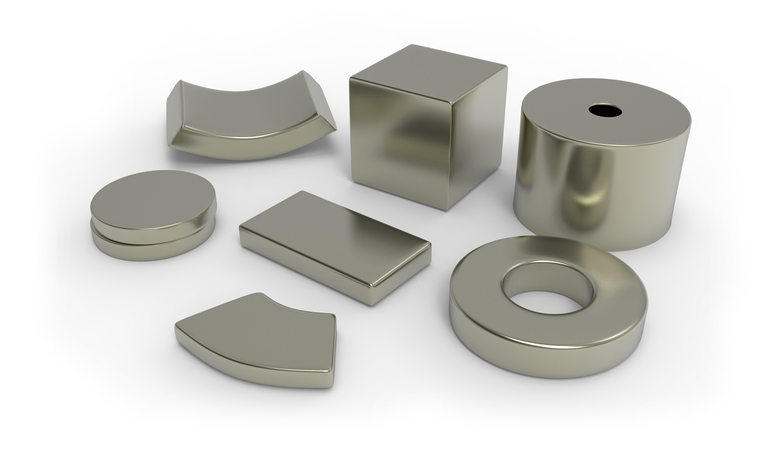 Rare earth magnets are increasingly finding their way into torque coupling and rotor design. Typically, rare earth magnets are used with the goal of improving efficiencies, reducing weight and lowering power consumption.
While rare earth magnets certainly provide advantages, it’s important to understand all of the cost, performance and safety considerations that come with using rare earth magnets before designing and installing a torque coupling or rotor.
What Defines the Main Types of Rare Earth Magnets?
There are two main types of rare earth magnets: samarium cobalt (SmCo) and neodymium-iron-boron (NdFeB). Each has been commercially available for several decades and provide several advantages over natural magnets.
NdFeB magnets are the strongest rare earth magnets, but their strength doesn’t result in bulk or weight. They have high remanence and energy product levels, however, they become unstable at high temperatures.
SmCo magnets, while not as strong as NdFeB magnets, have higher remanence and energy product levels and remain stable at high temperatures. SmCo magnets are used in high-heat, space-restricted applications but are typically the most expensive magnets on the market.
Certified Motion Control Professional Program
Strengthen Your Skills and Enhance Your Career

Become a Certified Motion Control Professional (CMCP) and join the elite group of system integrators, machine builders, manufacturers, end-users and others recognized in the industry for their professional knowledge and expertise.
What Special Considerations are Required When Using Rare Earth Magnets?
First and foremost, rare earth magnets are extremely expensive. The material is difficult to extract and processing the material that’s mined is wasteful. Only small amounts can be produced at a time due to the pressure required, and these magnets are typically brittle, making grinding and slicing operations slow.
These same characteristics of rare earth magnets make design and implementation challenging and dangerous. Conditions need to be tightly controlled because of the sensitive properties of the magnet, and every possible safety precaution needs to be taken.
After deciding to use rare earth magnets in torque coupling or rotor design, the following design, sourcing and implementation processes will be burdened with additional costs and safety considerations.
However, rare earth magnets do provide superior performance, particularly in space-restricted applications where a small magnet has to produce a lot of power. While these magnets can complicate a project, their performance benefits can certainly make the extra work worthwhile.
Recent Posts
- Emerging Technologies Driving Modern Motion Control Systems: Five Trends Reshaping Factory Automation
- Electronic Camming: Enabling Superior Flexibility in Advanced Motion Control Systems
- Electronic Camming: Enabling Superior Flexibility in Advanced Motion Control Systems
- How Electrification is Reshaping Motion Control
- Motion Control in Harsh Environments: Engineering for Extremes
- Next-Generation Motion Control: Integrating IIoT and Real-Time Data Analytics
- View All Motion Control & Motors Blogs