
Motion Control & Motors Blog
An Introduction To Linear Actuators
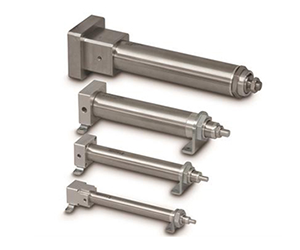 An actuator is a kind of motor used to move or control a mechanism. It can use many power sources, including electric current or pressure from a hydraulic or pneumatic component. Its goal is to convert that energy into the motion the system requires to do its work.
Many actuator technologies have emerged over the years. Today, electromechanical actuators are quickly overtaking traditional pneumatic and hydraulic ones. Though the actuator market is in flux, it remains valuable for engineers to be familiar with the full spectrum of actuators.
Even “old-fashioned” implementations may deliver required performance at a low cost!
Common actuators include:
Electromechanical Actuators
These are most commonly seen in the form of a linear device driven by a rotary servo motor. Screw-type, belt drive, and rack drive actuators can all use electromechanical principles. They can be highly efficient and compact compared to older actuators.
Lead Screw Actuator
In this type, a threaded nut traverses a threaded lead screw. Although friction between the metal parts does limit functional life, there are many advantages. Done right, the lead screw actuator is simple, efficient, economical, and quiet, with few failure points.
Ball Screw Actuator
These actuators were designed to resolve the lead screw actuators’ metal-on-metal friction. Ball bearings sit in raceways positioned between the screw and nut. This substantially increases the functional life of the system by converting sliding friction into rolling friction.
Certified Motion Control Professional Program
Strengthen Your Skills and Enhance Your Career
Become a Certified Motion Control Professional (CMCP) and join the elite group of system integrators, machine builders, manufacturers, end-users and others recognized in the industry for their professional knowledge and expertise.
Planetary Roller Screw Actuator
With a planetary arrangement of threaded rollers fully surrounding the main threaded shaft, the planetary roller is the high-performing screw-type. Its advantages include high thrust, long functional life, great efficiency, and few maintenance issues. However, these actuators can be large and costly.
Belt Drive
Though very fast and relatively inexpensive, belt drives were traditionally hindered by the need for ongoing tensioning and maintenance. Today’s belt drives are more precise and are available at an attractive price point.
Rack Drives
Rack drives are more precise and accurate than belt drives, while being faster than screw-type drives. Although not distance-limited, cost may prohibit rack drives from being effectively scaled up in some environments.
Integrated Actuators
Integrated actuators have been embraced by many as the future of automation. They deliver high performance with a compact footprint by combining the motor and actuator. The actuator’s nut works as the motor’s rotor while the motor travels the lead screw.
Recent Posts
- Emerging Technologies Driving Modern Motion Control Systems: Five Trends Reshaping Factory Automation
- Electronic Camming: Enabling Superior Flexibility in Advanced Motion Control Systems
- Electronic Camming: Enabling Superior Flexibility in Advanced Motion Control Systems
- How Electrification is Reshaping Motion Control
- Motion Control in Harsh Environments: Engineering for Extremes
- Next-Generation Motion Control: Integrating IIoT and Real-Time Data Analytics
- View All Motion Control & Motors Blogs