
Robotics Blog
Smart Linear Motor Technology’s Role in Industrial Production Lines
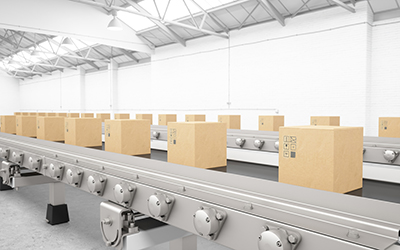 In today’s world of just-in-time manufacturing and the desire for the highest possible manufacturing efficiency, the role of smart linear motors in production lines is becoming increasingly important. Smart linear motors, coupled with advanced motion controllers and servo systems, play a valuable role in modern smart production lines.
What Is A Linear Motor?
A linear motor is, for the most part, very similar to a standard electric motor. Simply stated, a standard electric motor is comprised of a cylindrical rotor, which is a core of either tightly wound conductive wire or electromagnets. This core nests into, and rotates within, a cylindrical stator - which can be built from either permanent magnets or electromagnets. When power is supplied to the rotor, the electromagnetic force it generates interacts with the stator, generating rotational motion. A linear motor has a rotor as well, but the stator is laid out in a flat plane versus being cylindrical. So, in a linear motor, when power is applied to the rotor, it moves horizontally along the stator instead of rotationally around a center axis.
What Is A Smart Production Line?
A smart production line is one in which numerous interconnected computer-controlled processes take the place of a single large process. As a simple example, the production speed of a legacy production line is constant across all components of that line. The line can either be ‘on’ and operating at a set consistent speed, or ‘off’. In a smart production line, any of the individual components of the line can be sped up, slowed down, stopped, or started independently. This level of control gives operators the ability to easily adjust production rates to account for fluctuations in things such as demand or supply chain timeliness.
Certified Motion Control Professional Program
Strengthen Your Skills and Enhance Your Career
Become a Certified Motion Control Professional (CMCP) and join the elite group of system integrators, machine builders, manufacturers, end-users and others recognized in the industry for their professional knowledge and expertise.
How Can Linear Motors Help in A Smart Production Line?
Similar to servo drives and stepper motors, linear motors provide a highly accurate, powerful, and repeatable means to enable motion. In many cases, they may even use similar motor controllers and are almost always directed by the same software and servers. Unlike other types of motors, linear motors have the unique advantage of easily moving things horizontally. This is beneficial in quite a few ways, but especially in a production line that handles different SKUs simultaneously. If, for example, the line is bottling different varieties of custom-blended juices, each variety may require a slightly different bottle fill time. Linear motors, in this case, are used as part of a smart conveyor system in the bottle filling zone. They allow for each individual bottle to progress through the filling process at a speed that is matched perfectly to the fill rate. In this way, each bottle is filled perfectly, regardless of the contents.
While smart linear motors are becoming more streamlined, they offer increased efficiency and productivity in today’s flexible conveyor systems.
Smart conveyor technology has the ability to cut cycle time drastically, but it’s not the only type of conveyor technology to consider.
Recent Posts
- Emerging Technologies Driving Modern Motion Control Systems: Five Trends Reshaping Factory Automation
- Electronic Camming: Enabling Superior Flexibility in Advanced Motion Control Systems
- Electronic Camming: Enabling Superior Flexibility in Advanced Motion Control Systems
- How Electrification is Reshaping Motion Control
- Motion Control in Harsh Environments: Engineering for Extremes
- Next-Generation Motion Control: Integrating IIoT and Real-Time Data Analytics
- View All Robotics Blogs