
Robotics Blog
Improving Aircraft Production Efficiency with Collaborative Robots
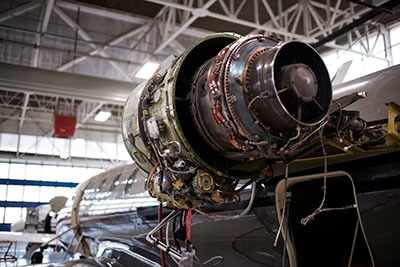 The aerospace industry had a record year for the production of aircraft in 2018, and there are no signs of the boom letting up soon. In order to meet demand, aircraft manufacturers are integrating and improving production with automation. Collaborative robots (cobots) are playing a key role in these automated improvements.
Challenges for the Aerospace Industry
Aerospace is looking to automation, including collaborative robots, to solve some major challenges. In manufacturing facilities, it’s difficult to bring an aircraft component to machines due to the size and strength of the materials and the real estate constraints of the facility. As a result, both aircraft components and collaborative robots must be mobile.
For safety, the aerospace industry is asking robotics manufacturers to engineer mobile platforms that are either track-guided or that move by means of automated guided vehicles (AGVs). They’re also looking for ways to improve ergonomics and take humans out of hazardous environments.
Robotic Applications in Aerospace
Robotic automated non-destructive test systems have been designed that can inspect large structural and non-structural components. Automation offers both high quality and speed improvements for these extremely large aerospace structures.
Engineers have designed a flexible, robotic, nondestructive inspection system with an ultrasonic test head to inspect carbon fiber parts. Robots move carbon fiber parts to other robots equipped with a robotic tool changer and an ultrasonic test head.
Manufacturers have implemented painting and coating robots that help maintain consistency and thickness of the material used. These applications require extreme precision in applying the product.
ROI Calculator

Discover the potential cost savings of robotic automation over a 20-year system life
This calculator compares your current manual labor costs against the total cost of owning and operating a robotic system over its 20-year lifespan.
De-painting robots use a xenon flash device that ablates paint and coatings from the material surface to remove products without getting the solution required near humans. It’s a very hazardous process and was once performed by humans.
Stringers must be placed precisely to add support to the panels of an aircraft. A coordinated motion application was developed for large parts to place the composite stringers onto the composite skin. The robots use laser guidance for placement.
Manufacturers also created a solution for drilling and riveting applications with tighter precision in positioning. Robotics are able to place the part and aircraft panel around the tool to increase productivity.
Long-Term Aerospace Automation Trends to Expect
Robotics manufacturers have already increased the size of robots to accommodate larger equipment and aircraft components. New end effectors have been engineered to accommodate these larger payloads. It is expected that this trend will continue and place more capacity demands on automation, including collaborative robots.
Vision-based and torque sensing systems will integrate with human interfaces to give a sense of feel, or touch, for manufacturing and inspection purposes. This is especially important in areas where manufacturers try to automate manual processes that carry safety concerns.
Automation will continue to work with higher precision as more accurate robotic systems are developed. Demands for better path accuracy will rise as cobots are expected to move to large components in their cells. Robots will also need more versatility to build multiple parts in a single cell instead of using the robot for only one purpose.
Recent Posts
- 6 Companies Driving Automation in Mexico
- Humanoids on the Horizon: What Hurdles Remain for Widespread Adoption?
- Safety by Design: How Humanoid Robots Must Evolve to Depart the Walled Garden
- Are Robots Really Taking All the Manufacturing Jobs?
- The Shipping Industry Floats Emerging Opportunities for Maritime Automation
- New to Robotics? Start with These Fundamentals
- View All Robotics Blogs