
Robotics Blog
The Shipping Industry Floats Emerging Opportunities for Maritime Automation
 For most of its history, maritime logistics and maintenance were a strictly manual business. Longshoremen moved cargo by hand. Divers inspected hulls. Engineers diagnosed machinery based on observation and experience. The first wave of maritime automation came to shipping during the containerization revolution of the late 1950s, which introduced mechanical cranes and standardized handling. Today, a second and considerably more sophisticated wave is arriving, driven by robotics, machine vision, the industrial internet of things (IIoT), and artificial intelligence (AI). And the pressure to further automate maritime operations is intensifying as global container volumes climb.
Smart Ports, from Gate to Quay
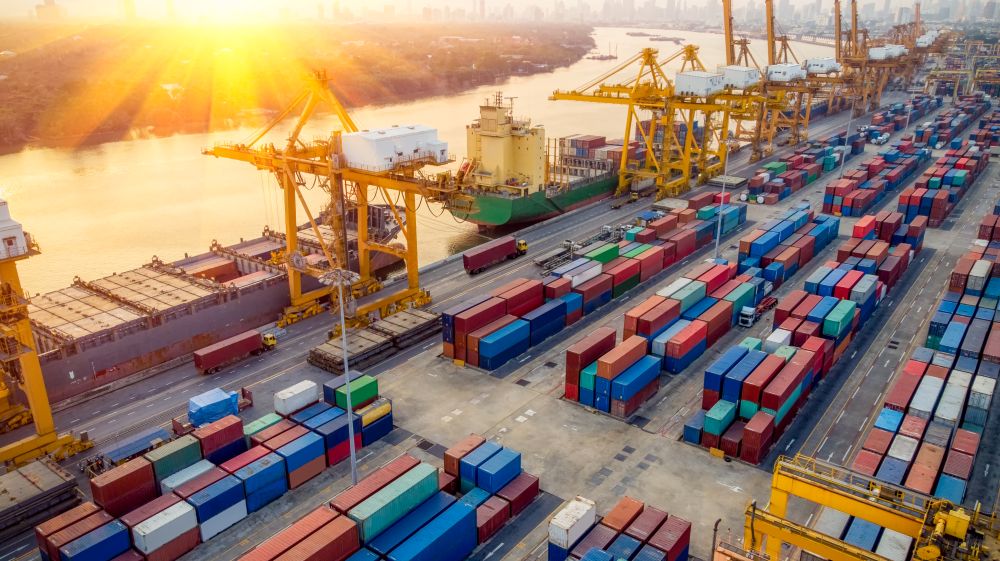
The most visible advances in shipping automation are happening at the port, where cargo containers move from ship to shore and through the terminal. A 2024 U.S. Government Accountability Office report confirmed that all 10 of the largest U.S. container ports have adopted some form of maritime automation. At least one terminal at each port is using automated systems to track and communicate shipping container movements.
Tools of Port Automation
The technologies driving automation in the maritime industry will be familiar to those in the industrial automation sector. At port gates,
- Optical character recognition (OCR) systems automatically read container identification numbers, license plates, and seal markings, streamlining formerly manual check-in processes that required trucks to queue for hours.
- Automated guided vehicles (AGVs) equipped with laser guidance systems and onboard sensor arrays transport containers along dynamically optimized routes.
- Automated stacking cranes (ASCs) handle loading and unloading operations with real-time position feedback and control systems.
Fully automated terminals are validating this model at scale. Shanghai’s Yangshan Phase IV facility operates around the clock with remote-controlled quay cranes, fleets of AGVs, and terminal management systems. Maritime Automation recently helped the facility set a new global record for annual container throughput.
Challenges to further adoption remain, however. Capital costs are a significant constraint, particularly for midsize ports that have shorter windows for a return on their investment. Fully automated greenfield terminals can require hundreds of millions in upfront capital.
Such challenges make phased or hybrid implementations more viable. For example, some small ports continue to rely on human labor for complex quayside tasks while automating gate operations and yard management.
Labor relations have also complicated adoption, most notably in late 2024, when more than 45,000 members of the International Longshoremen’s Association staged a three-day strike that paralyzed 36 ports in the United States. Automation restrictions were a central issue in the contract dispute.
Robotics in the Maritime Industry
Beyond the quay, many maritime operations still involve the sort of dangerous, dirty, and dull tasks that drive demand for automated solutions. Such solutions are emerging below the waterline. For example, hull inspection, traditionally performed by divers or during costly dry dock cycles, is increasingly performed by autonomous underwater vehicles (AUVs) and remotely operated vehicles (ROVs) equipped with high-resolution cameras, sonar, and ultrasonic metal thickness sensors that can detect corrosion and structural wear without the need to pull a vessel out of service.
ROI Calculator

Discover the potential cost savings of robotic automation over a 20-year system life
This calculator compares your current manual labor costs against the total cost of owning and operating a robotic system over its 20-year lifespan.
Greensea IQ’s EverClean system, introduced commercially in 2024, illustrates where the market is heading. The hybrid robot combines magnetic hull-crawling capabilities with maneuverable underwater flight. It integrates cameras and ultrasonic sensors with a cloud-based data platform to build longitudinal condition profiles of individual vessels. The system offers shipyards the same predictive maintenance options that helped transform industrial manufacturing, enabling them to schedule maintenance based on actual hull condition data rather than at fixed time intervals.
Research programs funded by the European Union are exploring this concept further with multi-robot inspection frameworks that combine AUVs, micro air vehicles, and magnetically attached crawlers for fully autonomous hull assessment. These programs haven’t yielded a commercial deployment yet, but they illustrate potential growth opportunities for machine vision, autonomous navigation, and sensor fusion in marine environments.
IIoT and Smart Shipping Containers
Once a vessel leaves port, automation continues in the form of intelligent container monitoring that leverages IIoT technologies. Modern smart containers embed networked sensors that measure temperature, humidity, vibrations, and door status, and transmit condition data continuously via satellite and cellular networks throughout the voyage.
This technology has already demonstrated its practical value. Consider cargo fires aboard container ships, one of the shipping industry’s most persistent safety risks. Real-time condition monitoring addresses this risk at its earliest detectable point. For example, when sensors aboard the Rhine Maersk detected abnormal temperature readings in a shipment of charcoal, the crew responded before the situation could escalate into a crisis. Major carriers, including Maersk and CMA CGM, have also deployed IIoT-enabled monitoring across portions of their refrigerated container fleets. Pharmaceutical and perishable cargoes are both key drivers for this technology, as condition compliance carries both quality and regulatory consequences.
Riding the Tide
Maritime automation spans port infrastructure, vessel maintenance, and cargo monitoring. And each domain draws on robotics, sensing, and data platforms that are already familiar to industrial users. However, the unique demands of the marine environment, including corrosive saltwater, connectivity gaps at sea, and capital-heavy infrastructure, pose unfamiliar challenges for automated solutions. Navigating these currents could slow adoption of automated solutions. But automation’s demonstrable benefits in other industrial sectors present a rising tide of opportunity that the maritime industry cannot ignore for long.
Recent Posts
- 6 Companies Driving Automation in Mexico
- Humanoids on the Horizon: What Hurdles Remain for Widespread Adoption?
- Safety by Design: How Humanoid Robots Must Evolve to Depart the Walled Garden
- Are Robots Really Taking All the Manufacturing Jobs?
- New to Robotics? Start with These Fundamentals
- Digital Twins in Healthcare: From Simulation to Clinical Transformation
- View All Robotics Blogs