
Robotics Blog
Humanoids on the Horizon: What Hurdles Remain for Widespread Adoption?
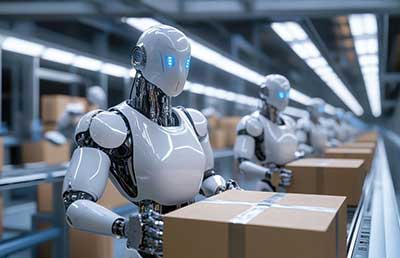 Whether you’re ready or willing to admit it, humanoid robots are coming. For years, and realistically still today, humanoids have been an exciting technology and an excellent discussion topic but have been viewed as not quite ready for widespread adoption. Recent years have seen some significant advances, however, and pilot programs are now underway at companies around the globe, from Airbus and BMW to Schaeffler and Siemens.
Instead of “Will humanoids ever work?” the conversation has shifted to “What is required to get humanoids to work safely at scale?” This question will be among many discussed at the Humanoid Robot Forum at Automate 2026 in Chicago. From June 23–24, the Humanoid Robot Forum will bring together global leaders in humanoid technology to discuss the real-world development, deployment, and commercialization of humanoid technologies. Experts at Boston Dynamics, Neura Robotics, NVIDIA, Toyota Research Institute, and more will share insights into the performance constraints and measurable outcomes of today’s most advanced bionic systems.
Safety Concerns Remain
Designed to operate in environments built for people, humanoids are suited for tasks where traditional automation has been challenging. With the ability to navigate stairs, reach and grab items from different shelf heights, and switch between tasks without reprogramming, humanoids offer a promising set of capabilities that differ from fixed industrial arm or autonomous mobile robots.
Most deployments today are in pilot programs, however, and there is a sizeable gap between an impressive (and almost always fun) demonstration and consistent, production-grade operation. Safety remains a primary hurdle. Deploying a robot that weighs 150–200 pounds and letting it traverse autonomously throughout a plant floor brings inherent risks. What happens, for instance, when the battery runs out or when the humanoid trips on something with people or machinery nearby?
Battery life and exorbitant costs represent other primary concerns. Bin picking, tote transport, line feeding, and palletizing are all use cases for humanoids, but these can also be solved with other types of automation. Flexibility is what makes the humanoid stand out, and when costs go from prototype to production, humanoids will become more attractive.
AI Advances Humanoid Timeline
While safety remains a hurdle, AI is at the forefront of the technologies that have helped push the humanoid timeline forward. Physical AI — AI-driven software that helps hardware such as robots perceive, navigate, and interact with the physical world in real time — is a specific technology that will enable humanoids to adapt, reason, and act across a vast range of applications. This and other topics will be discussed in depth at the Humanoid Robot Forum next month. The two-day conference will dive into the latest innovations in physical AI, generative AI, simulation and digital twins, and humanoid use cases. Topics will include:
- Safety and standards: Humanoids require a different safety framework than traditional robots, and this does not yet fully exist. Standards organizations are working on guidelines, but certification for fenceless operation remains a barrier to enterprise-scale deployment.
- Good and bad use cases: The forum aims to provide case-driven insights into what works and what doesn’t, including performance data, implementation pitfalls, and measurable outcomes from real-world deployment. “We’re giving attendees a practical opportunity to learn where the technology stands today, what challenges remain, and how humanoids may fit into real-world applications over time,” said A3 president Jeff Burnstein.
- AI advancements: In addition to physical AI, advances in vison-language-action models are creating new capabilities in humanoids by potentially reducing the time needed to deploy robots on new tasks. Understanding AI and how it can realistically work with humanoids today can help you determine whether humanoids may be right for your business.
- Humanoid commercialization: How will humanoid deployments be structured commercially, whether a direct purchase or robotics-as-a-service? Payback periods will undoubtedly decline over time as humanoid costs fall and capabilities increase.
- Workforce integration: Deploying humanoids will require more than a team of engineers. Workers will need to be reskilled, workflows redesigned, organizations changed, and of course, human workers must build trust in humanoid coworkers.
See the Latest Humanoids in Person
To see humanoids up close and personal on the Automate show floor, attendees can visit the Humanoid Robot Pavilion sponsored by NVIDIA. The pavilion will feature live demonstrations and a theater for humanoid exhibitors to present throughout the show.
Beyond humanoids, Automate is expected to bring together more than 50,000 professionals and 1,000 exhibitors in robotics, machine vision, AI, motion control, and beyond to see and showcase the latest and greatest in industrial automation.
The Humanoid Robot Forum is a separate ticketed event from Automate. More information can be found here.
Recent Posts
- Creating a Safety Culture in Your Organization at the International Robot Safety Conference
- 6 Companies Driving Automation in Mexico
- Safety by Design: How Humanoid Robots Must Evolve to Depart the Walled Garden
- Are Robots Really Taking All the Manufacturing Jobs?
- The Shipping Industry Floats Emerging Opportunities for Maritime Automation
- New to Robotics? Start with These Fundamentals
- View All Robotics Blogs