
Motion Control & Motors Blog
What is PLC Object-Oriented Programming for Industrial Automation?
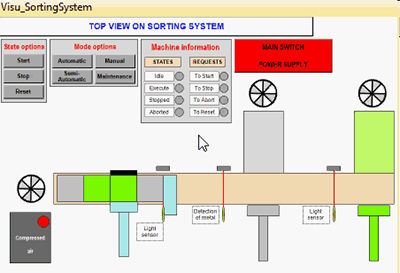 A Programmable Logic Controller (or PLC), simply defined, is the “brain” of a production machine or even an entire production line. When programmed properly, it is an important part of industrial automation and helps production environments to achieve maximum efficiency and speed.
PLC Basics
A PLC consists of a central processing computer, RAM and/or ROM memory, an Ethernet card, and a method of programming. The PLC takes any incoming signals from things such as sensors or manual controls, processes them in a programming application, and then outputs control signals to a piece of equipment’s individual motion controllers or motors.
What is PLC Object-Oriented Programming? How does it Work?
With object-oriented programming, the programmer defines the data structure, the data type, and the operations/functions applied to the data structure. A PLC uses a form of object-oriented programming called ladder logic, itself an advanced form of relay logic, which is closely related to the “C” programming language.
The ladder is a programming structure that represents the circuit diagrams that control output hardware. Contained within the ladder, and based on the desired output needs, are functions such as the opening and closing of electrical coils, timer functions, counter functions, and even embedded math equations.
ROI Calculator

Discover the potential cost savings of robotic automation over a 20-year system life
This calculator compares your current manual labor costs against the total cost of owning and operating a robotic system over its 20-year lifespan.
How is a PLC Programmed?
A PLC is programmed through a graphical user interface (GUI), more specifically with specialized software. This software allows the user to visualize the various steps in the ladder logic and ensure that the various needed actions are appropriately placed. PLCs can be attached to a PC via a USB cable, with more advanced systems able to communicate wirelessly.
What are the Benefits of a PLC?
A PLC synthesizes many operations, such as counting, relaying, and timing, that may have been individually wired processes in the past. This allows for much quicker installation, plus much more streamlined reconfiguration if needed in the future.
PLCs also take up less space than alternative systems, such as full-sized industrial computers or large assemblages of various relays and counters, and generally offer cost savings as well.
PLCs are well-accepted in today’s increasingly automated world, and are found in any application where accuracy, repeatability, and long-term adaptability are important.
Share This On X:
A PLC synthesizes many operations, such as counting, relaying and timing, that may have been individually wired processes in the past, increasing installation time. #industrialautomation
#DYK: A PLC consists of a central processing computer, coupled with memory (RAM and/or ROM), an Ethernet card, and a method of #programming?
Recent Posts
- Emerging Technologies Driving Modern Motion Control Systems: Five Trends Reshaping Factory Automation
- Electronic Camming: Enabling Superior Flexibility in Advanced Motion Control Systems
- Electronic Camming: Enabling Superior Flexibility in Advanced Motion Control Systems
- How Electrification is Reshaping Motion Control
- Motion Control in Harsh Environments: Engineering for Extremes
- Next-Generation Motion Control: Integrating IIoT and Real-Time Data Analytics
- View All Motion Control & Motors Blogs