
Motion Control & Motors Blog
The Benefits of Adding Encoders to Step Motor Systems
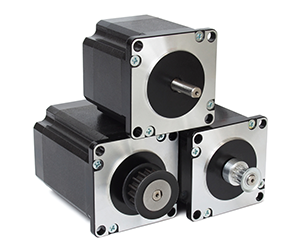 Today’s complex projects, such as quadcopters, often call for enhanced position control. Stepper motors have been developed to deliver excellent precision, allowing very predictable performance when the step angle and gearbox ratio are both known.
As a result, stepper motors have naturally become the motor of choice for many new electronics.
But even with the great visibility into position and velocity that a stepper motor offers, some engineers have taken things a step further.
Not content with the stepper's native open loop control, they’ve added encoders to their motor systems.
The Motor Encoder: When Closed Loop Control is Essential
An encoder is a rotary device that can be mounted onto an electric motor. It provides closed loop feedback signals, tracking the motor shaft’s position, speed, or both.
At first, this functionality might seem redundant. Isn’t precision control essentially what the stepper does on its own? The answer, it seems, is yes and no. Recent research has shown that the apparently “unnecessary” guidance provided by the encoder can have a powerful impact on how well a stepper motor works.
Certified Motion Control Professional Program
Strengthen Your Skills and Enhance Your Career

Become a Certified Motion Control Professional (CMCP) and join the elite group of system integrators, machine builders, manufacturers, end-users and others recognized in the industry for their professional knowledge and expertise.
Motion controller brand Galil conducted a series of side by side tests between open and closed loop stepper motor systems. Their team discovered that the addition of an encoder could produce appreciable gains in major performance metrics.
Compared to the open loop system, the closed loop system offered:
-
Significantly improved velocity smoothness;
-
Reduced overall current consumption;
-
Higher torque at lower velocities than comparable three-phase brushless servo motors.
Galil's researchers determined that “dramatic” performance gains for stepper motors were possible by integrating a positional feedback device along with a two-phase brushless amplifier. Their testing methodology and results have been made public on their website.
These results are truly exciting news in the motion control world. Engineers at all levels can enhance stepper motors into even more powerful and economical solutions through the use of readily available encoder technologies.
Recent Posts
- Emerging Technologies Driving Modern Motion Control Systems: Five Trends Reshaping Factory Automation
- Electronic Camming: Enabling Superior Flexibility in Advanced Motion Control Systems
- Electronic Camming: Enabling Superior Flexibility in Advanced Motion Control Systems
- How Electrification is Reshaping Motion Control
- Motion Control in Harsh Environments: Engineering for Extremes
- Next-Generation Motion Control: Integrating IIoT and Real-Time Data Analytics
- View All Motion Control & Motors Blogs