
Motion Control & Motors Blog
Stepper Motor Tutorial: Learning the Basics
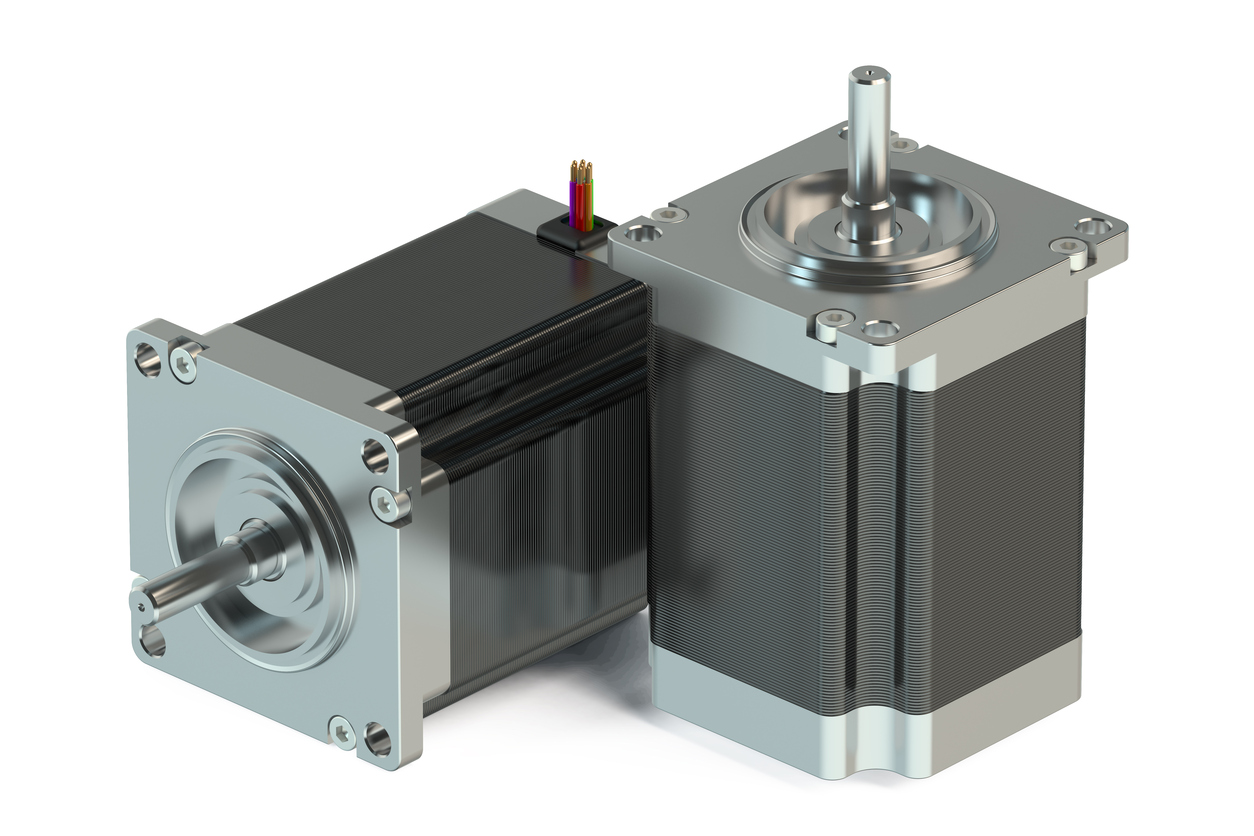 What is a Stepper Motor?
A stepper motor is a synchronous, brushless motor that runs on a pulsed current, where each pulse turns a rotor some fraction of a full rotation. Servo motors typically satisfy a wider range of applications, particularly when precision motion is needed, but stepper motors can be a useful alternative, depending on the application.
Stepper motors are rugged, economical and well-suited for digital drives and applications without close-loop feedback. They are typically used for spinning-disk hard drives, printers, robotics, CNC machine tools and more.
Stepper Motors 101: How Do They Work?
A stepper motor consists of a central rotor surrounded by a stator that contains a varying number of windings, depending on the model of stepper motor. To induce motion, these windings are energized, becoming electromagnets with a polarity determined by the direction of the current.
Typically, these directions include north poles and south poles. When a winding is energized, a rotor is forced to turn until a rotor’s north pole is positioned in proximity to a winding’s south pole, bringing torque down to zero. This constitutes one step.
For motion to continue, the first set of windings must be de-energized and another set energized. The result is another step.
ROI Calculator

Discover the potential cost savings of robotic automation over a 20-year system life
This calculator compares your current manual labor costs against the total cost of owning and operating a robotic system over its 20-year lifespan.
Types of Stepper Motors
There are several different types of stepper motors available today. However, the most common forms include the following:
- Two-phase permanent magnet (PM) stepper motor: this model has a rotor that contains a permanent magnet and a stator with four windings, creating a step angle of 90 degrees. PM stepper motors are an economical option, but provide low levels of torque.
- Variable-reluctance stepper motor: this model does not include a permanent magnet, and the number of rotor teeth differs from stator coils. Motion is created through varying widths in air gaps between the rotor and stator. Variable-reluctance stepper motors are a higher resolution alternative to PM stepper motors.
- Hybrid stepper motors: this model contains characteristics of both of the above stepper motors. It has a rotor that contains a permanent magnet, but the rotor teeth and stator coils are misaligned by half a tooth pitch with typically around 200 steps per revolution.
Stepper motors can perform a wide variety of functions, depending on the model and application. It's important to understand how stepper motors work, what their limitations are, and how this applies to your application before you invest in a stepper motor.
Recent Posts
- Emerging Technologies Driving Modern Motion Control Systems: Five Trends Reshaping Factory Automation
- Electronic Camming: Enabling Superior Flexibility in Advanced Motion Control Systems
- Electronic Camming: Enabling Superior Flexibility in Advanced Motion Control Systems
- How Electrification is Reshaping Motion Control
- Motion Control in Harsh Environments: Engineering for Extremes
- Next-Generation Motion Control: Integrating IIoT and Real-Time Data Analytics
- View All Motion Control & Motors Blogs