
Motion Control & Motors Blog
Components of Industrial Electric Motors
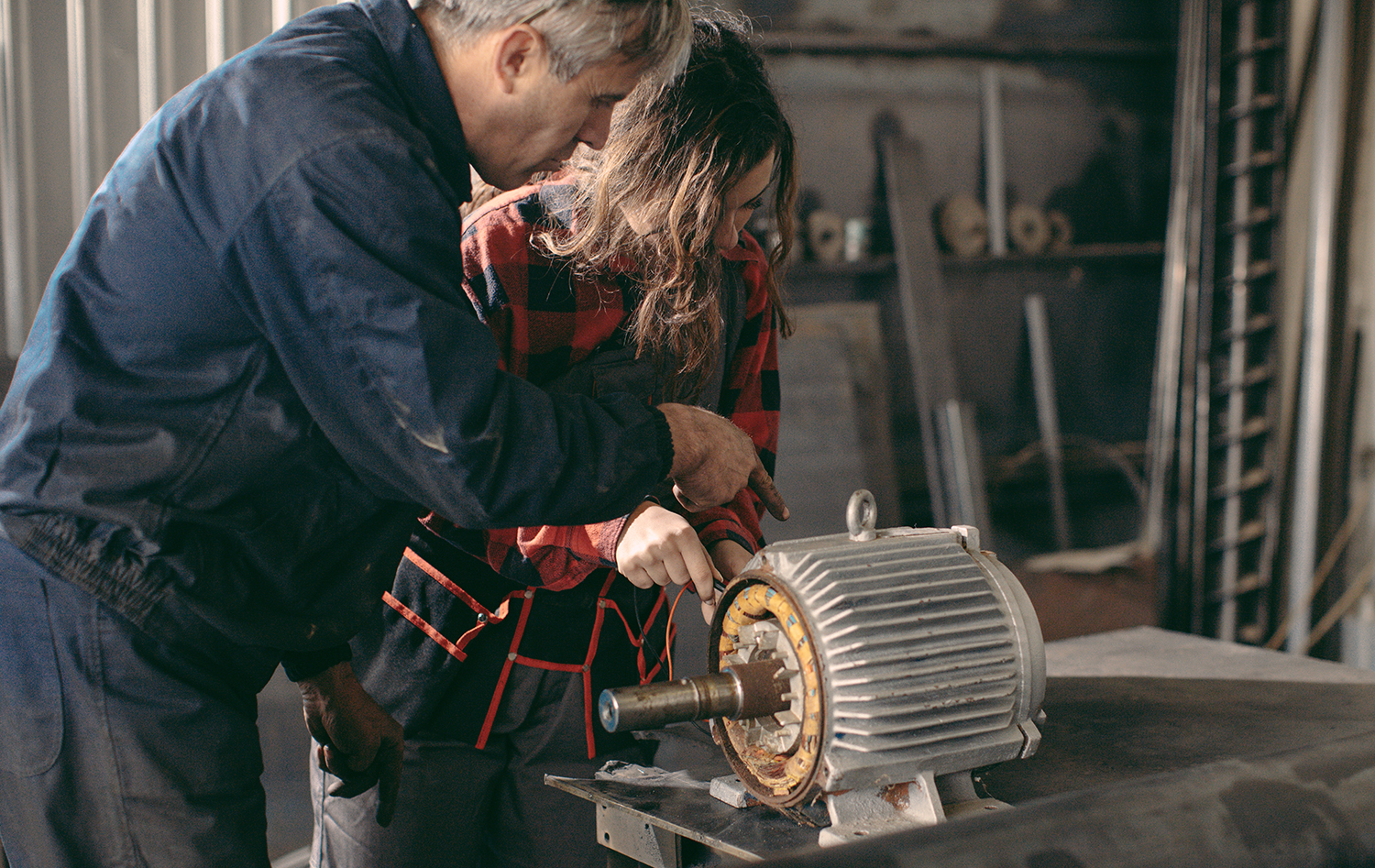 Converting electricity into mechanical energy is the job of the industrial electric motor. Motors create either a linear or rotary force. While electric motors can be powered by direct current (DC) sources like batteries, they are more often powered by alternating current (AC) sources like generators or the power grid. Here are the main components of industrial electric motors:
Armature
The moving part of the motor is the armature (or rotor), which turns the shaft in order to transform the energy into mechanical power. Usually, the armature has conductors which carry currents which interact with stator's magnetic field in order to create a force that turns the shaft. Most of the time, the armature is in the middle of the engine and rotates when the poles are attracted and then repelled by the poles of the stator.
Stator
The torque or strength of the motor is determined by the length of the electromagnet's wire in the stator as well as the voltage. As the central part of the electromagnetic circuit, the stator's core has thin metal sheets to reduce energy use. The stator can have permanent magnets or windings.
Air Gap
One important component is the air gap between the rotor and stator which increases the magnetizing current. The distance of the air gap is crucial in determining the performance. Generally, the air gap should be as small as possible.
ROI Calculator

Discover the potential cost savings of robotic automation over a 20-year system life
This calculator compares your current manual labor costs against the total cost of owning and operating a robotic system over its 20-year lifespan.
Winding or "Coil"
Windings are wires that are wound around a core that is usually a soft iron magnet used to create or receive the electromagnetic energy. The wire of the windings has to be insulated and is usually copper because it conducts electricity with the thinnest wire. Aluminum can be used but must be thicker.
Commutator
This is the switching mechanism which creates the reversal of electrical current and applies power to the machine as the rotor alternates from pole to pole. Without a current reversal, a motor would stop. The commutator usually is made of slip ring segments that are insulated from both each other and the shaft of the motor. Brushes or another mechanism is employed to shift current.
Industrial Electric Motors Increase in Importance
How important are industrial electric motors? Very. Almost all modern industry employs one of the many varieties of industrial electric motors. In fact, industrial electric motor demand is expected to increase by 5.4 percent through 2018.
Recent Posts
- Emerging Technologies Driving Modern Motion Control Systems: Five Trends Reshaping Factory Automation
- Electronic Camming: Enabling Superior Flexibility in Advanced Motion Control Systems
- Electronic Camming: Enabling Superior Flexibility in Advanced Motion Control Systems
- How Electrification is Reshaping Motion Control
- Motion Control in Harsh Environments: Engineering for Extremes
- Next-Generation Motion Control: Integrating IIoT and Real-Time Data Analytics
- View All Motion Control & Motors Blogs