
Blog
Innovative Solutions for Safer Collaborative Robot and Human Interaction
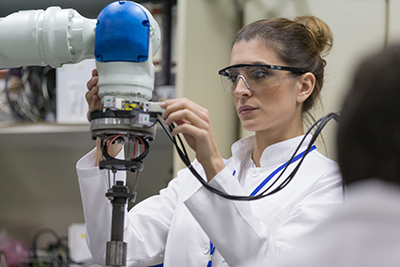 All legacy industrial robots may soon meet collaborative robot safety requirements thanks to new hardware and software solutions designed to enable robots and humans to work together in more areas than ever before. Leading engineers are developing safety maps that have them rethinking the design of unsafe work cells in an effort to protect human workers.
Legacy Industrial Robots Pose Safety Risks to Humans
Industrial robotic arms are often massive. Their large size, heavier weight, and fast speed can be lethal if not designed for human interaction. Many robots also handle heavy payloads capable of injuring workers. Understandably, facilities often put robotic arms in cages or find other ways to keep robots totally separate from humans.
In the past, industrial robots were not designed to remain in operation with humans near them. In response, the International Standards Organization sets clear guidelines for collaborative robots to ensure human safety. Unfortunately, manufacturers don’t always have the capital, time, or resources to change out an automation system on demand.
Collaborative Robot Safety for Legacy Systems
New machine vision hardware and software solutions are giving these legacy robots the ability to respond safely to nearby humans. These add-on automation systems can override a robot’s program to safely slow or stop it when humans are present. The system can also restart the robot once humans have exited the area.
ROI Calculator

Discover the potential cost savings of robotic automation over a 20-year system life
This calculator compares your current manual labor costs against the total cost of owning and operating a robotic system over its 20-year lifespan.
3D time-of-flight sensors are mounted around the perimeter of a workcell. An integrated hardware-software package processes image data from the sensors and implements Speed & Separation Monitoring (a requirement of ISO 15066). A software suite is then used to monitor and configure the behavior of the collaborative robots. The software has built-in redundancy as well as real-time comparison and health monitoring to protect both workers and the machinery.
Safety Maps Improve Workcell Safety
Another method that has been developed involves the use of safety maps which allow designers to determine if a robot they are designing is capable of causing injury to humans within a workcell. The maps help engineers to identify the most dangerous areas of a robot’s workspace and figure out whether their robot is more or less dangerous than other options. Designers can then use this data to build workcells that are safe for humans.
These new solutions let production facilities play to the strengths of humans and robots. Capital equipment costs are reduced while humans benefit from enhanced ergonomics. This results in increased productivity overall and helps manufacturers implement new manufacturing processes faster with less downtime and more flexibility, all while providing workers a safer environment.
Recent Posts
- 6 Companies Driving Automation in Mexico
- Humanoids on the Horizon: What Hurdles Remain for Widespread Adoption?
- Safety by Design: How Humanoid Robots Must Evolve to Depart the Walled Garden
- Are Robots Really Taking All the Manufacturing Jobs?
- The Shipping Industry Floats Emerging Opportunities for Maritime Automation
- New to Robotics? Start with These Fundamentals
- View All Blogs