
Vision & Imaging Blog
Machine Vision Saving Agriculture: One Crop at a Time
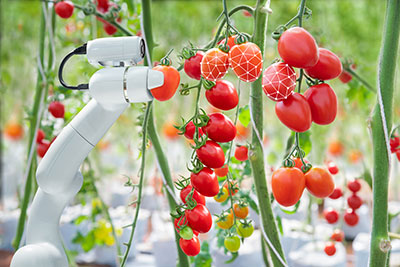 Ecological volatility results in devastating crop loss for many farmers. It’s estimated that a third of all food grown is lost. But, technologies that make use of machine vision, known as “precision agriculture” or “agricultural intelligence”, are helping the industry prevent loss.
Farmers get readouts alerting them to the health of their crops. Computer vision algorithms recognize patterns in fields and determine the presence of disease or other anomalies. Weed identification systems have been developed that combine computer vision images, satellite, and drone imagery.
Agricultural Imagery and Machine Vision
Artificial intelligence can tell farmers what weed types are attacking their crops in real time. In the past, farmers would typically respond with the use of many different herbicides. But, there are thousands of factors, ranging from species of weeds to diseases to pests on the weed, which can affect the choice of herbicide.
Aerial Images
Drones can be used to capture multispectral imagery over fields. Some drones can cover tens of thousands of acres per day. Resolutions are sharp enough to count insects on a single leaf. Deep learning engines use math models and cloud-based computing trained by agronomists and millions of examples of crop health issues.
Plant Population
Machine vision in agriculture is used to detect plant positions, calculate plant emergence, row spacing, row length, and compare data to planting date. Throughout the season, farmers can receive data on canopy cover, plant height, and stand count. Farmers even know average tree diameter, flower count, and more, without having to even step into the field themselves.
Certified System Integrator Program
Set Yourself at the Forefront of the Global Vision Market
.jpg) Vision system integrators certified by A3 are acknowledged globally throughout the industry as an elite group of accomplished, highly skilled and trusted professionals. You’ll be able to leverage your certification to enhance your competitiveness and expand your opportunities.
Vision system integrators certified by A3 are acknowledged globally throughout the industry as an elite group of accomplished, highly skilled and trusted professionals. You’ll be able to leverage your certification to enhance your competitiveness and expand your opportunities.
Weed Detection
Since machine vision systems are scanning farms frequently, weeds can be detected in near real time. As a weed emerges, AI can classify the weed and calculate its potential threat to yield. This lets farmers target specific weeds and create custom herbicide solutions. Machine vision can then detect the effectiveness of the herbicide and find resistant weeds left in the field.
Insects and Diseases
Computer vision systems identify and categorize top relevant diseases. Systems also find physical damage caused by insects and pests. Farmers are notified about the adverse field conditions at almost the time they originate. The system can then keep track of the status of the spread of disease or infestation and alert farmers to any ongoing threat. This helps eliminate the industry’s traditional costly and time-consuming scouting practices.
Growth Issues
Machine vision systems and AI analyze images of crops and farmlands. Often, they are taken close to sowing time to find growth issues before it’s too late to re-sow or correct underlying problems. An extensive, ongoing scan of the entire field provides data on the entire operation without costly, manual scouting procedures.
Recent Posts
- How 3D Vision Systems Are Transforming Food Manufacturing
- Autonomous Driving Technology: Dueling Approaches Fight for Control of the Wheel
- These Farms Are Harnessing Machine Vision for Smarter Agriculture
- Revealing the Hidden Effects of Climate Change with Advanced Imaging
- How Vision Systems Are Transforming Predictive Neurodiagnostics
- Innovative Machine Vision Lenses and Trends
- View All Vision & Imaging Blogs