
Vision & Imaging Blog
How 3D Vision Systems Are Transforming Food Manufacturing
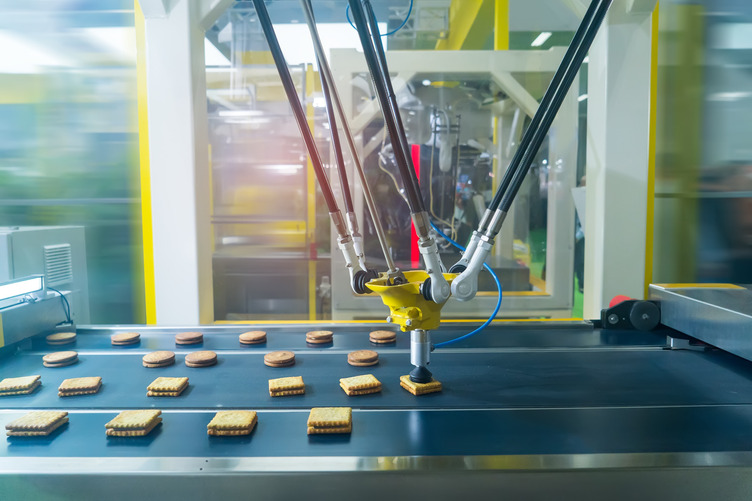 At one point in time, 3D vision systems were considered by many to be prohibitively expensive and too complex for use in manufacturing. Today, the cost, size, and complexity of vision inspection systems have been reduced, making them more accessible across the globe for a diverse range of industries, from automotive manufacturing to warehouse operations. One segment that continues to find new ways to reap the benefits of 3D vision advances is the food industry, both in smart farming and food manufacturing.
All 3D vision systems capture three-dimensional data of an object using a variety of common 3D imaging techniques, which include laser line triangulation, structured light, Time of Flight, and stereo imaging. In food manufacturing, finding ways to leverage these technologies to navigate the labor shortage and high turnover rates is particularly important. Below, we’ll look at some of the challenges faced by the food industry and the ways that 3D vision inspection systems can help solve these problems while improving food production.
How Machine Vision Systems Enhance Product Quality
In agriculture and smart farming applications, 3D vision systems are utilized in various ways; one common application is mounting a 3D camera onto an autonomous vehicle, such as a tractor. John Deere notably launched the production-ready 8R autonomous tractor at CES in 2022, which featured six pairs of stereo cameras to provide 360° vision to detect objects in the field and triangulate distance. Over time, this tractor has evolved to leverage a full AI-enhanced vision system, but in 2022, it represented a significant development. Other companies, including tractor companies and those developing third-party 3D perception hardware, followed suit, including Monarch Tractor, Sabanto, and Kubota.
Applications of 3D Vision Systems in Food Manufacturing
Autonomous harvesters, where 3D cameras help the machines navigate and avoid obstacles while enabling them to pick only ripe vegetables or fruit, often leveraging AI-enabled software for classification.
Precision weeding robots, where systems leverage 3D imaging—and oftentimes AI— to identify crops versus weeds for commercial weed removal deployments. This may include mechanical removal or targeted spraying.
Plant monitoring, where robots such as those from Directed Machines leverage RealSense 455 3D depth cameras and Raspberry Pi microcontrollers for autonomous navigation in structured and unstructured environments for applications including mowing, hauling, and plant monitoring.
Vertical farming, where machine vision systems can be used for automatic inspection tasks such as detecting crop position, determining crop orientation and geometry, enabling precision pick and place, monitoring plant growth, detecting insects and pests, and ultimately optimizing processes.
Uses of 3D Vision Systems in Manufacturing
Once ingredients and food products make it to the manufacturer or producer, 3D imaging technologies can help ensure product quality and enhance efficiency. While there are a growing number of novel use cases for 3D machine vision systems on the factory floor, several mature use cases have been reliably deployed by food manufacturers for years:
Certified System Integrator Program
Set Yourself at the Forefront of the Global Vision Market
.jpg) Vision system integrators certified by A3 are acknowledged globally throughout the industry as an elite group of accomplished, highly skilled and trusted professionals. You’ll be able to leverage your certification to enhance your competitiveness and expand your opportunities.
Vision system integrators certified by A3 are acknowledged globally throughout the industry as an elite group of accomplished, highly skilled and trusted professionals. You’ll be able to leverage your certification to enhance your competitiveness and expand your opportunities.
- Quality inspection and grading: 3D vision system technologies reliably inspect different types of food products to ensure they meet quality, safety, and production standards.
- Foreign object and defect detection: 3D imaging ensures that food products are free from contamination, foreign objects, and defects such as cracks, breaks, and uneven surfaces
- Vision-guided pick and place: Different types of 3D technologies—including stereo vision, structured light, Time of Flight, and laser triangulation—help robots accurately identify and locate objects for picking and placing into another part of the process, such as onto another conveyor or into a package or box.
- Volumetric measurements: 3D imaging technologies such as laser profilers capture the height, dimensions, and shape of objects—including organic, nonuniform products such as meat or fish—to ensure they meet specifications.
- Location and sortation: 3D cameras locate items moving on a conveyor belt and determine placement and alignment to inform a robot of its next pick, stack, or palletization.
- Missing product detection: 3D imaging technologies detect insufficiently filled or absent products in trays or open boxes.
How AI Software and 3D Vision Systems are Working Together to Improve Food Automation
Newer applications have also emerged, such as those that combine 3D vision inspection systems and AI-enabled software, which offer new capabilities when it comes to quality inspection, assembly verification, sorting, and more. By introducing AI capabilities, for example, a 3D machine vision system can detect difficult-to-find defects in irregularly shaped objects. AI also adds flexibility, enabling the system to learn new products over time without reprogramming and enhancing the system’s ability to recognize and singulate items in pick-and-place scenarios. In addition, AI helps systems learn acceptable variations in products, which is particularly useful in organic items such as proteins, fruits, and vegetables.
3d vision systems for robots are also relying on 3D, not just for guidance but for inspection and quality assurance capabilities at production speeds. In such a scenario, a 3D camera can create a point cloud of a given object that can be used not only for locating, sorting, and picking but also to ensure the object is the correct size while inspecting defects or foreign objects.
The Future of 3D Vision Systems
As 3D continues to progress and become more approachable and easier to integrate into new or existing machine vision systems, the technology will only become increasingly important, helping to ensure the food we eat each day is safe, ready to eat, and what we expected when we purchased it.
.png)
Join industry leaders and tech innovators to explore the latest in machine vision, computer vision, and AI-driven automation at A3's Advanced Vision & AI Conference in Santa Clara, California from September 23-24, 2026. Learn more.
Recent Posts
- Autonomous Driving Technology: Dueling Approaches Fight for Control of the Wheel
- These Farms Are Harnessing Machine Vision for Smarter Agriculture
- Revealing the Hidden Effects of Climate Change with Advanced Imaging
- Innovative Machine Vision Lenses and Trends
- An Early Look at GigE Vision 3.0
- Looking at the Latest Machine Vision Standards Updates
- View All Vision & Imaging Blogs