
Vision & Imaging Blog
These Farms Are Harnessing Machine Vision for Smarter Agriculture
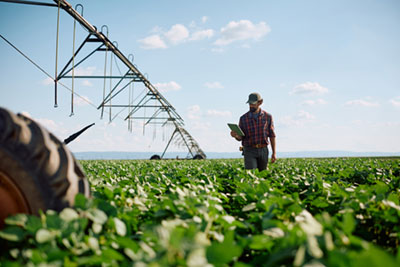 With each passing year, machine vision technology ventures further beyond the factory floor into both new industries and everyday life. In agribusiness and smart farming applications, for example, machine vision technologies have helped farms and food companies automate and streamline a vast range of processes, whether it’s dealing with crops, weeds, livestock, or beyond.
This expansion of machine vision agriculture applications has been enabled by the continuing advancement of technologies like AI software, 3D imaging, high-resolution cameras, industrial computing, LED illumination, motion control components, and non-visible imaging. Here is a look at just a handful of some of the latest exciting applications in machine vision in agriculture.
Detecting and Destroying Weeds
Known best for its AI-enabled LaserWeeder G2, Carbon Robotics has raised $157 million in capital since 2018. The company’s self-contained, fully sealed LaserWeeder G2 is a pull-behind robot that precisely identifies and destroys weeds among crops. The robot is available in multiple sizes that cater to individual crop needs and features two 240W lasers, three high-resolution cameras, two NVIDIA GPUs, and 20 LED lights. The lasers, which are used in lieu of harmful chemicals to destroy the weeds, have a 21-inch shoot width.
The system leverages neural networks running on the edge that help distinguish between weeds and crops and provide precise locations for the lasers to target. The algorithm, developed using a dataset of more than 40 million labeled plants, was built on images collected from three different continents. The company says its LaserWeeder G2 can target weeds with sub-millimeter precision and can process 4.7 million images per hour. The system is used by more than 100 growers across the world and has led to an 80% cost reduction per year in weed controls while offering the ability to kill 99% of unwanted plants.
Here’s another example that highlights the success of AI-enabled weed detection and elimination: Taylor Farms, North America’s leading producer of ready-to-eat salads and healthy fresh foods, was once a customer of FarmWise, a company that developed the automated Vulcan intra-row weeder and precision cultivator. Vulcan uses the FarmWise Intelligent PlantSystem (IPS) scanner, which leverages a high-resolution camera, integrated custom lighting, and AI algorithms to distinguish between individual crops and weeds.
The system also uses up to 18 UGA Low-Profile UniGuide linear motion slides with custom-positioned hand brakes from PBC Linear that provide precise height adjustments. This system allows for precision weed removal without damaging crops, saving farmers up to $250 per acre, maximizing yield potential, and minimizing the need for expensive manual labor. After working together for some time, Taylor Farms — also a Carbon Robotics customer — acquired FarmWise, highlighting the benefits and ROI of the technology. In addition, the partnership improved data collection accuracy and analysis, and crop management and yield prediction.
Certified System Integrator Program
Set Yourself at the Forefront of the Global Vision Market
.jpg) Vision system integrators certified by A3 are acknowledged globally throughout the industry as an elite group of accomplished, highly skilled and trusted professionals. You’ll be able to leverage your certification to enhance your competitiveness and expand your opportunities.
Vision system integrators certified by A3 are acknowledged globally throughout the industry as an elite group of accomplished, highly skilled and trusted professionals. You’ll be able to leverage your certification to enhance your competitiveness and expand your opportunities.
Weighing Pigs
Based in Ukraine, Barkom LLC. specializes in crop and livestock farming, including pigs and cattle. Traditional means of weighing pigs is time-consuming work that involves guiding them onto a scale, which causes unnecessary stress for pigs. Seeking a means to minimize the work and stress involved in the process, Barkom sought out tech consulting and engineering company Lemberg Solutions to develop a portable computer vision system that allows farmers to weigh the pigs.
To begin the process, images of pigs and their corresponding weights were gathered to create a 17TB dataset for an advanced weight-recognition algorithm that leverages neural networks and a custom image recognition algorithm. The system also leverages a Stereolabs passive stereo vision camera operating in the RGB spectrum while the second camera, a RealSense D435, captures 3D scans in the infrared spectrum. To determine the weight of a pig, even if it’s in motion, a farmer just holds the mobile device above a pig and captures an image, and the system easily measures the pig — with 98% accuracy.
Vertical Farming Innovations
Vertical farming startup company Interius Farms uses multi-sided rotating towers for a spatially and cubically efficient design. To integrate advanced automation into its design, the company partnered with Osedea, a company that creates custom technological solutions in areas like AI, software engineering, and robotics, and SmartOne, a robotics and physical AI training data company.
As part of the vertical farming setup, a Spot robot from Boston Dynamics autonomously navigates the farm collecting data and assessing plant health using its vision system, reducing reliance on manual work, streamlining farming operations, and enabling around-the-clock monitoring. Overall, by incorporating robotics, AI, and data analytics into its operation, Interius Farms uses 95% less water and 92% less land than traditional agriculture operations — while the controlled environment and lighting systems also reduce energy consumption — to grow crops such as leafy greens and herbs.
See the Future of Machine Vision in Action.png)
Join industry leaders and tech innovators to explore the latest in machine vision, computer vision, and AI-driven automation at A3's Advanced Vision & AI Conference in Santa Clara, California from September 23-24, 2026. Learn more.
Recent Posts
- How 3D Vision Systems Are Transforming Food Manufacturing
- Autonomous Driving Technology: Dueling Approaches Fight for Control of the Wheel
- Revealing the Hidden Effects of Climate Change with Advanced Imaging
- How Vision Systems Are Transforming Predictive Neurodiagnostics
- Innovative Machine Vision Lenses and Trends
- An Early Look at GigE Vision 3.0
- View All Vision & Imaging Blogs