
Vision & Imaging Blog
From Seabed to Space: Using Augmented Reality for Increased Visibility
 Machine vision technologies are being used to make possible complex augmented reality (AR) systems on earth. AR isn’t just for video games and entertainment anymore. AR could soon find everyday use on assembly lines, in operating rooms, and in the classroom.
Soon, NASA will be using smart glasses equipped with augmented reality video in space. But before that can happen, those systems are being tested in humankind’s other unexplored frontier, the bottom of the sea.
What Is Augmented Reality?
Augmented reality lets users add layers of digital information over a visual display of our physical world. AR adds sounds, videos, and graphs to real-time video, or overlaid onto transparent lenses.
Users experience a changed perception of reality, hence the term, augmented reality. AR can be displayed on a wide range of devices, including screens, glasses, handheld devices, mobile phones, and head-mounted displays.
How Augmented Reality Works
Simultaneous Localization and Mapping (SLAM) technology uses machine vision systems to create maps of a user’s environment. This technology allows 3D objects to be recognized and AR elements to be embedded onto the map. Cameras and sensors collect data about the user’s interactions. When used with CMOS sensors, global shutters achieve very high frame rates and maintain high resolutions. All this information goes to a CPU and other systems for processing.
ROI Calculator

Discover the potential cost savings of robotic automation over a 20-year system life
This calculator compares your current manual labor costs against the total cost of owning and operating a robotic system over its 20-year lifespan.
A miniature projector takes data from the sensors and projects digital content onto a surface for viewing. Some AR devices have mirrors to ensure proper image alignment. Depth tracking is used to calculate the distance from the camera of the objects in sight and to ensure that the objects are placed correctly on the display.
Testing AR on the Ocean Floor
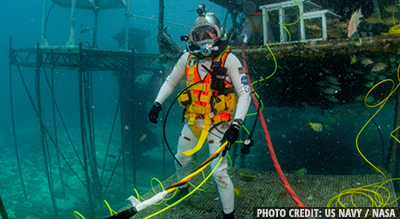
NASA’s Johnson Space Center is using the Aquarius Reef Base underwater habitat in Key Largo to try out a new high-resolution, see-through head-up display. This display, integrated into a Kirby Morgan-37 dive helmet, allows divers to have a high-resolution display of sector sonar imagery, text messages, diagraphs, photographs, and augmented reality video.
It’s like having sight restored to the blind for divers who must often work in zero visibility conditions. NASA astronauts and technical personnel were able to conduct training missions and determine the potential for a similar system that would be integrated into their extra vehicular activity (EVA) spacesuits. Astronauts would benefit most in situational awareness, safety, and effectiveness.
Photo credit: US Navy / NASA
Recent Posts
- How 3D Vision Systems Are Transforming Food Manufacturing
- Autonomous Driving Technology: Dueling Approaches Fight for Control of the Wheel
- These Farms Are Harnessing Machine Vision for Smarter Agriculture
- Revealing the Hidden Effects of Climate Change with Advanced Imaging
- How Vision Systems Are Transforming Predictive Neurodiagnostics
- Innovative Machine Vision Lenses and Trends
- View All Vision & Imaging Blogs