
Robotics Blog
The 3 Key Factors that Differentiate Service Robots from Industrial Robots
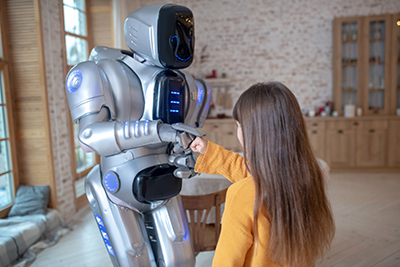 With all the recent advancements in robotics and the somewhat ambiguous definitions defining them, you might be wondering, “What makes a service robot a service robot?” and “How are service robots different from industrial robots?” If you’ve ever been confused and want some answers, this is the discussion for you! Let’s consider three major differences between service robots and industrial robots.
Service Robots vs. Industrial Robots: Applications
A major difference between these two types of robotics is application. Some think service robots are only found in homes, but service robots can have commercial uses too. A service robot might guide a customer around a store, assist a customer at a bank making a deposit, or even sweep up a mess on a retail store aisle.
So, what’s the difference then? A service robot typically performs useful tasks for humans, just not in an industrial setting. This excludes robots in manufacturing facilities but not in settings such as healthcare, logistics, and even the military. Service robots can also usually perform their tasks in a variety of environments. Industrial robots are often only suited to a particular task in a familiar setting.
Service Robots vs. Industrial Robots: Target Customers
Manufacturers purchase a large percentage of industrial robots. At their facilities, typical tasks include welding, painting, assembly, pick-and-place, and material handling. But industrial robots can be used in any other industry with the same types of uses and be considered an industrial robot.
ROI Calculator

Discover the potential cost savings of robotic automation over a 20-year system life
This calculator compares your current manual labor costs against the total cost of owning and operating a robotic system over its 20-year lifespan.
Service robots don’t often replace humans but are more likely to assist humans or perform tasks on their behalf. The target customers for service robots are likely service-oriented businesses, such as retailers, hospitality, or healthcare. Service robots currently help humans with tasks in agriculture, construction, inspection, and logistics too.
Service Robots vs. Industrial Robots: Maturity
Industrial robots are far more mature in their market compared to service robots. Although service robots have been around since the 50s, they are not as widespread. Manufacturers quickly adopted service robots to improve manufacturing processes and lower costs. In many ways, implementing industrial robots has historically been simpler. They are often mounted in place and perform the same task over and over.
Due to their flexibility and mobility, service robots were often more difficult to design, install, and maintain. Service robots have become more popular in recent years thanks to navigation systems powered by 3D vision technology and artificial intelligence. These same technologies have made service robots safer when operating near human workers.
Recent Posts
- 6 Companies Driving Automation in Mexico
- Humanoids on the Horizon: What Hurdles Remain for Widespread Adoption?
- Safety by Design: How Humanoid Robots Must Evolve to Depart the Walled Garden
- Are Robots Really Taking All the Manufacturing Jobs?
- The Shipping Industry Floats Emerging Opportunities for Maritime Automation
- New to Robotics? Start with These Fundamentals
- View All Robotics Blogs