
Blog
Collaborative Robot Safety: What is PRM & How Does It Work
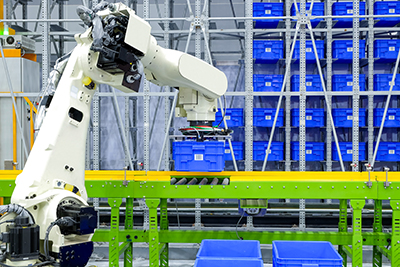 Clear, free workspaces are rare in warehouses, production facilities, and industrial spaces where collaborative robots (cobots) are used. Sometimes, cobots are pushed into work cells that are smaller than originally planned. On occasion, there’s nowhere else to stack materials except for in an area closer to a collaborative robot than originally planned.
What Are Probabilistic Roadmaps?
Probabilistic roadmaps (PRMs) help to create collision-free paths for collaborative robots. The word “probabilistic” refers to the set of random points in the configuration space within which the planner knows the cobot can safely move. If points are placed at regular intervals throughout a workspace, that is known as “uniform” placement.
PRMs first create a roadmap of the entire robot workspace. This map is not much different than a list of GPS directions based on the waypoints programmed into your smartphone app. Once the map of a workspace is generated, new routes and movements can be created as needed without generating the map all over again.
How Probabilistic Roadmaps Work
There are two separate phases to PRM algorithms. To set up a PRM, three properties must be configured: number of samples, edges per sample, and robot step. The number of samples offers the collaborative robot a more detailed space within which to move. Edges per sample also contribute to the detail and precision of the map. Lastly, robot step dictates how much movement is allowed per step. Bigger steps are more likely to result in collisions.
ROI Calculator

Discover the potential cost savings of robotic automation over a 20-year system life
This calculator compares your current manual labor costs against the total cost of owning and operating a robotic system over its 20-year lifespan.
The Construction Phase
In the construction phase, the PRM planner places a “sample” in a random location in the free space within the robot’s workspace. The algorithm tests the path between the sample and surrounding samples. As the collaborative robot moves along the path in steps, the planner checks for collisions. If the path is clear, it adds the path as an edge to the roadmap.
The Query Phase
The query phase is the phase a collaborative robot operator uses most often when building a PRM. The operator provides the planner with two targets: a start and an end. The planner then creates a collision-free path between the points using the roadmap. The planner uses a “Dijkstra’s shortest path query” (Dijkstra's algorithm finds the shortest paths between nodes in a graph, which may represent, for example, road networks) to ensure maximum speed and efficiency.
Recent Posts
- 6 Companies Driving Automation in Mexico
- Humanoids on the Horizon: What Hurdles Remain for Widespread Adoption?
- Safety by Design: How Humanoid Robots Must Evolve to Depart the Walled Garden
- Are Robots Really Taking All the Manufacturing Jobs?
- The Shipping Industry Floats Emerging Opportunities for Maritime Automation
- New to Robotics? Start with These Fundamentals
- View All Blogs