
Blog
4 Ways Agricultural Drones are Helping Farmers’ Productivity
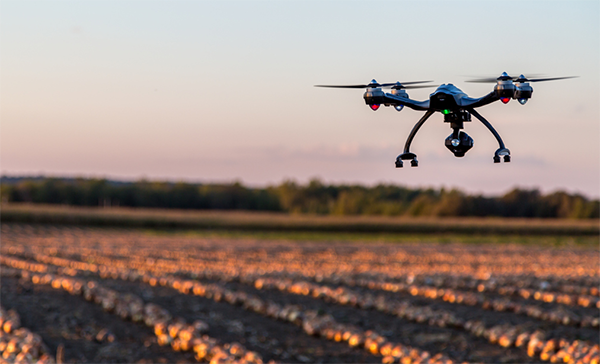 Drone technology, enabled by advances in imaging technology, are revolutionizing the agricultural industry. Approximately 80% of global drone industry revenues are related to agriculture. That fact may sound surprising, given all the consumer and commercial applications that come to mind when you think of drones, but they are proving to be particularly useful in agriculture.
Monitoring large fields of crops used to be time-consuming and inaccurate, but drones are changing that very quickly. Farmers are finding innovative ways to leverage drones with advanced imaging technology to improve their annual yields and refine their farming processes.
4 Ways Agricultural Drones are Being Used by Farmers
While drone technology equipped with advanced imaging systems is still relatively new technology, there are four main ways it is being used so far.
1. Soil and Field Analysis
Drones are instrumental at the start of the crop cycle. They can produce 3D maps for initial soil analysis, which is a major help in planning seed planting patters. Then, after planting, the same type of soil analyses can be used for irrigation data and nitrogen-level management.
2. Crop Monitoring
In the past, satellites were the most advanced form of crop monitoring, but had significant drawbacks. Now, drone imaging technology enables time-series animations that reveal the development of a crop and any inefficiencies in production. This leads to overall better crop management by giving the farmer a holistic view of what’s happening in their fields.
Certified System Integrator Program
Set Yourself at the Forefront of the Global Vision Market
.jpg) Vision system integrators certified by A3 are acknowledged globally throughout the industry as an elite group of accomplished, highly skilled and trusted professionals. You’ll be able to leverage your certification to enhance your competitiveness and expand your opportunities.
Vision system integrators certified by A3 are acknowledged globally throughout the industry as an elite group of accomplished, highly skilled and trusted professionals. You’ll be able to leverage your certification to enhance your competitiveness and expand your opportunities.
3. Irrigation
As mentioned above, drones with advanced imaging systems can provide soil analyses for irrigation by showing which parts of a field are dry and which are wet. This allows a farmer to immediately address irrigation concerns, whereas before the only method was to drive around on an ATV and look for dry spots. Using drones for irrigation ultimately improves crop yields.
4. Crop Health Assessment
There are many different ways drones are used to assess crop health. Multi-spectral imaging is used to determine overall crop health based on visible and near-infrared light emissions. Drones can also be used to spot fungal or bacterial infections – the detection of which can save an entire field from disease. Even in the event of crop loss, a farmer can comb back through drone data to analyze what went wrong and adjust farming processes from there.
While there are certainly other drone methods being deployed by farmers, such as seed planting and crop spraying, the four mentioned above are some of the most innovative combinations of drone and imaging technology being used today.
Imaging and drone technology are only advancing, and as they improve so will farmers' techniques for boosting productivity and annual yields.
If you'd like to learn more about imaging technology being used in life sciences, browse our Vision in Life Sciences section for more detailed information.
Recent Posts
- How 3D Vision Systems Are Transforming Food Manufacturing
- Autonomous Driving Technology: Dueling Approaches Fight for Control of the Wheel
- These Farms Are Harnessing Machine Vision for Smarter Agriculture
- Revealing the Hidden Effects of Climate Change with Advanced Imaging
- Innovative Machine Vision Lenses and Trends
- An Early Look at GigE Vision 3.0
- View All Blogs