
Vision & Imaging Blog
NASA’s Orpheus Leverages Vision Technology to Hunt for Undiscovered Life
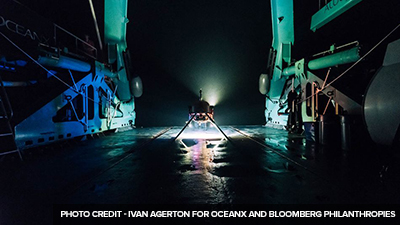 At one time, scientists assumed the greatest depths of the ocean were a barren wasteland, but NASA’s Orpheus has found that’s not the case. Even at depths with temperatures barely above freezing, crushing water pressure, and no sunlight whatsoever, the ocean is teeming with lifeforms.
The deep sea makes up 90% of the world’s oceans, but it remains largely unexplored. Technology like what’s packed into NASA’s Orpheus, allowing it to dive to incredible depths, wasn’t available until fairly recently. These challenges aren’t unlike those met by scientists looking for extraterrestrial life, so, they’re turning to our oceans for inspiration on how to find creatures throughout the cosmos.
NASA’s Orpheus is a drone submarine about the size of a backyard grill and weighs 600 pounds. Orpheus is equipped with four Go-Pro like cameras and flashes that help the vehicle navigate on its own and capture the scenery. The Orpheus uses multiple cameras to stitch together a single image, much the way the panoramic function on a phone camera works.
Scientists Rethink the Food Chain
For a long time, scientists believed all life on Earth must be sustained by a photosynthesis-based food chain. Some organisms must convert sunlight into food, and then other organisms eat those photosynthesizing organisms. The assumption was that life at the bottom of the ocean, where there is no sunlight, would have to consume the dead organic material that fell down through the water. If there was any life down there, it couldn’t be large or complex, putting to rest the idea of monsters under the sea.
ROI Calculator

Discover the potential cost savings of robotic automation over a 20-year system life
This calculator compares your current manual labor costs against the total cost of owning and operating a robotic system over its 20-year lifespan.
But in the ‘70s, a research team sent a camera and temperature sensor to the seafloor. They first found what was expected: barren lava flows. But in the same area, they found a dense cluster of white clams and brown mussel shells. There were crabs nearly a foot long living among giant white tube worms. Researchers found that microbes used chemicals from the rocks instead of sunlight. A different food chain was discovered.
NASA’s Orpheus Looks Ahead to Find Extraterrestrial Life
NASA hopes to one day use the Orpheus in other worlds, including Europa, Jupiter’s watery moon. Europa’s ocean is one of the most likely places for life to exist in our solar system. But first, Orpheus must learn how to recognize and observe possible forms of life.
Scientists searching for life in the cosmos have learned a lesson from the Earth’s oceans. Other lifeforms might not be reliant on a sun, as scientists long assumed. Now, astrobiologists are looking for life on planets that get very little sunlight from the stars they orbit.
Recent Posts
- How 3D Vision Systems Are Transforming Food Manufacturing
- Autonomous Driving Technology: Dueling Approaches Fight for Control of the Wheel
- These Farms Are Harnessing Machine Vision for Smarter Agriculture
- Revealing the Hidden Effects of Climate Change with Advanced Imaging
- How Vision Systems Are Transforming Predictive Neurodiagnostics
- Innovative Machine Vision Lenses and Trends
- View All Vision & Imaging Blogs