
Vision & Imaging Blog
Improving Soil Management with Agricultural Optical Sensors
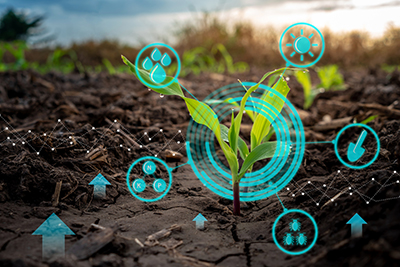 U.S. food growers must ramp up food production to feed the growing world population. Optical sensors are being used to ensure proper soil management and increase farm efficiency to offset a labor shortage in agriculture.
Agriculture Faces the Challenge of Growing Demand
The biggest drivers of food demand --population and income-- continue to rise. The world’s population is expected to reach 9.1 billion people in 2050, up from 7.4 billion in 2016. Farmers globally must increase food production by 70 percent compared to 2007 levels to meet the needs of the larger population, according to a report from the Food and Agriculture Organization of the United Nations.
The age of farmers is also a concern. Aging growers will eventually leave the industry with a shortage of younger growers to replace them. Farm consolidations are expected to be significant and happen quickly. One-man operations will turn into medium- or large-scale businesses.
Meeting the Challenge of Increased Food Production
To increase food production significantly, the farm industry must implement technology when it comes to soil management. Monitoring systems are being refined that feature continuous plant-growth sensors, soil moisture sensors, and microclimate tracking. Data is provided to mobile devices and computers for immediate action. The technology can result in less chemical use and lower environmental impact.
ROI Calculator

Discover the potential cost savings of robotic automation over a 20-year system life
This calculator compares your current manual labor costs against the total cost of owning and operating a robotic system over its 20-year lifespan.
Optical sensors are available that measure and record data about crops and soil in real time by using the reflectance of light shined on growing plants. The sensors can tell applicators to apply less nitrogen to healthy plants and more nitrogen to weaker, unhealthy plants. The technology isn’t based on ambient light, so the optical sensors can be used day and night.
Organic material is a major source of nitrogen in the soil. The more organic material that’s present, the more nitrogen the soil produces. Because organic matter concentrations vary, nitrogen availability in the soil varies greatly. Poor drainage and uneven moisture distribution lead to denitrification. Optical sensors can determine the nitrogen rate by monitoring crop vigor and based on plant biomass and nitrogen content.
Optical sensors measure soil properties by detecting the different frequencies of light reflectance in near-infrared, mid-infrared, and polarized light spectrums. Sensors are placed on vehicles, drones, aerial platforms, and satellites. Soil reflectance and plant color data are collected and processed. Optical sensors can determine clay, organic matter, and moisture content of the soil.
Optical sensors in agriculture can improve soil and crop quality.
Share This On X:
#Opticalsensors measure soil properties by detecting the different frequencies of light reflectance in near-infrared, mid-infrared, and #polarized light spectrums.
The #agricultural industry is leveraging #opticalsensors to measure and record data about crops and soil in real time by using the reflectance of light shined on growing plants.
Recent Posts
- How 3D Vision Systems Are Transforming Food Manufacturing
- Autonomous Driving Technology: Dueling Approaches Fight for Control of the Wheel
- These Farms Are Harnessing Machine Vision for Smarter Agriculture
- Revealing the Hidden Effects of Climate Change with Advanced Imaging
- Innovative Machine Vision Lenses and Trends
- An Early Look at GigE Vision 3.0
- View All Vision & Imaging Blogs