
Vision & Imaging Blog
How Barcodes Work
 Millions of products all over the United States use barcodes. Standard UPC barcodes help businesses throughout the supply chain to track and monitor their own products and those of partners, ensuring everything gets to its intended destination on time. Barcodes are especially important for perishable items, although they are used throughout retail.
Many vision systems professionals have some interaction with barcodes, but not everyone knows all the details behind how they work. Let’s take a closer look at barcodes, the unsung hero of so many common logistical challenges.
Uncovering the Universal Product Code
UPC stands for Universal Product Code, a standard for encoding key information about all kinds of products. UPCs were originally used in groceries, intended to accelerate the checkout process by making pricing and other information visible to point-of-sale systems.
Although UPCs are ubiquitous, they aren’t the result of federal or international regulations. Instead, they are administered by a private company, the Uniform Code Council. Each and every manufacturer that uses unique UPCs for its products pays an annual fee.
In exchange, each product is assigned a code consisting of two parts:
- The barcode itself, a standardized, machine-readable interface
- The “human-readable” 12-digit code with manufacturer ID
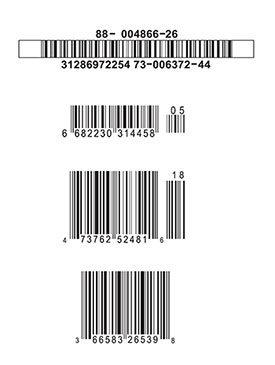 The manufacturer ID – which the annual fee pays for – is the first part of every human-readable code assigned to a brand. It takes up six digits and is followed by a five-digit code that denotes the individual product. The last digit is a “check digit,” the result of an algorithm that helps ensure each product is scanned correctly at the cash register.
Certified System Integrator Program
Set Yourself at the Forefront of the Global Vision Market
.jpg) Vision system integrators certified by A3 are acknowledged globally throughout the industry as an elite group of accomplished, highly skilled and trusted professionals. You’ll be able to leverage your certification to enhance your competitiveness and expand your opportunities.
Vision system integrators certified by A3 are acknowledged globally throughout the industry as an elite group of accomplished, highly skilled and trusted professionals. You’ll be able to leverage your certification to enhance your competitiveness and expand your opportunities.
What You May Not Know About UPCs
UPCs are vital to today’s convenient point-of-sale environment, but they also have some quirks you may not know about. For example, the Uniform Code Council doesn’t actually assign specific digits to products: That’s the job of an inside expert called the UPC coordinator. Businesses with lots of SKUs may actually spend hundreds of hours keeping all their UPCs up to date!
UPCs can become difficult to scan for a variety of reasons:
- Poor contrast
- Improper quiet zone
- Bad reading position
- Printing inconsistency
- Damage to print surface
Since UPC codes are highly standardized, reader software does not need to be designed with a wide range of variations in mind. However, codes can still become unreadable if they have not been printed according to appropriate standards. Even a code that seems flawless to the human eye might not be sufficient for scanning, especially in a fast-paced environment. When print quality is high, proper lighting is still essential – and the scanner must cross all bars in the code. Poor device calibration can cause scanning to fail even when all other factors are ideal. Machine vision software and technology helps ensure that barcodes are working.
Recent Posts
- How 3D Vision Systems Are Transforming Food Manufacturing
- Autonomous Driving Technology: Dueling Approaches Fight for Control of the Wheel
- These Farms Are Harnessing Machine Vision for Smarter Agriculture
- Revealing the Hidden Effects of Climate Change with Advanced Imaging
- How Vision Systems Are Transforming Predictive Neurodiagnostics
- Innovative Machine Vision Lenses and Trends
- View All Vision & Imaging Blogs