
Vision & Imaging Blog
Exploring Life on Mars with Vision Systems
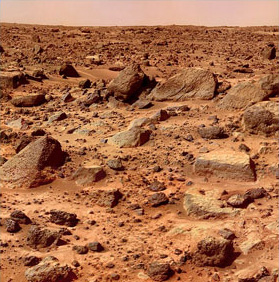 Humans get massive amounts of environmental information from visual data. But what happens when you need a machine that interprets sight data as well? Through ambitious missions to Mars, NASA is becoming a leader in machine vision.
Seeing the Red Planet Through Machine Eyes
The scientific goals of NASA's recent Mars missions are:
- To determine whether life ever existed on Mars.
- To characterize the climate of the Red Planet.
- To learn about Mars' geology and magnetism.
There are several reasons vision systems are critical to the mission:
Vision Systems Find Novel Signs of Life
Scientists easily recognize fossils and other life-signs on Earth, but what about on Mars? The alien atmosphere of the Red Planet means telltale biosignatures may be very different. Machine vision helps researchers discover life among non-life no matter what forms it takes.
Vision Systems Uncover Martian Geology
Each modern rover has a microscopic imager for creating detailed images of soil and rocks. To decide where fruitful samples might be found, researchers must evaluate a rover's position. Both the imager and the rover "eyes" must be as precise as possible.
The Nine-Eyed Mars Rover: A Scientific Triumph
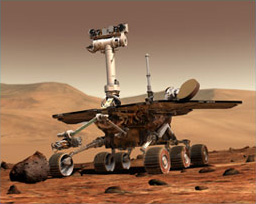
Including the microscopic imager, Mars Rover has nine "eyes" for specific tasks:
 Four Hazard Avoidance Cameras
If the rover gets stranded in impassable terrain, there's no sending someone to turn it around! Four "haz" cameras are mounted on the rear and front of the chassis and create 3D images using visible light. The images are passed to software that allows the rover to make tactical decisions about maneuvering.
Certified System Integrator Program
Set Yourself at the Forefront of the Global Vision Market
.jpg) Vision system integrators certified by A3 are acknowledged globally throughout the industry as an elite group of accomplished, highly skilled and trusted professionals. You’ll be able to leverage your certification to enhance your competitiveness and expand your opportunities.
Vision system integrators certified by A3 are acknowledged globally throughout the industry as an elite group of accomplished, highly skilled and trusted professionals. You’ll be able to leverage your certification to enhance your competitiveness and expand your opportunities.
The haz-cams are very impressive despite their low resolution: Their field of view is about 120 degrees, compensating for the fact they can't rotate independently. The rover compares pairs of images captured up to 10 feet in front of it to map the terrain. Its vision is "wedge-shaped," with maximum distance about 12 feet.
Two Navigational Cameras
These cameras are situated on the mast - the rover's "head." Using visible light, they generate 3D panoramic imagery in black and white. Each has a 45-degree field of view that complements the haz-cams and gives scientists the perspective necessary to devise strategies for traversing tough terrain.
Two Panoramic Cameras
The "Pancam" provides 3D color panoramas of the Martian landscape. With a precise height and narrow field of view, it simulates vision at 0.3 milliradians - specifications identical to the human eye. Each of its two stereo "eyes" contains eight specialized filters; together, they have 11 unique color and solar imaging filters. One of Pancam's greatest features is multi-spectral analysis. Using its solar filter, it can even face the sun to get absolute position information!
Pancam's position on the mast allows it to rotate 360 degrees, and the bar it is fixed to can move up or down 180 degrees. Despite their versatility - generating mosaics up to 4,000 pixels high and 24,000 pixels around - the individual cameras weigh only about eight ounces. Amazingly, their resolution is around two megapixels: Today's high-end consumer cameras have up to 50!
Recent Posts
- How 3D Vision Systems Are Transforming Food Manufacturing
- Autonomous Driving Technology: Dueling Approaches Fight for Control of the Wheel
- These Farms Are Harnessing Machine Vision for Smarter Agriculture
- Revealing the Hidden Effects of Climate Change with Advanced Imaging
- Innovative Machine Vision Lenses and Trends
- An Early Look at GigE Vision 3.0
- View All Vision & Imaging Blogs