
Vision & Imaging Blog
3D Microscope Able to Explore the Nervous System of Animals
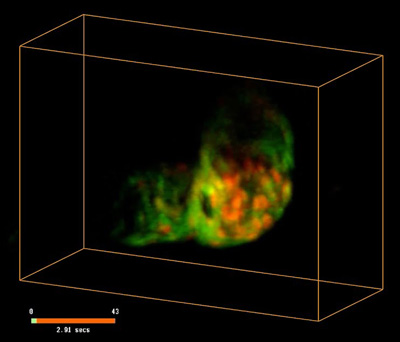 Columbia engineers and scientists have collaborated to use a 3D microscope to create videos of individual nerve cells moving inside fruit fly larvae. The data shows how these nerve cells work together to help the body sense where it is currently positioned in space. They developed a cutting-edge 3D microscopy, known as SCAPE (swept confocally aligned planar excitation), that is capable of imaging neurons at remarkably fast speeds.
Researchers used the fruit fly because it is transparent and small enough to image its entire brain and body. Since flies, worms, and fish have simpler brains than humans, scientists can observe complete nervous systems, cell by cell. Scientists found that each cell makes the larva sensitive to its body’s overall shape. After lining up the neurons’ signals, they saw that the neurons generated a detailed sequence of signals that reflected each body part’s movement.
How SCAPE 3D Microscopy Works
SCAPE microscopy forms 3D images of living samples by scanning them with a sheet of laser light. SCAPE can both project and detect the moving light sheet through a single, stationary objective lens. SCAPE provides imaging speeds up to 500 times faster than conventional microscopes.
SCAPE allows researchers to see how nerve cells along the body wall report movements back to the brain. The imaging generates a massive amount of data. So, the team created machine vision algorithms that track each nerve cell and determine exactly when it’s active.
Clearing and Staining in 3D Microscopy
For organisms that are not transparent, scientists must make samples transparent with chemical “clearing” methods. These methods are time intensive and can’t be applied to every sample. So, scientists developed the ALMOST (a label-free multicolor optical surface tomography) optical method for 3D surface imaging of reflective opaque objects. Using machine vision, the method provides a 3D surface reconstruction of non-transparent samples. The data includes information on color and reflective properties.
ROI Calculator

Discover the potential cost savings of robotic automation over a 20-year system life
This calculator compares your current manual labor costs against the total cost of owning and operating a robotic system over its 20-year lifespan.
In the 19th century, Camillo Golgi devised a way to stain individual brain cells in “the black reaction.” The method has been adapted for electron microscopy by replacing silver salts with gold salts. Doing so allows tracing of neurons over their entire length and preserves their structural details. Combining the method with fluorescent labeling and tissue clearing lets scientists use 3D modeling to visualize spatial relationships between neurons and amyloid plaques within the brain. This new method can be used to study neuronal morphology in brain disease.
The Future of 3D Microscopy
The ultimate goal is to leverage new tools such as SCAPE to understand exactly how the billions of connections between cells in the brain, in parallel with their complex activity, are able to generate the repertoire of complex behaviors that our brain can.
Regarding the possibilities of the 3D microscope and SCAPE, one scientist on the team said: "We can now literally label any type of cell and find out what it is doing when the animal is moving, eating or even forming a memory; the possibilities are endless."
Machine vision plays an important role in discovering scientific breakthroughs.
Recent Posts
- How 3D Vision Systems Are Transforming Food Manufacturing
- Autonomous Driving Technology: Dueling Approaches Fight for Control of the Wheel
- These Farms Are Harnessing Machine Vision for Smarter Agriculture
- Revealing the Hidden Effects of Climate Change with Advanced Imaging
- Innovative Machine Vision Lenses and Trends
- An Early Look at GigE Vision 3.0
- View All Vision & Imaging Blogs