
Industry Insights
Icarus Robotics is Automating Space's Future Workforce
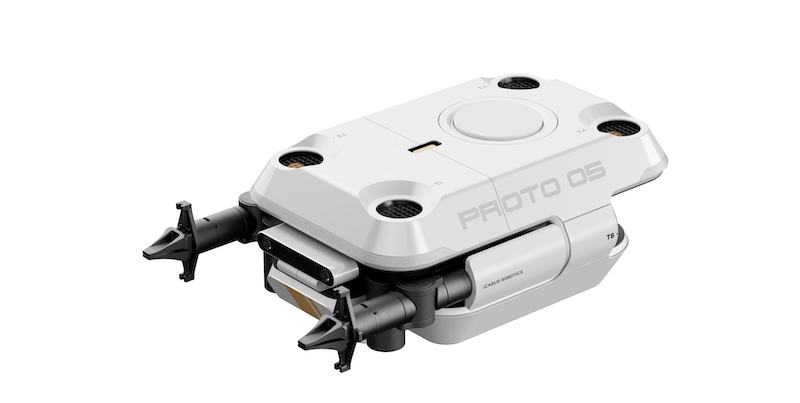
After more than three decades in orbit, the International Space Station (ISS) will be decommissioned in 2030. This marks a significant change to the space status quo and huge potential for its budding economy.
As companies and governments look to take the ISS’s place, Icarus Robotics is building a robot workforce to staff future space stations and missions.
The startup is building general purpose robots designed for space labor. The systems are meant to free astronauts from menial, repetitive tasks, like cargo loading and unloading, so the humans can focus on the things that can’t be automated.
“When you can do these pick and place operations with a robot, you can operate across a wide variety of task domains and have a great amount of economic impact, and free up astronauts to focus on the things that only they can do, because humans are extremely, extremely good at research,” Ethan Barajas, Icarus co-founder and CEO, told A3.
The company’s first robot, Joy, is fan-propelled and equipped with two arms designed for picking up and transporting objects around a spacecraft. Jamie Palmer, Icarus co-founder and CTO, told A3 the company utilized fan-based locomotion, as that approach has proven successful with past ISS robots. The two arms, meanwhile, will allow it to complete a variety of tasks.
“Ultimately it's much more appropriate to have a gyro-purpose piece of hardware, and that's why humans have been so useful in space,” Palmer said. “Oftentimes, if we can automate something in space, we will, because the environment is so hard, but getting the human up there unlocks so much because ultimately they too are a general-purpose machine.”
Icarus won’t have to wait long to test its 'bots on the ISS. The company announced a partnership with Voyager Technologies in March to send its devices to the space station in 2027. Human operators will remotely control the systems and help gather information on the environment and figure out what tweaks they might want to make.
Barajas told A3 that he got the “space bug” after an internship at NASA HUNCH where he worked on building agriculture nano labs for the ISS. The passion stuck with him and when he met Palmer, who has a rich robotics background, during the Entrepreneur First program in 2024, the two started talking about building bots for space.
After talking to folks in the industry for eight months, the pair began work on general purpose robotics, because their conversations revealed just how much time astronauts spent on menial work.
Icarus is venture backed and most recently raised a $6.1 million seed round in September 2025 that was co-led by Soma Capital and Xtal with participation from Massive Tech Ventures and Nebular.
The company is currently working to test the bots before deploying them in 2027. These tests include simulating zero-gravity on earth, Barajas said, and a Parabolic flight, which fly in repeated steep curves to simulate different gravities, scheduled for August.
“Its going to be a very big year for us, and we're going to have some very big announcements, both on the research side of things coming out soon, but also on the employment side of things, the partnership side of things,” Barajas said. We're just excited about how fast we'll be able to grow, and the new avenues that these partnerships will bring for us as a company.”
Association for Advancing Automation
Discover how Association for Advancing Automation can support your automation journey with their complete range of solutions and expertise.
Visit Company Website


PickNik Robotics to Collaborate with Sierra Space on Robotics for Space Habitats and Deep Space Missions
The companies anticipate that the robotic autonomy solutions developed with this collaboration will significantly improve the ability to support low Earth orbit (LEO), lunar and deep space missi
This Wind-Powered Robot is Designed to Explore Harsh Planets
WANDER is designed to walk stably over rugged terrain.