
Industry Insights
This Wind-Powered Robot is Designed to Explore Harsh Planets
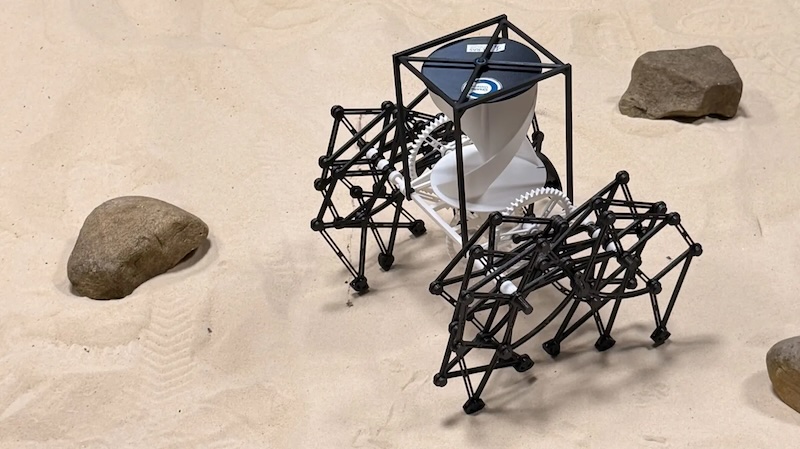
Researchers from Cranfield University have designed a new robot for exploring extreme environments, including polar regions, deserts, and potentially other planets. It currently has a low technology readiness (TRL) level, but work on the project is expected to continue. If successful, could be foundational to space exploration and discovery missions, as well as data collection in traditionally inaccessible areas.
Designing robots for such harsh environment is difficult. Most robots today rely on battery power, but the researchers took a different locomotion approach with the WANDER-bot. “Conventional robotic locomotion systems require high electrical power and large, heavy batteries, which degrade rapidly in hostile environments, leading to reduced performance over time” Sam Kurian, research associate in space engineering, Cranfield University told A3. “Long distance operations also depend on extensive support infrastructure for charging, maintenance, and transport”.
Instead of a battery, the WANDER-bot uses wind energy as a power source. “Harnessing natural wind energy through purely mechanical linkages eliminates most of the power demand for locomotion and removes the need for complex support systems, making it ideally suited for extreme environments” says Kurian. Movement is responsible for about 20% of battery use in many robots, so using natural energy means that the robot is not only more efficient, but it also negates the issues of battery degradation over time.
The robot utilizes a Savonius wind turbine, which is a type of vertical axis turbine. This is connected to a Jansen linkage mechanism for locomotion and a reduction gearing mechanism to multiply torque. So long as the wind is blowing, the robot can move continuously without the need for external power — enabling longer exploration and data collection operations to take place.
As to why these mechanisms were chosen specifically for the robot, Kurian explained to A3 that, “the Savonius vertical axis turbine provides continuous rotation regardless of wind direction and the reduction gear system increases torque, which enables the robot to walk on slopes and move directly against headwinds. The Jansen linkage, inspired by Strandbeest designs, efficiently converts rotary motion into low energy, stable forward walking, offering terrain adaptability advantages over wheeled locomotion.” This design is much simpler than many other robots, using simple mechanical linkages to move, making it cheaper and easier to maintain.
Certified Motion Control Professional Program
Strengthen Your Skills and Enhance Your Career
Become a Certified Motion Control Professional (CMCP) and join the elite group of system integrators, machine builders, manufacturers, end-users and others recognized in the industry for their professional knowledge and expertise.
The robot itself was created using additive manufacturing (3D printing), so if any parts do get damaged during operation, it will be much easier and faster to replace. For space exploration, it could negate the need for expensive and time-consuming resupply missions as new parts could be made by a nearby printer.
“The robot was designed so that all components could be fully 3D printed, enabling easy on-site servicing and rapid replacement of damaged parts with minimal downtime,” Kurian confirmed. “The fully printable design also supports future in situ resource utilization (ISRU), allowing parts to be manufactured and assembled directly at the deployment location, reducing storage and transport requirements”.
The current prototype was produced using a standard polymer-based additive manufacturing technique called fused filament 3D printing. “As this is an early-stage conceptual prototype, the robot is entirely manufactured from PLA [polylactic acid]. This material was selected for its ease of printing and suitability for rapid prototyping. Alternative materials that are more suitable for extreme environments will be explored in future iterations” says Kurian.
The WANDER-bot could be the first step towards a lower cost and easily repairable, self-sufficient robot that is suitable for off-Earth exploratio. It has already been proposed for use on Saturn’s largest moon, Titan. Because of this, the robot was designed to walk forward in omnidirectional wind conditions and on firm terrain, with a Titan-equivalent weight offset.
The robot is not yet suitable for these harsh environments and grandiose missions, as thisis just the first prototype, and the fundamentals have now been established. The design can now be taken forward to develop more mature and robust designs with a variable speed control that can traverse more challenging terrain. When asked by A3 where the research will go next, Kurian concluded that “Future work will focus on improving the design for operation in unstructured environments and integrating onboard decision making, perception, and autonomy components to support monitoring, exploration, and adaptive behavior”.

Association for Advancing Automation
Discover how Association for Advancing Automation can support your automation journey with their complete range of solutions and expertise.
Visit Company Website


Aging slower in space?
The importance of space exploration is growing, with more and more astronauts cavorting in space.
Icarus Robotics is Automating Space's Future Workforce
The startup's robots will automate space work so astronauts can focus on other things.