
Robotics Blog
Lessons on Robotics and Automation in India from a Visit to Mumbai
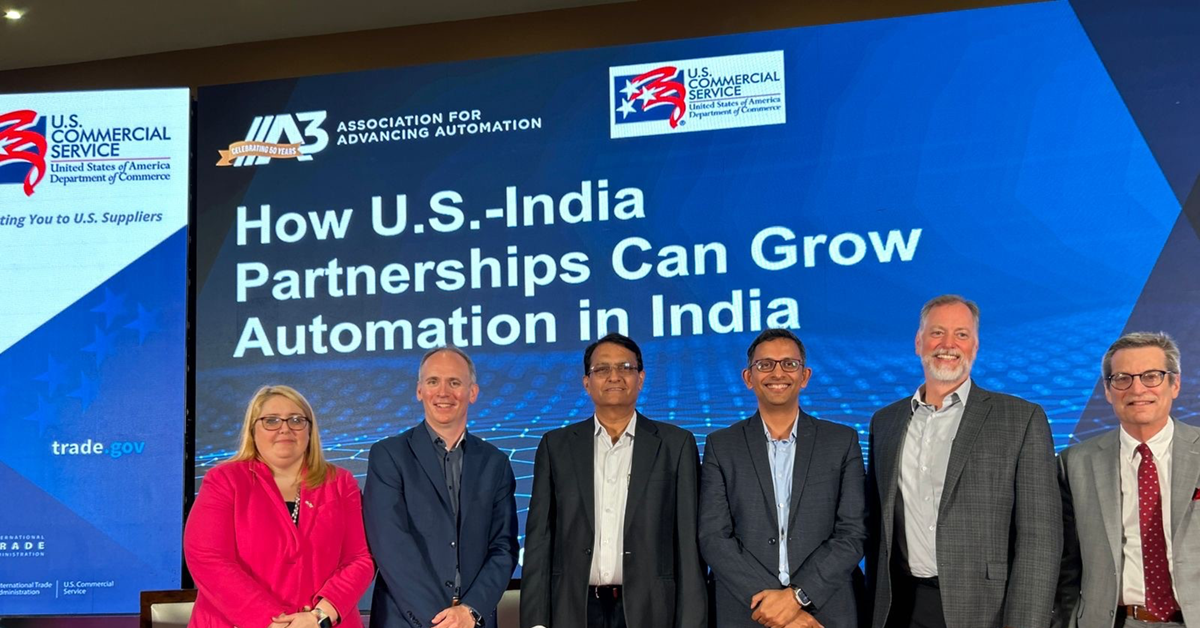 We just returned from one week in Mumbai, India, visiting Automation Expo 2024, one of that country’s premier automation trade shows. The visit was part of a larger effort by the Association for Advancing Automation (A3) to grow U.S. and India business partnerships and drive U.S. exports as part of a three-year Department of Commerce grant.
A3 last visited this trade show 16 years ago. At the time, the Indian robotics industry had barely taken root. One of the largest auto manufacturers had hardly any robots deployed in 2008 — and saw little reason why they would need more of them. Today, they use hundreds of robots in highly automated manufacturing plants.
The landscape has clearly changed since then. As of 2022, India ranked 11th globally in annual robot installations, according to data from the International Federation of Robots.
But we could also witness the excitement with our own eyes. The Expo featured a floor filled with robotics, machine vision, industrial software, and A.I. applications. It was also packed with potential customers from a spectrum of industries. Some seemed to want to dip their toes in the water, while others were looking to scale their operations at a blistering pace.
As part of our visit, A3 hosted a panel discussion and networking dinner. The session, called “How U.S.-India Partnerships Can Grow Automation in India,” featured Madhav Kulkarni, managing director, Nexteer Automotive India; Hari Parthasarathi, application engineering leader – IN, SEA & ANZ, 3M; Dale Deering, senior director business development, Teledyne Imaging, and Jeff Burnstein, A3’s president. About 100 Indian business leaders attended the session.
From that panel and other conversations in Mumbai, here are some of our key thoughts and takeaways from a week in India:
QUALITY, SPEED, AND COST: Unlike many markets that are accelerating their deployment of robotics and automation, one of the central drivers is not a shortage of labor. India has plenty of workers. Experts told us that the need for precision and speed — along with the need to control costs — are pushing more companies, in more industries, to turn to robotics.
MAKE IN INDIA: In addition to those pressures, the Indian government has launched various initiatives, such as “Make in India,” which aims to promote advanced manufacturing technologies. These initiatives have created a conducive environment for the adoption of automation in industries such as automotive, electronics, and pharmaceuticals.
THE CHINA FACTOR: In the wake of COVID and potential U.S.-China trade tensions, companies are looking for alternative homes for their supply chain. India is proving to be an attractive destination for business looking to relocate operations out of China — or hedge their bets by adding additional suppliers.
DEARTH OF TECHNICIANS & ENGINEERS: While India has lots of workers, it must deal with challenges similar to those faced by U.S. companies: A shortage of technicians and engineers for robotics and automation systems. India has a robust technology education infrastructure — and it’s attempting to add resources. But meeting this demand is still a ways off.
A TECH-SAVY, START-UP CULTURE: While it may be short of robot technicians, India has a robust software development ecosystem and artificial intelligence expertise. There’s a strong start-up culture — which is starting to turn its attention toward industrial applications, service robots, and AI-driven robotics. These start-ups are increasingly attracting investment and partnerships with larger companies to drive innovation in automation.
AREAS OF OPPORTUNITY: As in the United States, the automotive industry has led the way in the adoption of robotics and automation. Automation in other sectors has been gaining traction. Those areas include metal and raw materials, the rubber and plastics industry, and the electrical/electronics industry. In 2022, automotive robots made up 28% of total installations. That’s down from 66% in 2015.
BOOTS ON THE GROUND: Over and over, we were told that companies would need people and operations in India to step into the market. Businesses in India build trust over time — trying solutions at a small scale initially before jumping into bigger investments.
INTEGRATORS WANTED: A lack of experienced integration companies in India may create a bottleneck for the short-term expansion of robot deployments, but it could also be seen as an opportunity for U.S. and foreign firms looking to do business in India. Integration companies, who partner with local players, could be valuable as the Indian automation market grows and looks to take on more challenging applications.
COST SENSITIVITY: In nearly every conversation, business leaders stressed the cost-conscious nature of the Indian market. However, the Indian market could be similar to the early days of China’s big automation push, where the scale of the potential operations might present savvy businesses with ways to be successful even with lower margins.
Are you interested in learning more about A3’s efforts in India or joining us on our next trade mission? Sign up here to stay informed of our India activities.
Recent Posts
- Creating a Safety Culture in Your Organization at the International Robot Safety Conference
- 6 Companies Driving Automation in Mexico
- Humanoids on the Horizon: What Hurdles Remain for Widespread Adoption?
- Safety by Design: How Humanoid Robots Must Evolve to Depart the Walled Garden
- Are Robots Really Taking All the Manufacturing Jobs?
- The Shipping Industry Floats Emerging Opportunities for Maritime Automation
- View All Robotics Blogs