
Industry Insights
NVIDIA’s Jetson Thor Robotics Computer is Now Available
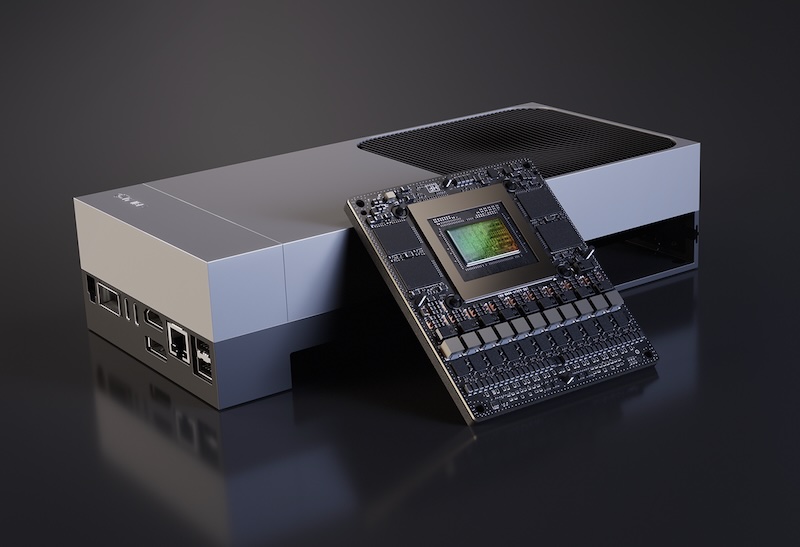
NVIDIA kicked the week off by announcing Jetson Thor’s general availability. The long-awaited robotics compute module is now available both as a developer kit and for straight-to-production manufacturing.
The Blackwell GPU forms the core of the upgrade from 2022’s Jetson Odin. That comes coupled with 128GB of RAM and 2,070 FP4 teraflops of AI compute. Much of power is aimed specifically at empowering on-device generative AI processing, where possible. According to NVIDIA, Thor manages up to a 7.5x AI compute increase with 3.5x greater energy efficiency than Jetson Orin, when running modern AI models.
“I think where the industry is looking right now is fundamentally using multi-modal reasoning models,” NVIDIA’s VP and GM of Robotics and Edge AI, Deepu Talla, told me recently. “It’s LLMs (large language models), VLMs (vision language models) – of reasonable size, because you’ve got to run it at the edge inside the robot brain.”
Thor marks the most recent addition to the robotics development ecosystem the company has been compiling for just over a decade.
“We have a saying inside NVIDIA – ‘if you’re not at least 10 years before a market or a technology takes shape, you’re probably late,’ ” explains Talla. “I think it was perfect timing for us to jump into physical AI and autonomous robotics applications.”
In hindsight, NVIDIA was uniquely positioned in 2014, when it pulled back on smartphone processors, and opted instead to invest a decade out on automation. Experience in gaming graphics set the company up well to create training simulations. NVIDIA also boasts tremendous knowhow around compute, manufacturing, and developer relations that have become essential to the platform’s growth.
Tallu points to the 2.2 million developers across 7,000 companies that have engaged with Jetson – numbers that would have been unheard of in robotics when the platform launched a decade ago.
Much of the excitement of late is centered around humanoid robots, a fact that NVIDIA has happily embraced. It seems like every time CEO Jensen Huang takes the stage at an official event, he is flanked by an ever-larger army of the machines. Interest in the form factor has grown in tandem with generative AI.
Proponents believe foundational models like VLMs and VLAs will usher in more general-purpose systems, with humanoids serving as the primary embodiment. While some skeptics have warmed up to the formfactor, many believe bipedal systems currently occupy a disproportionate segment of the spotlight.
Tallu notes that, while he, Huang, and NVIDIA are true believers in humanoids, future robots will continue to be represented by a diverse array of form factors. “It's pretty logical to expect that there will be multiple embodiments,” he says.
The executive adds,
The beautiful thing about what's happening with humanoids, is that -- even though some might feel like we are pushing it way too much and it's hype -- because of the opportunity, the best in the world are gravitating towards it to solve the number one problem that we need to solve, which is to create a general-purpose brain. Testing the general-purpose brain in a humanoid form factor makes logical sense because in the last 200 years, we have built the whole world around human form factors.
In other words, go where the excitement is. Work on humanoids will have a far reaching impact on automation, embodied AI, and robotics, generally. One form factor may be hogging a disproportionate amount of money and brainpower, but investment in robotics is not a zero-sum game. Genuine technological breakthrough will move the industry forward at large.
Association for Advancing Automation
Discover how Association for Advancing Automation can support your automation journey with their complete range of solutions and expertise.
Visit Company Website


Automation Empathy: Russ Tedrake on Physical AI's Human Impact
MIT professor and former TRI researcher Russ Tedrake discusses how physical AI can support human labor.
From Research Rockets to One Million Robots
Tye Brady discusses his journey, from working on rockets at MIT, to helping Amazon build a one million-plus fleet of
NVIDIA Declares 'Big Bang of Physical AI' at GTC 2026
The chip giant made big announcements across autonomous driving, robotics, manufacturing, simulation, and more.