
Industry Insights
Automation Empathy: Russ Tedrake on Physical AI's Human Impact
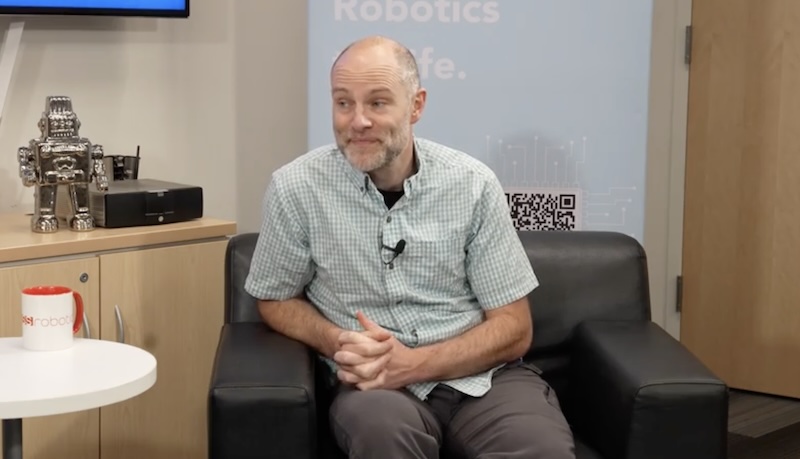
“If we're successful, if the field is successful, then it's going to change the very nature of work for people,” Russ Tedrake says. It feels like hyperbole at first blush, but it’s hard to find fault with the sentiment. "If the field is successful" is a big and important qualifier, of course, requiring tremendous time, money, and brainpower to materialize. But the promise of physical AI and robotics is one of true transformation, and all the good, bad, and unexpected that brings.
As our conversation winds down, however, the researcher mentions empathy, a word too seldom mentioned in this context.
“What are the implications for the future of factory work?” Tedrake posits. “How do we help people age in place more gracefully? It has really shaped the way I think about this. I'm spending a lot of time these days talking to labor economists and spending time with people that I think could be potentially impacted, and just trying to build my empathy muscles and build my understanding.”
A longtime MIT professor and TRI employee, Tedrake says the concept is a big piece of what ultimately pulled him into the startup world. He points to the impact generative AI has already had on the design and art world. While proponents of these technologies argue that they have served to democratize access to previously “gatekept” fields, society continues to grapple with the question of how to support those skilled artisans who have built lives around such talents.
“I can make art in a way that I couldn't a couple of years ago,” says Tedrake. “What is that going to look like in the physical world? We're going to have a lot of tasks that would have been very hard to automate before that are suddenly vibe codable almost. We'll have top craftspeople that could do magnificent things more quickly with super tools. But how does that change a culture that distributes wealth through labor? That people's sense of worth, sense of purpose often comes through the job that they've taken. We have to think very carefully about that.”
Tedrake believes that “a thoughtful physical AI company could change the way that plays out.” The researcher adds, “You have to spend time helping people understand what the tools are capable of, helping them adjust using the best parts of what they can do and amplifying that with proper tools. I think we have to solve this for artists, we have to solve this for software engineers, and we're going to have to solve it for physical labor too.”
Tedrake’s connection to that world pre-dates his study in robotics. Growing up outside Detroit, his father was a mechanical engineer who helped invent anti-lock brakes for light trucks. An internship at a Ford assembly plant in Fort Wayne found the future roboticist developing some homebrewed automation, designed to control airflow.
“I was the junior guy on the totem pole,” Tedrake says. “When somebody had to climb into the sludge pit with the sensor, that was my job the first time. I did work up to writing some of the initial codes that would sort of automate the systems. The most defining part of that experience for me was the day that my — I thought — clever code, which when there was an exception, like somebody tripping over an ethernet cable, I thought the safe thing to do would be to turn off the air fans. Velocity, airspeed go to zero.”
It was an important lesson on real-world consequences. “It was the wrong thing to do because the temperature in the booth went from 81 to 82 degrees, which was the unionized threshold when people walked off the line because they didn't have to work at 82 degrees,” Tedrake adds. “I got yelled at. I really learned a hard lesson that day about what it means to stop the line in an automotive plant. I grew up a lot that summer.”
Arriving at the University of Michigan, Tedrake found a robotics program in-flux. “Dan Koditschek had been leaving right around then,” he explains. “John Laird was studying AI there. I worked with him and the closest thing to robotics I could get into at the time was doing AI for video games. I spent a summer at Microsoft Research doing AI for video games at Microsoft Research.
His robotics work accelerated at MIT, when he began to study under future manager, Gill Pratt, at the school’s legendary Leg Lab. Here, alongside future luminaries like Jerry Pratt, Dan Paluska, and Peter Dilworth, Tedrake shifted focus to bipedal robots. That work began to incorporate concepts that would soon be regarded as essential aspects of robot intelligence.
“I used reinforcement learning back in the day before it was cool,” Tedrake says with a smile. His work on the passive-dynamic Robotic Toddler that made headlines for its ability to walk without any prior information baked into the system’s control.
“That was the first time in a handful of years that we had seen RL and learning working on real robots. So that got people kind of excited. But there was still a lot of skepticism. I mean, used to teach in my class, I used to teach a whole curriculum of robotics. I had a third of the class was set up for reinforcement learning. And you could tell people were just kind of like, yeah, I don't really care. I don't think this is going to go the distance. Reinforcement learning is a cute idea, but it's not gonna really work, and then actually kind of slowly weeded out of the curriculum because people just didn't seem that interested.”
Breakthroughs in compute, manufacturing, sensors, and AI have profoundly changed notions around robotic development over the past decade.
“There's a voice of skepticism in the air, there's a voice of enthusiasm in the air,” Tedrake says. I think in my mind, a number of incredible things have happened all at the same time, and it makes me extremely optimistic. Almost nobody doubts that robotics will change our world dramatically. I think the biggest question is when. We have a bunch of energy, bunch of momentum.”
That momentum, in turn, has led massive sums of capital and talent to enter the worlds of robotics and physical AI.
“It's incredible what's happened in China in terms of the ability to manufacture these very capable devices at cost,” Tedrake adds. "The world needs this technology in certain ways. [I] mean, the changing expectations for work, the silvering society. There's so many things that sort of have aligned to make me think that the field has an incredible opportunity. I feel like there's no question we're shooting for the moon. Do we have escape velocity? I think so. I think this is the time that it's really different.”
Association for Advancing Automation
Discover how Association for Advancing Automation can support your automation journey with their complete range of solutions and expertise.
Visit Company Website


Skild’s Brain Helps Injured Robots Learn To Limp
The founders of the well-funded startup discuss the limitations of current robotic training.
Robots Learn to Share Skills Across Embodiments
Researchers have determined a way to help different robot configurations share learned skills.
FieldAI is Building Embodied Intelligence For the World's Harshest Terrains
FieldAI's CEO discusses the company's cosmic backstory and why construction is the right path forward.