
Industry Insights
Robots Learn to Share Skills Across Embodiments
Upgrading robotic fleets usually requires new hardware and reprogramming tasks. Even when two robots have been designed and installed to perform the same task, they're often still distinguished by different physical features. This means a task programmed for one, might not function correctly on another.
Researchers from Swiss Federal Technology Institute of Lausanne (EPFL) have developed a new framework called "Kinematic Intelligence," that enables robots to learn new skills without rewriting code, even when their mechanical designs differ.
“The motivation came from a very practical limitation in robotics: transferring a skill from one robot to another is still surprisingly difficult. Even when robots are designed for similar tasks, small differences in their structure mean that a skill needs to be reprogrammed from scratch” says Sthithpragya Gupta, one of the researchers in this latest study.
“A lot of recent work tries to address this using larger AI models and more data. While powerful, these approaches can be data-intensive, computationally expensive, and sometimes unpredictable in safety-critical settings,” says Gupta “,we took a step back and instead of adding more complexity, we wanted to see if we can better understand what fundamentally governs how robots move. This led us to focus on robot kinematics, where the structure of its constraints enabled reliable skill transfer”.
The framework was created by capturing human-demonstrated object manipulation tasks ― such as pushing, placing, and throwing ― with motion-capture technology, before mathematically converting them into a general movement strategy. This can then be adapted to different robots, alowing the tasks to be performed across a range of physical designs.
A systemic classification was also developed of the physical limits of different robot designs, including how much joints can move before they become unstable. The framework works within these limits to tailor the general movement strategy to the specific robot body to ensure that it remains stable when performing the task.
By embedding an understanding of the system’s structure directly into the control framework, the researchers achieved scalable and reliable behavior with significantly less complexity than when other control frameworks have tried to use large data models and AI for transferring skills between robots.
A learned skill can effectively be transferred from one robot to another, while ensuring that the new system performs the task safely and in a predictable manner. “Robot kinematics can serve as a unifying foundation for transferring skills across different robots,” says Gupta. "We’ve shown that it is possible to learn a task once and execute it across multiple robots without robot-specific tuning or retraining and the framework allows robots to automatically adapt their motion strategies based on their own physical structure."
ROI Calculator

Discover the potential cost savings of robotic automation over a 20-year system life
This calculator compares your current manual labor costs against the total cost of owning and operating a robotic system over its 20-year lifespan.
Gupta told A3 the framework is needed because, “as robots move beyond controlled industrial settings into more dynamic environments, such as manufacturing, logistics, assembly, inspection, and human-centered workspaces, the need for flexibility becomes critical. Deploying robots at scale is limited by the effort required to program and adapt them individually. If every new robot or configuration requires re-engineering the same skill, the process will be slow, costly, and not scalable”.
There is also an increasing need for reliability and predictability in robotics. In many real-world applications, especially those involving human interaction, systems must behave consistently and safely. This framework addresses both challenges because it enables transfer of skills across different robots without reprogramming and it ensures consistent and interpretable behavior, grounded in the robot’s physical capabilities rather than learned approximations.
When asked about where robotic platforms with Kinematic Intelligence could be used, Gupta told A3 that, “the framework enables non-expert users to efficiently teach tasks to robots with different designs and is applicable to six- and seve-axis wrist-partitioned robots that make up most of the existing industrial designs. Some key applications include flexible manufacturing where robots are frequently replaced in production lines, warehousing and logistics systems that have regularly changing layouts and robotic fleets, and service robots operating in less structured public space environments."
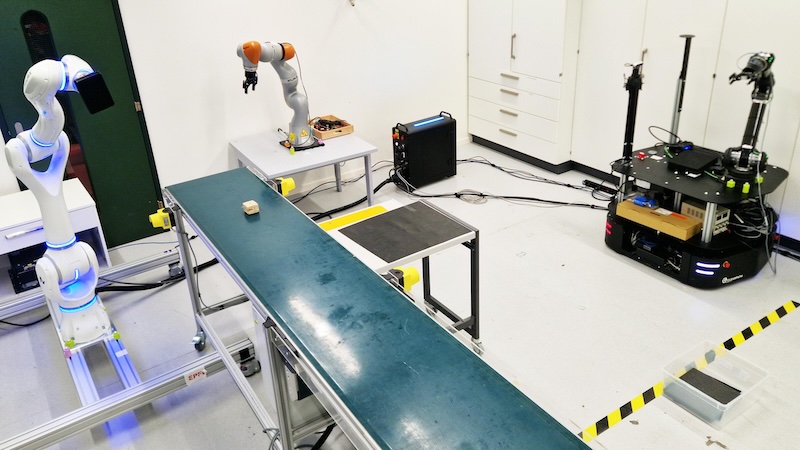
The researchers tested the framework in an assembly line experiment where a human first demonstrated a task that the robots had to complete. This task involved pushing a wooden block off a conveyor belt onto a workbench, followed by placing it on a table, and then throwing it into a basket. Using the Kinematic Intelligence framework, three different commercial robots handled different steps of the task, and all the tasks were reproduced safely and reliably. Each robot interpreted the skill in its own way, but they all operated within safe limits.
When asked about what’s next for the research, Gupta concluded the interview with A3 by stating that ,“the current work establishes the foundation for transferring skills across a broad class of robots based on their kinematics. The goal is to move toward robotic systems that can learn efficiently, adapt across platforms, and operate reliably in real-world environments without extensive reprogramming. Going forward, we plan to extend the framework to other serial robot designs and integrate the framework with perception and real-time feedback, so that robots can adapt not just to their structure but also to dynamic environments”.
Association for Advancing Automation
Discover how Association for Advancing Automation can support your automation journey with their complete range of solutions and expertise.
Visit Company Website


The Model’s the Thing: Dyna’s AI-first Approach to Building Humanoids
After raising $120 million, the company is taking on laundry folding.
FieldAI’s CEO On The Startup’s “Physics First” Embodied AI
The startup discusses its unique approach to empowering different robot form factors.
How Foxglove is Navigating Robotics' Data Gap
Founded in 2021 by former Cruise employees, Foxglove is designed to take on a massive data crunch facing physical AI.