
Industry Insights
FieldAI’s CEO On The Startup’s “Physics First” Embodied AI
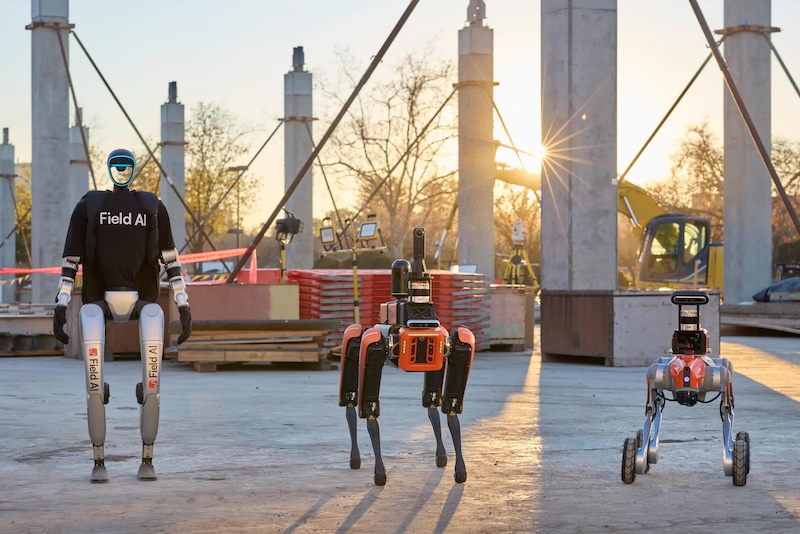
Ali Agha describes it as FieldAI’s “aha moment.” Still, it would take another two years before the company nailed down the architecture for its FFMs (field foundational model). The CEO is quick to distance the term from the similarly initialed LLMs (large language models), which much of the competition is attempting to backward engineer into automation.
“It’s a very physics-first mentality,” he says of FieldAI’s models. “We don’t take a gigantic neural network and pass a lot of data and hope for success as we’ve done in ChatGPT. We don’t rely on one pure end-to-end model to pass raw data from one side — like LiDAR and raw images — and get the motor velocity, actions, and torque, on the other end.”
The approach has garnered interest from investors and customers, alike. On the former, FieldAI came out of semi-stealth just under a month ago by announcing it had raised $405 million over a quiet couple of rounds. Notable supporters include Bezos Expeditions, BHP Ventures, Canaan Partners, Emerson Collective, Intel Capital, Khosla Ventures, NVentures (NVIDIA), the Gates Frontier, and Samsung.
Being able to meaningfully reference embodied AI in the first sentence of your pitch deck is something akin to a VC blank check these days, but the OC-based startup has something even more important when it comes to sustained funding: deployments.
“These are massive customers,” Agha says, maintaining client confidentiality. “These are among the top three or five construction companies in Japan and the U.S., each of which can have hundreds of sites and deploy thousands of robots – potentially. Similarly, we’re with the largest energy providers in the world.”
Agha claims that — over the 18 in which the systems have been deployed — customers have seen sufficient enough ROI to expand existing partnerships into “multimillion-dollar contracts.”
Part of that success, according to Agha, is the “training wheels” afforded by the company’s FFMs. He believes the physics first approach outfits the systems with edge processing that allows the system to navigate in unknown, unstructured environments without posing significant safety concerns. While systems are always prone to certain errors, Agha says further refinement through real-world data collection is largely about improvements to speed and performance.
The technology driving FieldAI’s work stems from Agha and CTO David Fan’s background at NASA’s Jet Propulsion Laboratory. Agha arrived at JPL by way of Qualcomm, through his drone work. He joined the space agency to work on a then-classified Mars helicopter — and really, who can blame him? Further Martian projects found the team working on robots designed for navigating underground caves, where extraterrestrial life might be sequestered away from the harmful space rays.
The challenge of relying on edge compute to navigate unstructured environments helped the pair find themselves among the winners of DARPA’s Subterranean Challenge. That, in turn, set them on the path to developing a kind of “single brain” physical AI. The hardware agnostic system is designed to be deployed across a wide range of robotic form factors, differentiating FieldAI from those companies building specialized models for different embodiments.
That gets to another foundational piece of the company’s approach, allowing different robot form factors to work in tandem with one another. This element is especially useful for search and rescue deployments, where legged and wheeled robots can work together with drones to access areas prohibited by the others’ form respective form factors.
Other use cases include inspection, construction, and engineering — you’re standard dull, dirty, and dangerous robot gigs.
Association for Advancing Automation
Discover how Association for Advancing Automation can support your automation journey with their complete range of solutions and expertise.
Visit Company Website


ABB Robotics Partners with NVIDIA to Deliver Industrial-Grade Physical AI at Scale
ABB Robotics is integrating NVIDIA Omniverse libraries into RobotStudio to help manufacturers deploy physical AI in real world robotics applications.
Bridging the Gap: Why Software Architecture is the New Bottleneck for Physical AI
A newly released Architecture Benchmark Report by QNX, which surveyed 1,000 global robotics developers, finds that hardware is no longer the primary constraint.
Why Generalist is Starting With Robotics' Hardest Problem
The startup's CTO discusses breakthroughs and training for real world settings.