
Industry Insights
The Model’s the Thing: Dyna’s AI-first Approach to Building Humanoids
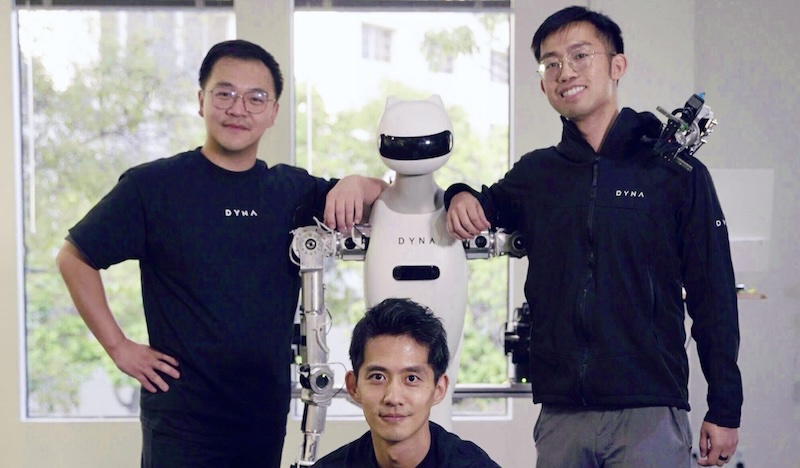
If you stumble into a laundromat somewhere in the United States, there’s a chance — albeit an infinitesimally small one — you might encounter an early version of Dyna’s robot. Keep your distance, and you can watch the system in action, performing an essential link in the laundry chain that is nearly always performed by human hand. Get within, say, a foot of the robot, however, and it will stop. No one wants a human flesh bag within the swinging distance of two metal appendages.
Laundromats are the one pilot founder Lindon Gao is ready to discuss, and even that part of the conversation is left intentionally vague. Announcing pilot partners is a big, resource intensive process unto itself. We do know, however, that Dyna didn’t walk around the neighborhood trying to hard sell ma and pop coin-op laundries on hiring a robot folder.
Rather, the nature of the deployments seems to revolve around locations that process commercial laundry by the pound. These are spots that wash bedding and pillowcases for hotels, and blankets and uniforms for airlines in bulk. In other words, it’s precisely the sort of laundromats that would most benefit from automating folding the way the industry has both washing and drying.
In this sense, Dyna isn’t a huge leap from Gao’s previous company, Caper. He describes the New York startup’s founding principle as “a very contrarian thesis to Amazon Go,” the retail giant’s cashier-free bodega concept. Rather than sticking cameras and various sensors in strategic spots around the store, however, Caper built a smart shopping cart.
Instacart dug the idea. In fact, the grocery delivery service was so amped up by pandemic-fueled windfall, it went ahead and bought Caper for a cool $350 million in late 2021. Gao stuck around at Instacart until late 2024, which gives you an idea of the very short timeframe in which Dyna has ramped up operations.
The CEO notes in a recent blog post,
NEW ONLINE TRAINING COURSE
Designing Industrial AI Agents
Gain the skills to orchestrate advanced AI agents that learn, adapt, and collaborate like experts in real-world automation environments
Our focus has been on developing infrastructure that enables rapid training, evaluation, and deployment, at both the architectural and data levels. At DYNA, we run hundreds of model variants weekly across offline and online evals. Over time, this compounding cycle of rapid iteration, evaluation, and deployment becomes our ultimate competitive advantage.
The Bay Area-based firm has also done so with a lean headcount of around 30. While some of that sizeable $120 million Series A the company just raised will go toward building out the staff, Gao stresses Dyna’s extremely deliberate approach to hiring.
“We have a really, really, really high talent bar,” he tells me. “What you realize is that when your team is really not that big, but talent density is super high, you get things done a lot faster because there's a lot less communication managerial overhead.”
In this instance, “getting things done” refers to the joint development of in-house embodied AI models and hardware designed specifically for them to run on. Notably, Dyna is not a graduate of the cross-embodiment school, which is precisely why the company is building its own robot.
“We're only going to have one hardware and that one hardware is going to be able to perform very, very well with our own model,” says Goa. “So, it's an end-to-end build and the reason why we believe that is true is because when you are building robotics, you will realize that different hardware has different actuation, has different control stacks, has different firmware and so forth. You cannot fully draw out the performance.”
He's quick to add, however, that Dyna prioritizes its embodied AI research over its humanoid hardware work. “We are a model first company,” he explains. “The model is the most important thing, because that's the core of our research and engineering. That's what we put most of our time into.”
Association for Advancing Automation
Discover how Association for Advancing Automation can support your automation journey with their complete range of solutions and expertise.
Visit Company Website


Genesis AI goes minimalist humanoid with Eno
The robot is shipping to early customers in the second half of 2026.
Physical AI Hits the Factory Floor: Predictive Optimization for Chemical Processes
Physical AI applies predictive optimization to chemical manufacturing, enhancing efficiency, reducing waste, and improving factory-floor operations.
Automation Empathy: Russ Tedrake on Physical AI's Human Impact
MIT professor and former TRI researcher Russ Tedrake discusses how physical AI can support human labor.