
Industry Insights
Genesis AI goes minimalist humanoid with Eno
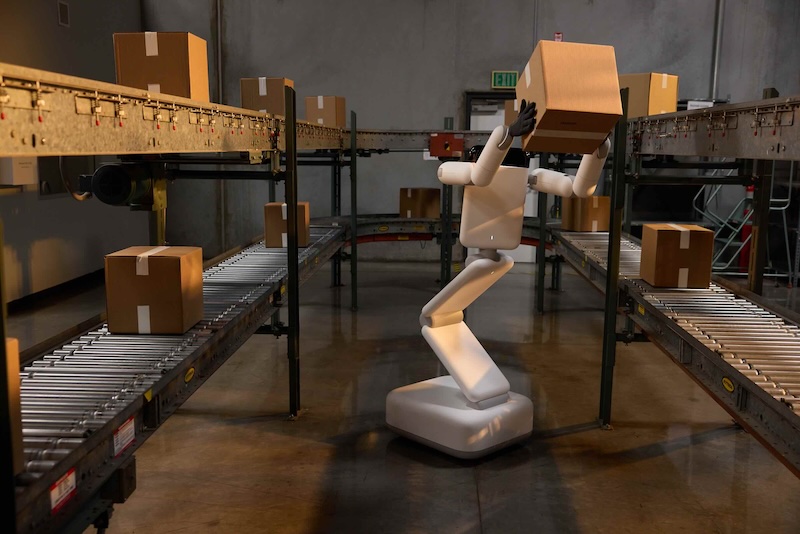
July 1 marks a year since Genesis AI emerged from stealth with $105 million in seed funding. Examining the size and volume of massive physical AI funding rounds that have emerged in the intervening months, it’s easy to lose sight of how massive that amount is — particularly when dealing with the seed stage.
It’s true that the unfathomable sums of money being funneled into the space are the product of substantial hype surrounding concepts of generalized AI, but there’s another phenomenon worth examining here. A major motivating factor is a bid by many to launch a full stack solution.
In my consumer electronics days, we would frame the conversation in terms of iOS verses Android. It’s massively expensive upfront to build a stack, but the theory goes that building hardware and software under the same roof creates a more unified experience. Your own mileage will vary, but Microsoft and Google have clearly seen enough value in concept to attempt similar models with Surface and Pixel, respectively.
Robotics has historically been more fragmented for myriad reasons, but —– particularly in a world of general-purpose systems/humanoids — firms are increasingly seeing the value of the full-stack approach. This marks a shift in philosophy from a robotics world that was far more likely to embrace off-the-shelf components. But again, that’s a robotics world where funding rounds in the hundreds of millions of dollars were unheard of.
It should be no surprise that many of these well-funded physical AI firms are taking their own crack at general purpose systems. Rhoda AI is a good example of a top tier firm that has announced its intentions to launch a humanoid in the near future. Today, Genesis AI is doing precisely that with Eno, a “a next-generation robot” the company says is “the culmination of Genesis AI’s full-stack approach to building robots that operate seamlessly across industrial and consumer environments, with human-level capabilities.”
“Customers love the full stack approach,” the company’s VP of commercial and strategy told me on a recent call. “You can imagine it's impossible for them to say, ‘let me do it piecemeal. I will pull the foundation model from this, the hardware from this, data from this. It doesn't work like that.”

Get the Training You Need for a Safer Workplace!
Autonomous mobile robots are one of the fastest-growing segments of the robotics industry. During this live virtual training, you'll be introduced to safety protocols and best practices for working with mobile robots in industrial settings.
Learn more and register now for upcoming training dates.
Eno represents an aesthetic break from just about every other humanoid we’ve seen. It was pitched to me as looking a bit like an Apple approach to robot design, a nod to the minimalist aesthetic. Paring the design down has a number of potential upsides, including a reduction of pinch points and ease of manufacturing. As a matter of personal preference, I also appreciate anything that breaks from the more dystopian design we’ve seen from earlier industrial humanoids.
While I have been dropping the “h” word thus far, I admit that Eno is really testing the boundaries of how we’re defining humanoids. A bi-dexterous mobile manipulator suffices here as well, in the absence of not only legs, but also any head to speak of. Turns out the robot’s brain is located in the wheeled base. The base itself, meanwhile, looks to be fairly narrow, addressing one of the bigger concerns surrounding wheeled humanoids.
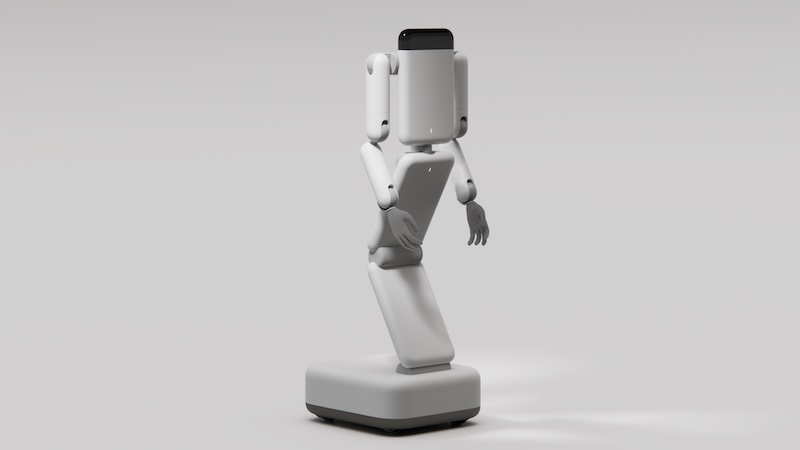
The size of the base required to maintain balance is considered by many to be a non-starter for some of the narrower aisles. Sun adds that Genesis has “definitely not ruled out” the possibility of a legged version, should customers demand it. Speaking of which, the company will be deploying this version of Eno to “a few select customers” in the H2. Given that this news is dropping on June 16, that gives us 5.5 months to make good.
One of the more interesting elements I pointed out here is the contrast between the overall minimalism of Eno’s design and the complexity of its five-fingered hand. The latter is due to Genesis’ training methods, which required a close human hand analog for transferring realworld training. When I ask whether these two elements are at odds, Sun posits that — head aside — the upper part of the robot (torso, up) is both rather complex and analogous to that of a human.
“The upper body, if you look at, you know, is quite similar to human in terms of your arm, how many joints,” says Sun. “How many motors and your hands in terms of how many degrees of freedom, and then the size. The upper body, if you can look at it from a functionality perspective and the capability and the size and the make and form of the human, is actually very similar.”
Association for Advancing Automation
Discover how Association for Advancing Automation can support your automation journey with their complete range of solutions and expertise.
Visit Company Website


OnLogic to Showcase Practical Physical AI and Full-Facility Workload Consolidation at Automate 2026
Industrial computing leader cuts through cloud AI hype with live edge use cases, next-generation Intel® Core™ Series 2 processing previews, and ultra-compact solutions for space-constrained environments at McCormick Place, Booth 867.
Rhoda AI CEO on Video Training: I Don't Think the World is Going Back
A new approach to video training could help robots generalize faster.
FieldAI is Building Embodied Intelligence For the World's Harshest Terrains
FieldAI's CEO discusses the company's cosmic backstory and why construction is the right path forward.