
Industry Insights
NVIDIA Declares 'Big Bang of Physical AI' at GTC 2026
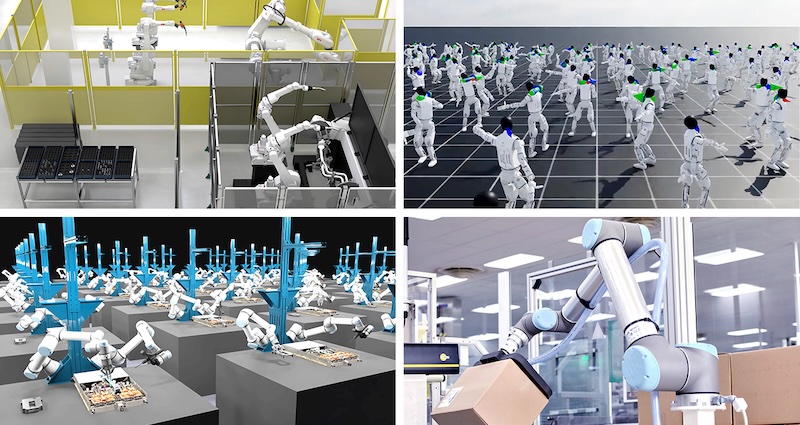
If you came to GTC 2026 for understated expressions of technology, good news, the Rosicrucian Egyptian Museum is walkable from here, and it’s a pretty good way to kill an afternoon. Those looking for some neon green bombast, on the other hand, have come to the right place, as NVIDIA proudly declared, “the big bang of physical AI has started.” Surely this means Gil Pratt’s “Cambrian explosion of robotics” can’t be too far behind (whatever 13 or so billion years amounts to in tech terms). The chip giant just unveiled updates to some of its key properties in the space, including new versions of Cosmos world models, NVIDIA Isaac simulation frameworks, and NVIDIA Isaac GR00T N models.
The news also sees a veritable who’s who of robotics firms partnering with the company. What’s notable here isn’t the number of names, so much as the breadth of categories, ranging from industrial stalwarts to humanoid and physical AI startups. The list includes (in alphabetical order, mind) ABB Robotics, AGIBOT, Agility, FANUC, Franka Robotics, Figure, Hexagon Robotics, KUKA, Skild AI, Universal Robots, World Labs, and YASKAWA. While much of the coverage around the companies physical AI plays have focused on “general purpose” form factors, this list includes tentpoles of the industrial arm world, including ABB, Fanuc, KIKA, UR, and Yaskawa. Those partnerships are focused on Omniverse libraries, Isaac sim, and Jetson modules for controllers.
NVIDIA’s Physical AI Data Factory Blueprint is Designed to Improve Robot Training Data
One of the biggest hurdles standing between physical AI and its “ChatGPT moment” is a lack of quality data. A big part of the reason LLMs have been such a massive – and often surprising – success is the fact that humans have essentially been creating training data for 100,000 years or so. The same can’t be said for the input required to train robots. NVIDIA is among the companies working to address the gap, and this morning at GTC the company announced Physical AI Data Factory Blueprint, an open reference architecture designed to improve how both real-world and simulated data is gathered, shaped, and assessed. The company has already recruited some big names from across autonomous driving and robotics, including FieldAI, Hexagon Robotics, Linker Vision, Milestone Systems, Skild AI, Uber, and Teradyne Robotics.
The platform is host to number of processes designed to do right by the real and synthetic robot data alike. There’s Cosmos Curator, which processes and annotates datasets, Cosmos Transfer, which is designed to address edge cases and long tail scenarios, and Cosmos Evaluator, which, you know, evaluates data. “Physical AI is the next frontier of the AI revolution, where success depends on the ability to generate massive amounts of data,” says Omniverse VP, Rev Lebaredian. “Together with cloud leaders, we’re providing a new kind of agentic engine that transforms compute into the high-quality data required to bring the next generation of autonomous systems and robots to life. In this new era, compute is data.”
NVIDIA Partners with FANUC, Mercedes Pepsi, Samsung for Industrial Manufacturing AI
Self-driving cars and humanoids tend to hog the headlines at these events, but this morning at GTC, NVIDIA announced new offerings designed to accelerate industrial manufacturing. The news features big name partners, including some top industrial robotics firms, chip fabs, and automakers: FANUC, HD Hyundai, Honda, JLR, KION, Mercedes-Benz, Mediatek, PepsiCo, Samsung, SK Hynix, and TSMC. All of the above will be deploying NVIDIA’s CUDA-X and GPU-accelerated software to improve manufacturing, engineering, and design. Each will also be deploying NVIDIA’s agentic AI for customer interfacing.
“The dawn of a new industrial revolution has arrived, where physical AI and autonomous AI agents are fundamentally reinventing how the world designs, engineers and manufactures,” per NVIDIA CEO, Jensen Huang. “Uniting our global ecosystem of software giants, cloud providers and OEMs, NVIDIA is delivering a full-stack accelerated computing platform that empowers every industry to turn this vision into reality at a scale and speed never before possible.”
NVIDIA Taps T-Mobile’s edge network for ‘AI Infrastructure’
NVIDIA also announced partnerships with T-Mobile and Nokia designed to showcase the use of edge networks for executing physical AI applications. As part of the pilot, the carrier will utilize NVIDIA’s RTX PRO 6000 Blackwell Server Edition to run applications in San Jose – not coincidentally, the site of GTC and the chip giant’s hometown. “Telecommunication networks are evolving into the AI infrastructure enabling billions of devices — from vision AI agents to robots and autonomous vehicles — to see, hear and act in real time,” NVIDIA CE, Jensen Huang, notes in a release tied to the news. “By turning the 5G network into a distributed AI computer with T-Mobile and Nokia, we’re creating a scalable blueprint for the world’s edge AI infrastructure.”
Applications for the deal include “City Operations Agents,” a smart city offering designed to simulate and optimize traffic light timing to improve response rates. Drone firm Skydio and AI partner, Levatas, are looking into AI-RAN (artificial intelligence—radio access network) to improve utility inspection efficiency and storm recovery times. Fogsphere and oil drilling firm, SAIPEM, meanwhile, are using the technology to improve disaster detection and response times.
Association for Advancing Automation
Discover how Association for Advancing Automation can support your automation journey with their complete range of solutions and expertise.
Visit Company Website


Super Models: Skild.AI is Building a Big Robot Brain with $1.4B in Fresh Funding
Cofounder and president, Abhinav Gupta, discusses the startup's work to build a hardware agnostic model.
NVIDIA’s Jetson Thor Robotics Computer is Now Available
NVIDIA's latest is aimed at humanoid robots and physical AI.
Flexiv and NVIDIA Join Forces in Robotics Simulation
Flexiv launches the Flexiv-Isaac Bridge App, empowering developers to design, test, and deploy force-controlled robotics applications in hyper-realistic virtual environments.