
What Are Autonomous Mobile Robots (AMRs)?
Autonomous Mobile Robots (AMRs) are smart vehicles that use onboard sensors, mapping, and artificial intelligence to navigate facilities, handle materials, and perform tasks without relying on fixed infrastructure. Unlike traditional automated guided vehicles (AGVs), which follow preset paths, AMRs make real-time decisions, adapt to changes, avoid obstacles independently, and choose the best routes based on surrounding conditions.
AMRs combine technologies like lidar (for sensing the environment), cameras (for object recognition), and inertial sensors (for tracking movement), all guided by advanced mapping and navigation software. This allows them to safely share space with people, forklifts, and equipment. AMRs are ideal for a range of industries, including manufacturing, warehousing, healthcare, and retail. Modern AMR fleets collaborate autonomously, recharge as needed, and adjust to facility changes without extra programming.
How Do AMRs Navigate Without Fixed Infrastructure?
AMRs navigate using SLAM (Simultaneous Localization and Mapping) algorithms that build digital maps from sensor data while tracking the robot's position. They combine this with dynamic path planning to calculate clear routes, adjusting instantly to any changes or obstacles they encounter.
SLAM and Path Planning
To get started, an AMR drives around the facility, scanning and mapping walls, fixtures, and aisles. This usually takes just a few hours. Once up and running, the robot continually compares what its sensors see to its map, so it always knows its location by using SLAM. As conditions in the facility change, the robot's maps update automatically.
AMRs use smart algorithms (like A* or Dijkstra's) to plan the best routes through their environment. As they move, sensors detect new obstacles, such as people, equipment, or other robots, and the AMR instantly adjusts its path. If something blocks the way, it quickly finds a new route. The robot doesn't just look for the shortest path; it also considers things like travel time, floor quality, traffic, and battery life to make the smartest decision.
Sensor Fusion for Robust Navigation
AMRs combine multiple sensor types for reliable localization:
- Lidar: Provides 2D or 3D distance measurements creating geometric map representations, working reliably regardless of lighting conditions
- Cameras: Capture visual features supplementing geometric localization and enabling QR code reading for precise positioning at specific locations
- Inertial measurement units: Measure robot motion and orientation changes, providing positioning data between sensor updates
- Wheel odometry: Tracks distance traveled and heading changes, particularly during straight-line travel
The robot's software decides which sensors to trust most depending on the situation. For example, in tight aisles, lidar is usually best. In open spaces full of unique features, cameras take the lead. This system keeps AMRs moving even if one sensor has trouble.
What Sensors Do AMRs Use for Perception and Safety?
AMRs stay safe by using lidar scanners that see in all directions, 3D cameras to spot objects at different heights, certified laser scanners to trigger emergency stops, ultrasonic sensors to catch transparent objects, and bumpers as a final layer of protection. This multi-layered approach helps AMRs avoid accidents in busy environments.
Lidar (Light Detection and Ranging)
Lidar serves both navigation and safety functions. 2D scanning lidar mounted at a fixed height (typically 200-400mm above the floor) scans a horizontal plane, measuring distances to objects in all directions. 3D lidar creates point clouds detecting objects at various heights from floor level to 2+ meters, preventing collisions with shelves, low-hanging obstacles, or elevated platforms.
Safety-rated lidar certified to functional safety standards (SIL 2 or PLd) defines multiple protection zones. Warning zones trigger slowdowns when objects approach, while protective zones trigger immediate stops if objects enter. Field sizes adjust based on robot speed to ensure the robot stops before a collision.
Cameras and Vision Systems
Cameras provide visual perception capabilities:
- Navigation cameras: Capture visual features for localization, recognizing distinctive environmental elements supplementing lidar geometric data
- 3D depth cameras: Detect objects transparent or thin enough to evade lidar detection (e.g. glass walls, thin poles, wire mesh)
- Payload monitoring: Verify load presence and stability, detecting if transported items shift dangerously
- Visual markers: Read QR codes or AprilTags enabling precise positioning for docking with conveyors or charging stations
- Traffic analysis: Detect humans, vehicles, and movement patterns to improve navigation decisions
Ultrasonic Sensors and Contact Detection
Ultrasonic sensors complement lidar and cameras by detecting objects too low for lidar scanning planes, transparent objects, and providing reliable close-range sensing in the 100-1500mm range. Sensors mounted on corners and sides detect obstacles during turning maneuvers.
Pressure-sensitive bumpers around the AMR perimeter provide last-resort safety, triggering emergency stops on contact to catch objects that evaded electronic sensors. After bumper activation, operators must manually inspect and reset the system.
How Do AMRs Differ From AGVs (Automated Guided Vehicles)?
AMRs navigate autonomously using onboard sensors and dynamic path planning, adapting to environmental changes and obstacles in real time without fixed infrastructure. In contrast, AGVs follow predetermined paths defined by magnetic tape, wire guidance, or laser reflectors, requiring infrastructure installation and offering less flexibility but potentially higher positioning precision.
AMR vs AGV: Feature Comparison
| Feature | Autonomous Mobile Robots (AMRs) | Automated Guided Vehicles (AGVs) |
|---|---|---|
| Navigation Method | Onboard sensors, SLAM, dynamic path planning | Fixed infrastructure (e.g. magnetic tape, wires, reflectors) |
| Infrastructure Required | None, uses natural features | Magnetic tape, guide wires, or laser reflector installation |
| Path Flexibility | Dynamic routing adapts paths to conditions | Fixed paths, changes require physical infrastructure modification |
| Obstacle Handling | Autonomous avoidance, dynamic rerouting | Stops and waits, requires obstacle removal or manual intervention |
| Deployment Time | Days to weeks (mapping and configuration) | Weeks to months (infrastructure installation) |
| Layout Changes | Update software maps, no physical changes | Reinstall infrastructure |
| Positioning Accuracy | ±10-30mm typical, ±3-5mm with advanced visual SLAM | ±5-10mm possible with wire/magnetic guidance |
| Initial Cost | Moderate ($25,000-$80,000+ per unit) | Lower to moderate ($20,000-$60,000+ per unit plus infrastructure) |
| Operating Cost | Low, minimal maintenance | Moderate, infrastructure maintenance (tape replacement, reflector cleaning) |
| Scalability | High, add units without infrastructure changes | Limited by infrastructure capacity and complexity |
| Best For | Dynamic environments, frequent layout changes, flexible operations | Predictable routes, high-precision requirements, static layouts |
Key Practical Differences
The key practical differences between AMRs and AGVs involve deployment, flexibility, and obstacle handling.
Deploying AGVs requires installing navigation infrastructure before operation. Installation takes weeks to months, with infrastructure costs ranging from $10,000 to $100,000+, depending on facility size. AMRs require no fixed infrastructure. Deployment involves driving the AMR through the facility to create maps, configuring operational parameters, and validating navigation performance, typically completing in days to 2-3 weeks.
AGV paths are physically defined by installed infrastructure. Changing routes requires physically moving tape, rewiring guide paths, or repositioning reflectors. AMRs adapt to layout changes through software map updates that require no physical infrastructure changes, and adapt in real time to temporary obstacles by dynamically replanning routes.
Traditional AGVs detect obstacles and stop, waiting for obstacle removal. AMRs detecting obstacles autonomously calculate alternate routes, maintaining productivity in shared workspaces. AGVs achieve ±5-10mm positioning accuracy sufficient for precise docking with conveyors or tight clearances, while AMRs typically achieve ±10-30mm (±3-5mm with advanced visual SLAM), which suffices for most material handling but may require wider docking areas. Advanced AMRs use visual markers at critical locations to achieve ±10mm accuracy at specific positions while maintaining flexible navigation everywhere else.
For large fleets or facilities with frequent layout changes, AMRs are more economical due to faster deployment, easy reconfiguration, and no infrastructure maintenance costs.
What Applications Are Best Suited for AMR Deployment?
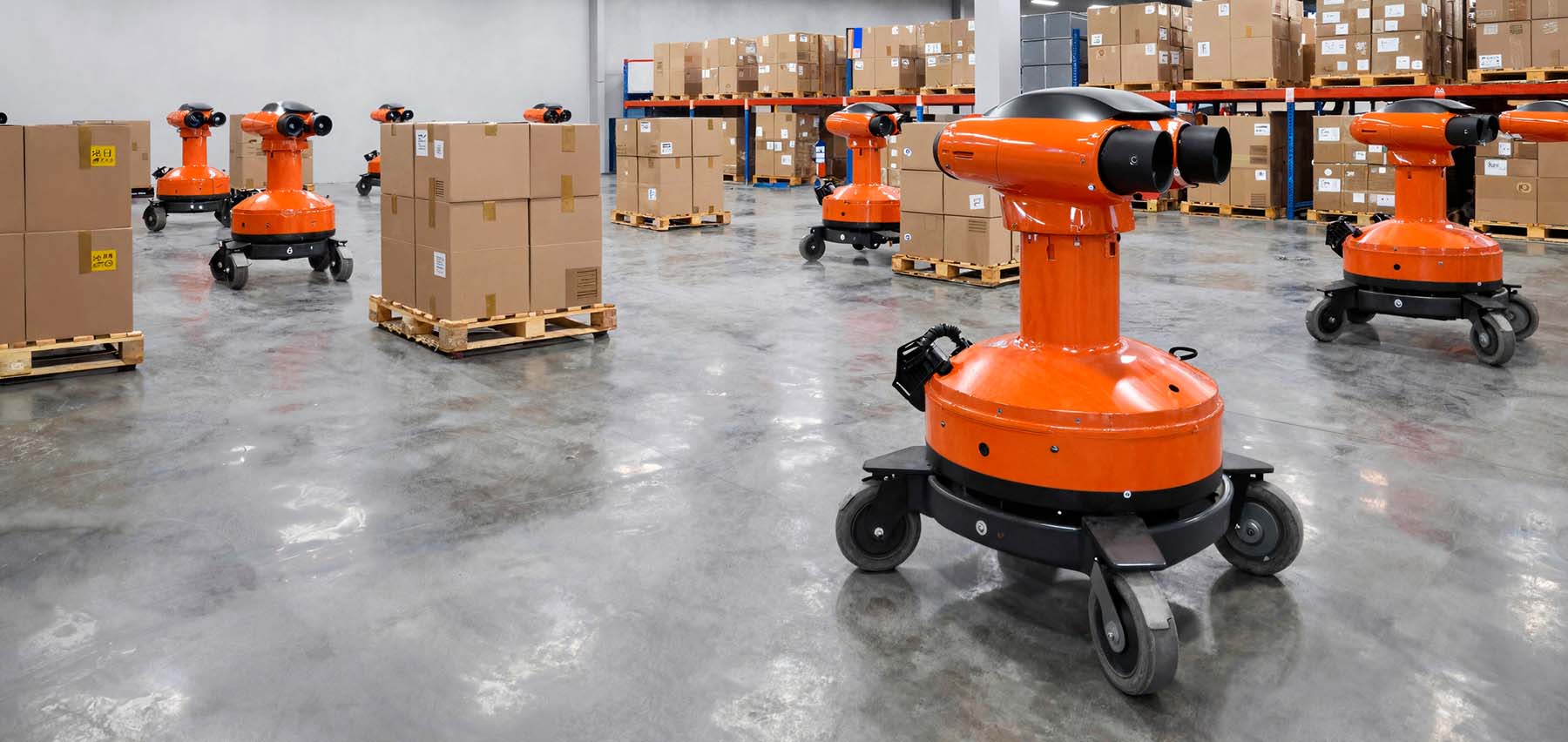
AMRs are best suited for manufacturing material handling, warehouse order picking and transportation, hospital supply and equipment logistics, retail backroom-to-floor restocking, and cross-docking operations. These applications benefit most from AMR's flexibility and autonomous navigation, as they can operate safely in environments with frequent human interaction.
Manufacturing Material Handling
AMRs excel in manufacturing environments requiring flexible material flow. They transport raw materials, components, and subassemblies from warehouses to production lines, adapting delivery patterns through software configuration as production schedules change. Components move between production stages via AMR based on manufacturing execution system (MES) integration, while completed products move to quality inspection, packaging, or shipping areas. AMRs enable just-in-time delivery minimizing line-side inventory by delivering components precisely when needed, benefiting facilities with frequent new product introductions, seasonal demand variations, and layout changes.
Warehouse and Distribution Center Operations
Warehouses deploy AMR fleets for:
- Goods-to-person picking: bringing inventory to picking stations and improving productivity
- Pallet transportation: moving palletized goods between areas while reducing forklift traffic
- Order sortation: routing picked orders to appropriate shipping lanes
- Cross-docking: moving inbound shipments directly to outbound shipping
Warehouses benefit particularly from AMR scalability, as they can add robots during peak seasons without infrastructure constraints.
Healthcare and Hospital Logistics
Hospitals use AMRs to transport medications from central pharmacies to nursing stations and operating rooms, move blood samples and diagnostic specimens between collection points and laboratories, deliver clean linens and medical supplies to patient care areas, and transport meal trays from kitchens to patient floors.
Healthcare environments particularly value AMR autonomous navigation since patients, wheelchairs, beds, and equipment constantly move through corridors, making fixed-path systems impractical.
Retail
Retail facilities use AMRs to transport products from backroom storage to sales floor locations based on inventory levels and promotional schedules, move customer returns from service desks to appropriate backroom locations, and transport picked items to packing stations for e-commerce fulfillment. AMRs operate safely during business hours in customer-accessible areas, navigating around shoppers.
Conclusion
Autonomous Mobile Robots represent a shift from fixed-path automation to flexible, intelligent material handling that adapts to dynamic environments without infrastructure installation. By combining sensors, mapping, and AI-based navigation, AMRs operate safely alongside humans, autonomously plan routes, avoid obstacles, and coordinate with other robots to complete material transport tasks.
The choice between AMRs and AGVs depends on application requirements, with AMRs favored for dynamic environments and frequent layout changes, while AGVs remain relevant for applications requiring extreme positioning precision in stable, controlled environments. Understanding AMR navigation principles, sensor systems, and application suitability enables organizations to evaluate this technology for improving material handling efficiency, safety, and operational flexibility.
Recommended Resources
Explore more robotics insights and industry developments
COMAU INTRODUCES MI.RA/ONEPICKER, A NEW AND FULLY AUTOMATED INTELLIGENT PIECE PICKING SOLUTION
Chicago (Illinois) - May 6, 2024 - Comau unveils the newest solution in its Machine Inspection Recognition Archetypes (MI.RA) family of hardware-agnostic, intelligent vision systems, MI.RA/OnePicker. Making its worldwide debut...
Vecow Reveals Time Synchronization Solution for Autonomous Cars
Vecow Co., Ltd., a team of global embedded experts, today announced the availability of a new solution that enables autonomous vehicles and robotics to handle demanding tasks in outdoor and complex environments efficiently, with productivity and safety.
Safety, Reliability, and Robustness are the Cornerstones of Autonomous Vehicle Development Platforms
Building safe and robust advanced driver assistance systems (ADAS) and autonomous driving systems is so complex that no single manufacturer can single-handedly develop all...