
Blog
What are the 4 Types of Collaborative Robots?
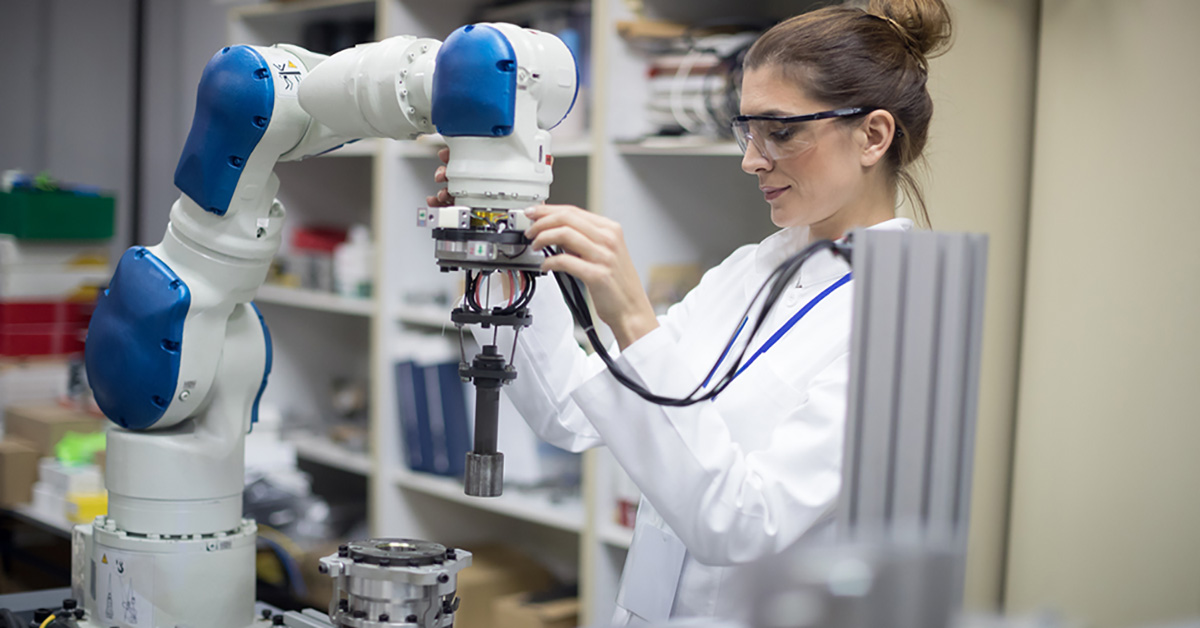 Collaborative robots are a relatively new invention in the robotics industry, but already, there are several different kinds. Their instant success in a wide range of industries has spurred rapid product innovation, resulting in four major types of collaborative robots.
The different types of collaborative robots are defined by their safety and programming features, or the way in which they avoid potentially dangerous encounters with human workers. Each type of collaborative robot deploys unique methods and technologies to maintain a safe operating space - this difference defines which environments they’re best suited for.
4 Major Types of Collaborative Robots
According to ISO 10218 part 1 and part 2, the four types of collaborative robots are defined as safety monitored stop, speed and separation, power and force limiting, and hand guiding.
- Safety Monitored Stop: collaborative robots defined as safety monitored stop are intended for applications that have minimal interaction between the robot and human workers. Typically, these types of collaborative robots actually leverage an industrial robot with a series of sensors that stop robot operation when a human enters the work envelope.
- Speed and Separation: these types of collaborative robots are similar to safety monitored stop collaborative robots in the fact that they leverage an industrial robot. However, speed and separation collaborative robots use more advanced vision systems to slow operations down when a human worker approaches and stop operation altogether when a worker is too close to the robot.
- Power and Force Limiting: these types of collaborative robots are built with rounded corners and a series of intelligent collision sensors to quickly detect contact with a human worker and stop operation. These collaborative robots, which use collaborative robot arms, also feature force limitations to ensure any collisions are unlikely to result in injury.
- Hand Guiding: these collaborative robots are equipped with a hand-guided device by which an operator directly controls the motion of the robot during automatic mode. While in automatic mode, the robot performing hand-guiding collaboration responds only to the operator's direct control input. This allows the robot, for example, to support the weight of a heavy workpiece while the operator manipulates it into position, thereby reducing the operator's risk of repetitive-stress injury. Similar capabilities can be used to "teach" or program a robot, but properly speaking, hand guiding as a collaborative operation occurs while the robot is in automatic mode, during normal production, whereas programming is not done in automatic mode nor used during production.
The four major types of collaborative robots defined above include every type of robot intended for some degree of human interaction during operation. Not all are built for constant collaboration, but each features a number of safety capabilities to prevent serious injury.
ROI Calculator

Discover the potential cost savings of robotic automation over a 20-year system life
This calculator compares your current manual labor costs against the total cost of owning and operating a robotic system over its 20-year lifespan.
Collaborative robots have been an important development in the robotics industry - the first automation technology that allows safe operation directly alongside human workers. The four types of collaborative robots have emerged in a relatively short time span and more are likely to emerge as the industry matures.
Share This On X:
Although fairly new, #collaborativerobots already have variations. The different types are defined by their safety and #programming features, or the way in which they avoid potentially dangerous encounters with human workers.
Collaborative robots have been an important development in the #robotics industry. The four types of #collaborativerobots have emerged in a relatively short time span and more are likely to emerge as the industry matures.
Recent Posts
- Creating a Safety Culture in Your Organization at the International Robot Safety Conference
- 6 Companies Driving Automation in Mexico
- Humanoids on the Horizon: What Hurdles Remain for Widespread Adoption?
- Safety by Design: How Humanoid Robots Must Evolve to Depart the Walled Garden
- Are Robots Really Taking All the Manufacturing Jobs?
- The Shipping Industry Floats Emerging Opportunities for Maritime Automation
- View All Blogs