
Blog
The Future of Elder Care is Service Robots
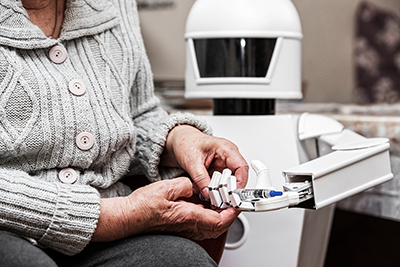 With massive improvements in healthcare and lifestyle in the last century, people are living longer. While longevity is an important achievement of modern-day, it does present challenges in terms of caring for an increasingly elderly population.
The issue of elder care is one of supply and demand. As the elder population increases in numbers, the number of caregivers is not correspondingly increasing. Japan predicts a shortage of 1 million caregivers by the year 2025. And the United States predicts that the percentage of people aged 65 and older is expected to increase to roughly 26% of the population by 2050. The relative lack of people able to care for the elderly is what keeps the costs of elderly care so high and creates a burden on family and caregivers.
One solution to this supply and demand issue is the development and adoption of elder care robots.
The Role of Robots in Elderly Care
Using medical robots for elderly care will vastly reduce the current astronomical cost of elderly care. Additionally, it will pick up the slack in terms of the number of caregivers available as the ratio of elderly to nonelderly people shifts.
Medical robots are a growing industry. According to the International Federation of Robotics World Robotics 2018 Service Robots report, medical robot sales increased 73% in 2017 over 2016, accounting for 2.7% of all professional service robot sales.
ROI Calculator

Discover the potential cost savings of robotic automation over a 20-year system life
This calculator compares your current manual labor costs against the total cost of owning and operating a robotic system over its 20-year lifespan.
There are numerous ways that medical robotics can help the elderly:
- Robots can perform small tasks like fetching food and water.
- Some elder care robots handle social and emotional needs by providing entertainment through games, helping remind them of events and appointments, and providing social engagement.
- Other eldercare robots take a more direct, muscular approach and use powerful hydraulics to help provide mobility and transportation support to seniors.
Robots and Dementia Care
Given the large number of people who either have dementia or care for somebody with dementia, the need for robotic support for these caregivers is critical. One specific application of robotics to dementia care is in the treatment of a phenomenon called “sundowners syndrome,” a poorly understood issue in which dementia patients quickly become more agitated and anxious as late afternoon transitions to evening.
Pet-style robots can help mitigate the effects of sundowner’s syndrome, as well as provide generally-improved mood to patients suffering from dementia.
As medical robotics technology continues to grow and develop, the applications of robots in homes and senior care facilities to improve the quality of life for seniors and their caregivers will only continue to expand.
Recent Posts
- Creating a Safety Culture in Your Organization at the International Robot Safety Conference
- 6 Companies Driving Automation in Mexico
- Humanoids on the Horizon: What Hurdles Remain for Widespread Adoption?
- Safety by Design: How Humanoid Robots Must Evolve to Depart the Walled Garden
- Are Robots Really Taking All the Manufacturing Jobs?
- The Shipping Industry Floats Emerging Opportunities for Maritime Automation
- View All Blogs