
Blog
Exploring the Potential of Humanoid Robots and AMRs in Customer-Facing Roles
As automation moves beyond its traditional manufacturing and logistics strongholds , humanoid robots are emerging as sophisticated ambassadors of technology in customer-facing roles. From retail and hospitality to banking and entertainment, these systems are no longer confined to backstage operational tasks. They are stepping into public space as interactive, embodied interfaces. Designed not just to function, but to engage, humanoid robots interpret voice, gesture, and affect with increasing fluency, signaling a shift from mechanical execution to socially intelligent collaboration. Their deployment marks a watershed in robotics, where physical form, behavioral nuance, and environmental perception converge to meet the complex demands of human-centered service.
For robotics professionals, this evolution introduces both an engineering frontier and a human interface paradigm. At this juncture of social dynamics and embedded autonomy, humanoid robots must integrate emotional signaling, multimodal perception, behavioral adaptability, and fleet-wide data synchronization while meeting stringent requirements for uptime, responsiveness, energy efficiency, and user trust. The challenge is not simply to automate tasks but to orchestrate meaningful, intuitive interactions at the edge of human experience.
From Labor Automation to Customer Engagement
Traditional service robots have historically been deployed for narrowly defined, transactional functions such as food delivery in hospitals, inventory scanning in retail, and directional assistance in airports. These applications prioritized reliability, repeatability, and task efficiency. The latest generation of humanoid customer service robots builds upon this operational foundation but introduces a new dimension of complexity through affective computation, multimodal perception, and interactive autonomy.
Rather than acting as passive tools, these robots function as collaborative agents embedded within socially dynamic environments. They welcome guests in hotel lobbies, provide product guidance in retail settings, support navigation in large public venues, and deliver concierge-level services with situational awareness and behavioral modulation. In doing so, they contribute not only to operational throughput but also to the quality and personalization of the customer experience at both functional and emotional levels.
This evolution is measured in global adoption metrics. According to the International Federation of Robotics, sales of public relations robots grew at a compound annual growth rate of 37 percent between 2019 and 2021. Such sustained growth signals a broader redefinition of automation’s role within customer engagement strategies. Increasingly, organizations are viewing humanoid service robots not as cost-reduction instruments, but as platforms for brand interaction, behavioral data acquisition, and real-time service augmentation.
The Engineering of Empathy
Designing humanoid robots for customer-facing environments requires a high degree of interdisciplinary precision. Mechanical engineers, cognitive scientists, and interaction designers must collaborate to craft machines that not only execute tasks but also convey social cues in ways that align with human expectations.
At the hardware level, key design priorities include:
- Human-scale proportions for approachability and ergonomic alignment
- Articulated joints and expressive faces to enable gestures, gaze direction, and emotional feedback
- Sensor arrays for voice recognition, facial analysis, and environmental awareness
Meanwhile, the software stack driving these systems often includes:
- Natural language processing (NLP) for multi-language customer support
- Emotion recognition algorithms to detect and respond to human affect
- AI-driven behavior orchestration that blends scripted routines with adaptive interactions
The goal is not to replicate human emotion but to simulate emotional intelligence in a way that guides social engagement. Detecting frustration in a customer’s tone, a humanoid robot may, for example, adjust its posture to signal attentiveness and offer help more proactively. Tesla’s Optimus was framed in this context during the company’s 2022 AI Day, with Elon Musk calling it “a fundamental transformation for civilization” and part of a “future of abundance.” Beyond utility, Musk emphasized the robot’s personability, envisioning roles where it could teach, babysit, walk a dog, mow a lawn, fetch groceries, or simply “be your friend, serve drinks. Whatever you can think of, it will do.” These examples underscore a vision in which utility is combined with social presence, positioning humanoid robots as both helpers and companions.
Contextual Intelligence at the Edge for Service Robots
Operating at the edge, within dynamic and semi-structured public environments, demands far more than preprogrammed routines. Humanoid service robots must engage in continuous perception, contextual interpretation, and adaptive response to variable human behavior and shifting environmental stimuli.
This requirement is accelerating developments in edge AI and embedded autonomy. Onboard systems must process multimodal data streams, including audio, visual, and spatial inputs, in real time to support responsive, socially appropriate interactions. Recent advances in edge compute architectures, including ruggedized and fanless processors from companies such as Cincoze, have enabled the deployment of low-latency inference models directly on the robot. These models support a range of perceptual and behavioral tasks, including:
- Facial expression classification
- Pose estimation
- Crowd-aware navigation
- Contextual voice command interpretation
This decentralized intelligence architecture, augmented by cloud-based orchestration for software updates, telemetry aggregation, and fleet-wide task coordination, allows for continuous learning and real-time behavior modulation. By minimizing dependence on cloud roundtrips, this hybrid model ensures low-latency responsiveness while preserving user privacy and maintaining operational resilience in bandwidth-constrained environments.
Retail and Hospitality as Robotics Laboratories
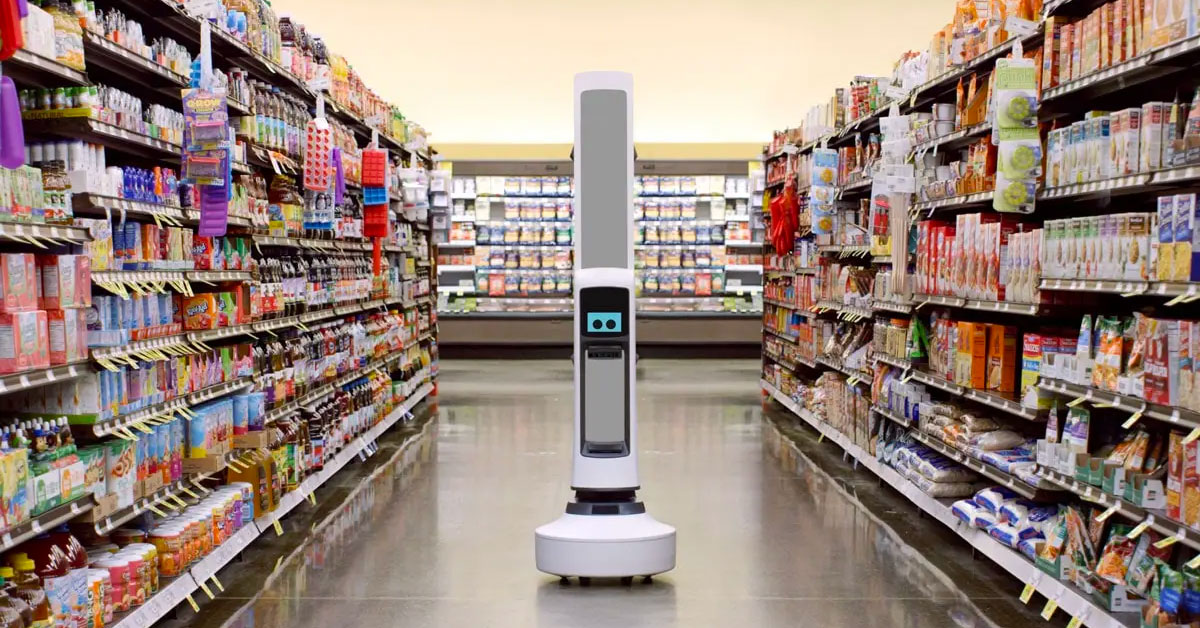
Retail and hospitality environments have become functional proving grounds for socially interactive robotics. Service robots like Simbe Robotics’ Tally, originally developed for autonomous inventory scanning, now represent a broader evolution in retail automation that emphasizes ambient, customer-facing interaction over  isolated task execution. A Schnuck Markets case study, based in St. Louis, Missouri, found that “just by having Tally in the store, stock conditions improved by at least 20% in those stores,” according to Dave Steck, VP of Infrastructure and Application Development. This transition reflects a strategic pivot from efficiency-focused automation to experiential engagement, where the robot becomes both a functional asset and a brand extension within the physical store environment.
In the hospital and hospitality sector, service robots such as Richtech’s Medbot and Aethon’s TUG are evolving beyond logistical utility into roles that require contextual awareness and basic social fluency. Hotels increasingly deploy robots or autonomous systems for functions including guest check-in, lobby supervision, and concierge-style recommendations. In some implementations, robots are integrated with room service workflows, equipped with natural language processing and real-time feedback interfaces that enable conversational exchange and responsive task execution.
The critical advancement lies in the integration of these robots into enterprise-wide data ecosystems. Every interaction, whether a question posed, a directional request, or a moment of hesitation, becomes a granular behavioral data point. This data is used not only to refine robotic performance through reinforcement learning but also to inform customer relationship management platforms, recommendation algorithms, and in-store analytics. In doing so, robots serve as both real-time service agents and high-fidelity data collection nodes, enabling a closed-loop system where interaction drives insight and insight drives personalization. This convergence of robotics, analytics, and customer engagement redefines automation as an active participant in omnichannel brand strategy.
Robots-as-a-Service: Lowering Barriers, Expanding Access
The emergence of the Robots-as-a-Service (RaaS) model has significantly expanded the feasibility of deploying humanoid robots in customer-facing roles. Rather than requiring capital-intensive investment in hardware and infrastructure, RaaS allows businesses to pay for outcomes such as guest reception, in-store assistance, or guided navigation. In this model, the robotics provider assumes responsibility for system engineering, maintenance, software updates, and remote diagnostics.
This approach aligns operational expenditure with delivered value, accelerates return on investment, and enables rapid prototyping and deployment across diverse environments. It is particularly impactful for smaller retailers and hospitality operators that may lack the in-house expertise or budget to support traditional automation models. With centralized platforms facilitating over-the-air updates, behavioral tuning, and real-time performance monitoring, robotic systems can be scaled and iterated quickly in response to changing business needs.
As Peter Seiff of Aethon has noted, RaaS functions not merely as a pricing construct but as a comprehensive architecture for service continuity and technical scalability. This approach, reflected in the adaptable solutions offered by Flexible Vision, allows organizations to remain focused on service delivery while offloading the complexity of lifecycle management. The result is a highly adaptable deployment framework that ensures the robot fleet remains operationally optimized and continuously aligned with the latest advances in autonomy, perception, and interaction.
Balancing Presence with Privacy When Designing Humanoid Robots
While humanoid robots present a powerful interface for customer engagement, their physical embodiment and sensory capabilities introduce a complex array of design considerations related to privacy, informed consent, and user comfort. The integration of high-resolution cameras, directional microphones, and facial analysis systems necessitates not only technical rigor but also ethical accountability. These sensing modalities must be implemented transparently, with explicit policies governing data capture, storage duration, access controls, and user rights.
System architecture must align with evolving global data protection frameworks, including GDPR, CCPA, and application-specific regulatory standards across sectors such as healthcare, hospitality, and retail. However, regulatory compliance alone is insufficient. Engineering teams must also focus on the interaction layer, crafting behavioral models and interface flows that make users feel secure, respected, and in control when engaging with robotic systems in public or semi-public contexts.
Emotional design plays a critical role in bridging this gap. By incorporating non-threatening gestures, animated facial expressions, and warm, humanlike vocalizations, designers can soften perceptions of surveillance and reinforce the robot’s role as a cooperative presence rather than a passive observer. Diligent Robotics’ Moxi serves as a clear example of this principle in action. Although task-driven in functionality, Moxi’s expressive design elements foster positive human response and reinforce trust, even in high-sensitivity environments such as hospital corridors. In customer-facing domains, affective design is not a superficial enhancement but a core requirement for achieving lasting acceptance and enabling meaningful human-robot collaboration.
The Road Ahead: Toward Collaborative Social Automation
As Robots-as-a-Service (RaaS) lowers adoption barriers and perceptual systems improve in accuracy and nuance, these robots are becoming more than functional assistants. They now serve as brand touchpoints, data-gathering interfaces, and adaptive engagement platforms. By merging service execution with personalized interaction, humanoid robots are evolving into integral components of customer experience ecosystems.
For robotics professionals, this evolution presents a multifaceted challenge. Future development must advance vision, voice, and control systems while supporting seamless integration with enterprise platforms. Success will depend on building machines that are not only technically robust but emotionally intuitive. While Morgan Stanley Research projects the humanoid market could reach $5 trillion by 2050 with over a billion units in use, adoption is expected to remain gradual until the mid-2030s, accelerating in the decades that follow.
In the near term, consumer-facing humanoids are unlikely to appear at scale. Instead, autonomous mobile robots (AMRs) are already reshaping the service landscape. These non-humanoid systems, designed to navigate dynamic environments without human control, are filling critical operational roles across industries. Simbe Robotics’ Tally improves retail inventory management, while Aethon’s TUG autonomously transports materials in hospitals and hotels. Alongside them, Diligent Robotics’ Moxi, a humanoid robot equipped for socially aware interaction, supports clinical staff with deliveries and patient assistance. Together, these systems illustrate how the next era of automation will be defined not just by autonomy, but by the capacity to connect effectively, reliably, and at scale.
Robotics, AI, and automation are rapidly reshaping the world around us. Veteran tech journalist Brian Heater dives into the stories behind these technologies with the innovators driving them forward. Don’t miss the conversations shaping the future of automation, explore the Automated podcast here.
Share This On X:
Humanoid robots are entering retail and hospitality with emotional intelligence and real-time edge processing. Explore how automation is becoming social.
From concierge bots to in-store guides, humanoid robots are transforming customer engagement. See how affective design and adaptive AI power this shift.
Recent Posts