
Blog
Autonomous Driving Technology: Dueling Approaches Fight for Control of the Wheel
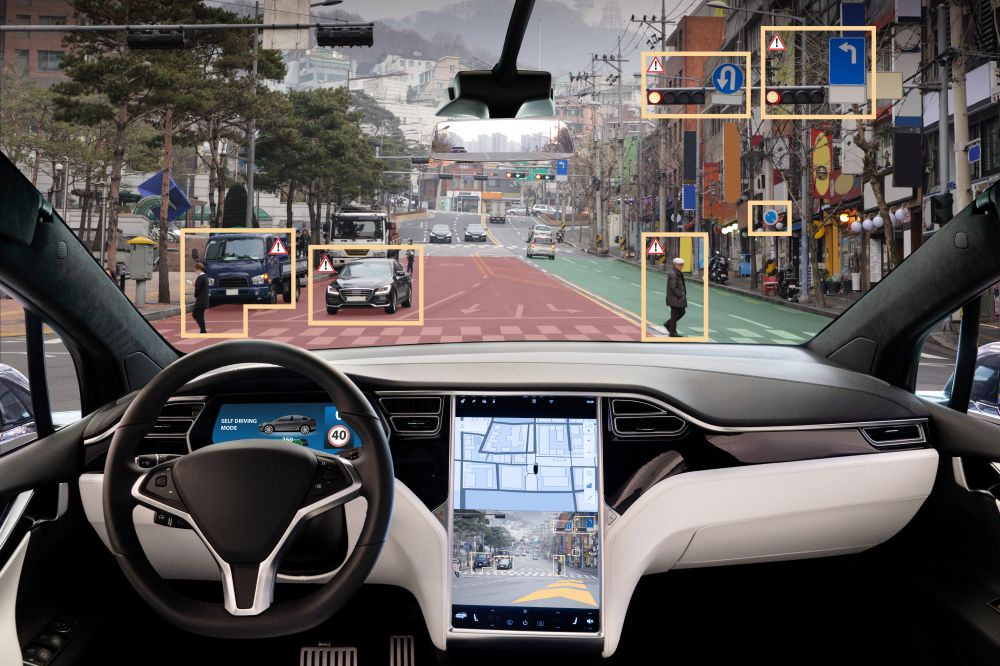 While autonomous driving systems keep improving their ability to navigate from point A to point B accurately, quickly, and safely, automakers are debating which self-driving technology offers the best path forward. That debate was on display in October 2025, when two automotive giants charted very different courses.
In October, General Motors announced it will equip the 2028 Cadillac Escalade IQ with a Level 3 autonomous driving system. GM’s solution relies on a multisensor approach that incorporates LiDAR, cameras, and radar for environmental perception and redundancy.
That same month, Tesla released Full Self-Driving (FSD) v14, its first major software update in a year. The revision supports the ongoing development of Tesla’s camera-only neural network architecture, which analyzes data from embedded cameras to provide all environmental perception, object detection, and path planning.
Tesla CEO Elon Musk has consistently argued that because human drivers rely solely on eyesight, autonomous systems should also depend entirely on vision technology. Tesla stopped using radar sensors in its vehicles in 2021. Since then, FSD v14's improvements all derive from advances in computer vision and AI rather than additional sensor modalities.
The Technology Crossroads
The dueling October announcements from GM and Tesla signal more than competing corporate strategies. They represent fundamentally different bets on how sensor technology and data processing architectures will steer future automotive models to full autonomy.
GM’s multisensor approach has some broader industry validation. Waymo reports its commercial robotaxi services, which are offered in multiple U.S. cities, now provide more than 250,000 paid rides every week. Its vehicles are driven by a redundant sensor suite leveraging LiDAR, cameras providing 360-degree vision, radar, ultrasonic sensors, and even audio receivers.
The path to advanced autonomy isn’t winner-take-all. Key technologies, such as machine vision, sensors, edge computing, and AI are all rapidly evolving, shaped by advances in industrial automation. Automakers may recalibrate their strategies as these components mature.
LiDAR-based autonomy demonstrates how a key technology has significantly advanced through improvements in solid-state sensor designs. Unlike earlier mechanical scanning LiDAR units that could cost tens of thousands of dollars, solid-state systems eliminate moving parts, boosting reliability and lowering manufacturing costs.
Frequency-modulated continuous wave (FMCW) LiDAR, for example, integrates velocity detection with traditional 3D spatial mapping to create a true 4D sensing platform. FMCW systems also perform better in bad weather compared to traditional time-of-flight LiDAR, which has been a long-standing issue. Companies such as Mobileye are advancing this technology by using silicon photonics to develop compact FMCW sensors specifically for automotive applications.
The camera-centric approach to autonomous driving, meanwhile, has benefited from parallel advances in vision processing and AI. Modern autonomous vehicle prototypes from Tesla and others typically incorporate eight to 12 high-resolution cameras to provide 360-degree coverage.
But cameras alone are insufficient. The breakthrough enabling vision-only systems is arguably edge computing power. The cameras embedded on autonomous vehicles generate approximately 1 GB of data per second. In industrial systems, such data loads can be processed in the cloud. But cloud processing can typically impose 150–200 ms of latency — an eternity when a vehicle is traveling at highway speeds.
Certified System Integrator Program
Set Yourself at the Forefront of the Global Vision Market
.jpg) Vision system integrators certified by A3 are acknowledged globally throughout the industry as an elite group of accomplished, highly skilled and trusted professionals. You’ll be able to leverage your certification to enhance your competitiveness and expand your opportunities.
Vision system integrators certified by A3 are acknowledged globally throughout the industry as an elite group of accomplished, highly skilled and trusted professionals. You’ll be able to leverage your certification to enhance your competitiveness and expand your opportunities.
Edge AI processors from companies such as NVIDIA, Intel's Mobileye division, and Qualcomm now provide the computational horsepower to run sophisticated neural networks locally within the vehicle. These systems execute convolutional neural networks (CNNs) for real-time object detection and classification and can process multiple video streams simultaneously while adhering to stringent automotive power and thermal constraints.
The Integration Challenge Ahead
The engineering challenges ahead extend beyond individual sensors to include system-level challenges, such as sensor fusion. An autonomous vehicle might need to combine data from LiDAR, radar, cameras, and other sensors with disparate data formats into a coherently unified environmental model. This requires sophisticated algorithms that must execute in real time. Sensor fusion systems need to handle not only normal driving conditions but edge cases, such as unexpected pedestrian behavior, construction zones with temporary signage, or emergency vehicles approaching from multiple directions.
To prepare for a future filled with automated driving systems, regulatory frameworks are evolving to accommodate these technologies. In September 2025, the U.S. Department of Transportation announced initiatives to update decades-old Federal Motor Vehicle Safety Standards designed for human drivers. Standardization efforts will need to address how different sensing modalities meet equivalent safety requirements. That becomes particularly challenging when accounting for LiDAR-based and camera-based systems, which detect the environment through fundamentally different physical principles.
The Road Ahead
The October 2025 announcements from GM and Tesla don't resolve the technology debate. But they soundly demonstrate that autonomous driving has progressed from laboratory research to commercial deployment decisions. GM's choice of multisensor redundancy and Tesla's commitment to AI-powered vision systems represent different perspectives on which technologies will achieve cost-effective mass-market deployment first. Both strategies, however, will require continued innovation in component technologies, including high-resolution imaging systems and edge computing platforms.
This technological crossroads represents opportunity for the automation industry. As autonomous driving moves from prototype to production, decades of innovation in automation and integration are reshaping transportation.
.png)
Join industry leaders and tech innovators to explore the latest in machine vision, computer vision, and AI-driven automation at A3's Advanced Vision & AI Conference in Santa Clara, California from September 23-24, 2026. Learn more.
Recent Posts
- How 3D Vision Systems Are Transforming Food Manufacturing
- These Farms Are Harnessing Machine Vision for Smarter Agriculture
- Revealing the Hidden Effects of Climate Change with Advanced Imaging
- How Vision Systems Are Transforming Predictive Neurodiagnostics
- Innovative Machine Vision Lenses and Trends
- An Early Look at GigE Vision 3.0
- View All Blogs