
News
Drone-Based Daylight Electroluminescence Imaging of PV Modules using SWIR Cameras
Electroluminescence (EL) imaging of photovoltaic (PV) solar panels provides high accuracy in detecting defects and faults, such as cracks, broken cells, interconnections, shunts, among many others; furthermore, the EL technique is used extensively due to a high level of detail and direct relationship to injected carrier density.

Figure 1: Drone with Raptor 640 SWIR camera
This technique is commonly practiced only indoors - or outdoors from dusk to dawn - because the crystalline silicon luminescence signal is several orders of magnitude lower than sunlight. This limits the potential of such a powerful technique to be used in utility scale inspections, and therefore, the interest in the development of electrical biasing tools to make outdoor EL imaging truly fast and efficient.
A team at Technical University of Denmark (DTU) lead by Gisele Alves dos Reis Benatto and Peter Behrensdorff Poulsen have used a drone-based system capable of acquiring EL images using an Owl 640 SWIR camera, running at a frame rate of 120 frames per second and imaging in the 1125-1175nm range. In a single second during high irradiance conditions, this system can capture enough EL and background image pairs to create an EL PV module image that has sufficient diagnostic information to identify faults associated with power loss. See Figure 1. Figure 2 highlights the Signal and sensor involved in daylight EL imaging.
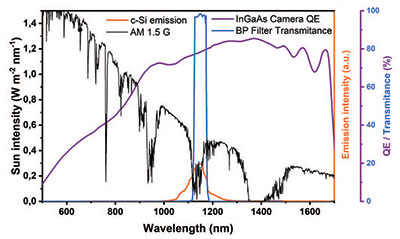
Figure 2: Signal and sensor involved in daylight EL imaging.
Figure 3i highlights drone based EL images, acquired with global horizontal solar irradiance close to one sun in the plane of the array, where one sun equals 1000W m-2.
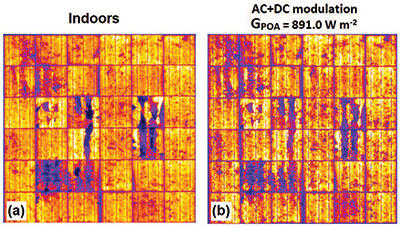
Figure 3i: Mechanically stressed PV panel EL images - stationary
It shows images acquired indoors (a) and outdoors from a stationary position (b).
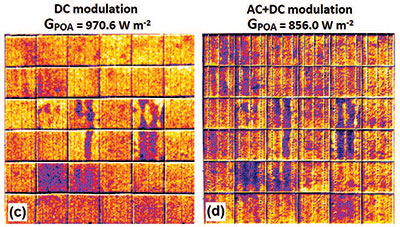
Figure 3ii: Mechanically stressed PV panel EL images - in motion.
When the drone starts to fly overhead, you can see further EL images shown in figure 3ii. It shows images with DC modulation (c) and AC & DC modulation (d). It presents lower quality compared to those obtained indoors and stationary in daylight in figure 3i, but still having sufficient quality to identify the main features related to the module power loss.
With further work on the algorithms, this technique shows much promise. It is an obvious advantage to use a drone to inspect PV modules on a solar farm during daylight hours.
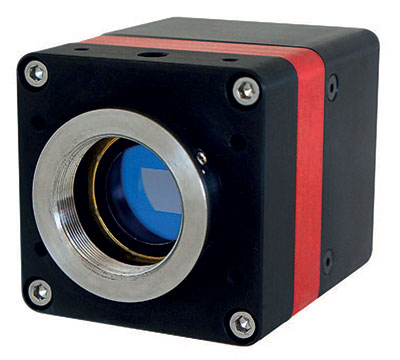
Figure 4: Owl 640 S InGaAS camera
- SWIR technology. Enables high sensitivity imaging from 0.9μm to 1.7μm
- High quality sensors. 99.5% operability, 640x512 15μm
- High Speed Imaging. Owl 640 S achieves up to 300Hz
- On-board Automated Gain Control (AGC). Enables clear video in all light conditions
- On-board intelligent 3-point NUC. Enables highest quality images
- Easy control of camera parameters. Control of Exposure, Gamma and intelligent AGC
- Compact and lightweight: 50x50x74.2mm / 260g
- Rugged, fanless. Operation tested up to 2.3 teslas.

Raptor Photonics Limited
Raptor Photonics Limited is a global leader and manufacturer of high-performance, industrial-grade and extremely rugged ultra low light digital and analog cameras. Raptor specializes in complete cameras and core engine solutions using EMCCD, CCD and SWIR sensor technology. The extreme low light capability of Raptor’s cameras makes them ideal for day/night surveillance, homeland security, aerospace, industrial and scientific markets. Raptor Photonics Limited is a registered ISO 9001:2015 company and is headquartered in Larne, Northern Ireland.
Discover how Raptor Photonics Limited can support your automation journey with their complete range of solutions and expertise.
Visit Company Website
Raptor Photonics Limited is a global leader and manufacturer of high-performance, industrial-grade and extremely rugged ultra low light digital and analog cameras. Raptor specializes in complete cameras and core engine solutions using EMCCD, CCD and SWIR sensor technology. The extreme low light capability of Raptor’s cameras makes them ideal for day/night surveillance, homeland security, aerospace, industrial and scientific markets. Raptor Photonics Limited is a registered ISO 9001:2015 company and is headquartered in Larne, Northern Ireland.
New Imaging Technologies Announces LiSaSWIR 2048 v2
NIT announces next-generation SWIR InGaAs line-scan camera for High-speed Industrial inspection applications with high performance.
Benefits of Line Scan Imaging
Line scan cameras are popular because one 2k line scan camera cost-effectively provides high resolution images.
Raptor Photonics offers the Owl 640 S for high speed SWIR imaging.
Raptor Photonics offers the Owl 640 S for high-speed SWIR imaging. It is a digital 12-bit SWIR camera...