
Tech papers
3D for Everyone
Time-of-Flight as a key technology for cost-sensitive 3D applications
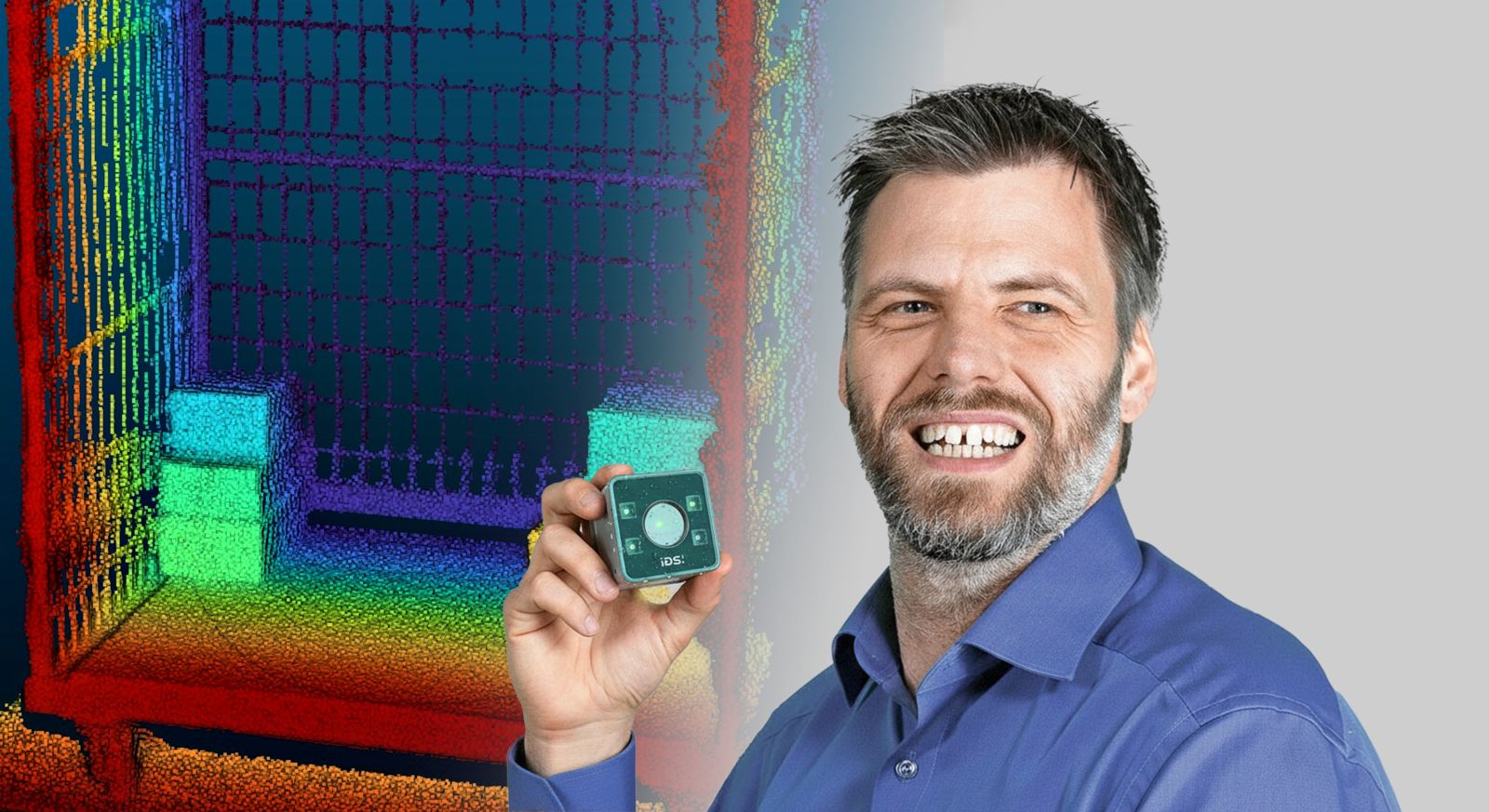
Nion is the first 3D camera developed in-house by IDS and is designed to provide a cost-effective entry point into 3D data acquisition. It thus complements existing solutions in the high-precision segment, such as Ensenso stereo vision cameras. The depth sensor from onsemi uses indirect time-of-flight technology, provides high-resolution depth data, and operates reliably even under varying lighting conditions, both indoors and outdoors. This makes Nion particularly well-suited for industrial applications that require robust depth information without the complexity of traditional high-end 3D systems. In this article, Patrick Schick, Product Manager for 3D Vision at IDS, explains the background and technical decisions behind Nion, provides an overview of iToF technology, and highlights typical applications.
IDS enters the iToF 3D Market with Nion
IDS has been a player in the 3D market for many years with its Ensenso Stereovision cameras. Nion is expanding this portfolio with its own entry-level Time-of-Flight camera.
Patrick Schick: “With the Nion, we are deliberately entering a new market segment. Ensenso remains our solution when the highest data quality and depth accuracy are required. Nion is designed for applications that require stable depth data but do not need the full precision of complex 3D measurement systems. The camera rounds out the portfolio in the lower price segment and offers an option for users who want to use 3D in a practical and versatile way.”
The role of iToF technology in 3D image processing
Indirect ToF (iToF) sensors determine distances by measuring the phase shift between the modulated light emitted and the reflected light. This method offers greater accuracy and resolution than many direct ToF approaches, in which the transit time of the light pulse is measured. iToF sensors are frequently used in industrial automation, robotics, and 3D scanning.
Patrick Schick: “For us, iToF is a logical addition to our 3D portfolio. The technology provides high spatial resolution and operates reliably even when in motion. It enables the generation of depth information in real time without the need for complex computations outside the sensor. That's exactly what many industrial applications need: reliable depth data that's easy to use.”
Nion relies on a modern iToF sensor with integrated depth acquisition
The onsemi AF0130 sensor from the Hyperlux series used in this application offers 1.2-megapixel XY resolution and, thanks to modulation frequencies of up to 200 MHz, also provides high depth resolution. In addition, the sensor captures the four phase images required for iToF within the sensor before they are all read out together.
Patrick Schick: “We chose the Hyperlux sensor because it meets several requirements at once. With a resolution of 1280 × 960 pixels, it delivers four times the data density of standard VGA ToF cameras, processes depth information directly within the sensor, and effectively suppresses ambient light. The wide range of modulation frequencies makes it possible to cover various distances, from close range to longer working distances. This allows us to offer a camera that delivers reliable results in a wide range of scenarios.”
Motion-stable depth estimation in dynamic scenes
A key feature of the Nion is its low motion blur. This is particularly important for logistics, material handling, or applications involving rotating parts. This is because motion blur leads to unstable depth values.
Patrick Schick: “To determine depth information, iToF sensors require multiple phase images of the same scene. In many ToF cameras, these phase images are exposed one after another and read out from the sensor individually. Time passes between these exposures. If the object moves during this time, the phase images will no longer match exactly. The camera calculates depth based on image data that no longer aligns. This results in unsharpness throughout the depth range. In the Nion onsemi Hyperlux sensor, all phase images are buffered within the sensor before being read out in a single block. As a result, the exposures run almost without interruption. This ensures that the images remain aligned and the depth values remain stable, even when objects move quickly across the image.”
Stable in changing light: Indoor and outdoor use
Nion is designed for both indoor and outdoor use. This is based on the high spectral sensitivity of the iToF sensor used in the 940-nm range, combined with the appropriate laser light in the same wavelength range.
Patrick Schick: “Nion operates in the 940-nm range and is therefore significantly less sensitive to sunlight and many artificial light sources, which primarily fall within other wavelength ranges. This is important for logistics centers, production facilities, or outdoor areas. Users do not need to install complex shields or enclosures to obtain usable data. In these scenarios, the camera provides stable depth images that can be analyzed immediately.”
Typical applications for Nion
Nion is suitable for many industrial applications. The camera provides depth information in scenes with varying distances, object sizes, and movements. It functions as an all-purpose ToF system and is therefore suitable for any environment where flexible and robust 3D capture is required.
Patrick Schick: “Logistics is a major issue. The goal here is to detect, track, or measure objects without interrupting operations. The camera detects packages and other goods regardless of size or distance and operates reliably even when in motion. Applications such as level monitoring or presence detection are also of interest. In many cases, existing 2D processes can be retained and supplemented with depth data where necessary, if that aids decision-making in the process.”
Easy integration into existing systems
For industrial use, integration into existing software environments is crucial. Nion is GigE Vision-compliant and fully integrated into the IDS software environments.
Patrick Schick: “We wanted a 3D camera that could be used just like a traditional industrial camera. Nion complies with GigE Vision standards and is fully integrated into our IDS peak Software. This means that users don't need any exotic, specialized solutions; instead, they can easily integrate the camera into their existing tools and applications. In addition, like any other IDS 2D vision camera, the Nion is fully integrated into the IDS peak cockpit. This significantly reduces the effort required to get started with 3D.”
Distinction from high-precision 3D technologies
There are various 3D solutions available on the market, including active stereovision systems such as Ensenso, which offer the highest precision. However, Nion is designed for other use cases.
Patrick Schick: “High-precision 3D technologies such as Active Stereovision are the right choice when it comes to the finest details, maximum depth accuracy, and complex measurement tasks. Nion is positioned differently. The camera is designed to deliver reliable depth data at an attractive price point, with a clear focus on ease of use and integration. It does not replace high-end 3D systems, but rather complements the range of options when applications require reliable, though not maximally precise, depth information.”
Further development of the 3D product line
Nion is designed to be the first component of a new 3D family. IDS is planning expansions in various directions.
Patrick Schick: “We deliberately took our time with the launch of the Nion, tested prototypes, and gathered a lot of feedback. This experience is also incorporated into other models. Variants with a wider field of view, multi-camera capabilities, or additional features are possible. Our goal is to create a 3D product line that meets all requirements and offers our customers the right solutions for their needs.”
Further information
- Time-of-flight taken to a new level – discover the advantages of Nion: To the product information page
- Discover the capabilities of the Nion 3D camera. Discover the benefits of onsemi Hyperlux technology and learn how it delivers high-resolution 3D data, operates reliably in outdoor environments, and provides accurate results for fast-moving objects and demanding applications: Watch the video
- Find more technical articles in our knowledge base.

IDS Imaging Development Systems, Inc.
The IDS product lines include 2D and 3D cameras with different interfaces and capabilities, as well as a wide selection of image sensors for a wide variety of applications. Additionally, the company develops custom cameras and provides the appropriate software.
Discover how IDS Imaging Development Systems, Inc. can support your automation journey with their complete range of solutions and expertise.
Visit Company WebsiteIDS Imaging Development Systems, Inc. 

The IDS product lines include 2D and 3D cameras with different interfaces and capabilities, as well as a wide selection of image sensors for a wide variety of applications. Additionally, the company develops custom cameras and provides the appropriate software.
Helios2 Time of Flight (ToF) 3D Camera - IP67, Sub-Millimeter Precision
The Helios2 combines a factory tough design with exceptional 3D precision and accuracy into a compact IP67 machine vision camera. Featuring Sony's IMX556PLR DepthSense sensor, users are able to stream 3D point clouds in real time for use in a variety of industrial applicati
Neousys Announces Rugged NVIDIA® Jetson Orin™ NX GMSL2 Camera Sensor Hub for Autonomous Vehicles and AMRs
Neousys announces a new rugged Jetson Orin™ NX GMSL2 camera sensor hub for autonomous vehicles and AMRs.
Why AT Has Been the Innovation Leader for 3D Cameras for 20 Years
AT offers the highest resolution and fastest 3D camera, and the company also caused quite a sensation with the launch of its new C6 series with unique features such as MultiPart, MultiPeak, GeniCam3.0 and its own specially developed sensor chi