
Industry Insights
NEURA Robotics CEO on 'bots, blockchain, and humanoid gyms
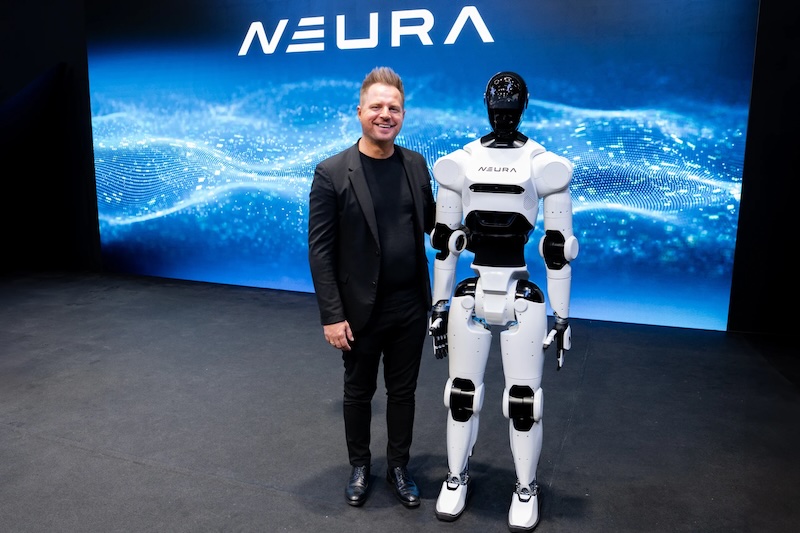
German robotic darling NEURA Robotics announced a sizable Series C round of up to $1.4 billion in June. This round valued the company at $7 billion and was led by a surprising source: blockchain company Tether.
A blockchain company leading a sizable round into a mature robotics startup definitely caught our eye. Also, the round size not being a set total stood out. Was the round up to $1.4 billion because it's tied to the ever-fluctuating cryptocurrencies Tether’s business is built off of?
Thankfully, Brian Heater and I were able to sit down with NEURA Robotics CEO David Reger at A3's recent Automate conference to get some answers.
For starters, Reger told us that Tether reached out to NEURA originally. While he assured us that this doesn’t mean they are becoming “crypto guys or whatever,” he said the partnership with Tether actually makes a lot of sense.
One of the fundamental aspects of blockchain is its peer-to-peer transaction technology. As robots, humanoids especially, eventually gain more autonomy they’ll need their own infrastructure to communicate with one another in the “machine economy” as Reger put it. Tether thinks that could be a future use case for its blockchain tech.
“Somehow the devices have to pay each other, have to interconnect to each other,” Reger said. “This is actually where we see Tether as a crucial partner in that space. They're the largest and at the same time [have] a large focus on physical AI and what they're doing.”
No crypto was involved in the actual funding round either, Reger said, and the potential for the funding round total to fluctuate is just due to currency conversions.
Reger said the raised funds will majorly go toward the company’s new ambition to build out its NEURA Gyms which the company sees as a way to move the whole industry forward. The startup plans to build these gyms for partners to use to test their bots using its Neuraverse robotic brain software and the gym’s real-world situations. Companies can choose to share the data they collect back with NEURA but don’t have to. The company didn’t provide pricing information when asked.
NEURA is seeing momentum for its humanoids too, Reger said. While robotic arms and similar robots still make up the vast majority of the startup’s revenue, NEURA has now racked up $500 million in deal value for its humanoids, including an order for 500 of the bots to be delivered to one customer this year. Despite the success thus far, he isn’t overselling what these bots can do yet.
“It's basically pressing buttons, turning switches, putting parts in machines, but without actually changing anything in the environment,” Reger said. “We proved it works. Now prove that it works day and night and 24/7.”
That reliable automation will be the next area of focus, Reger said. The company also is continuing to improve its robotic brain software to increase the ability for humanoids to learn new tasks from the world around them. This is something the company hopes these humanoid gyms will be able to help with.
“Let's do it actually as smoothly as possible, as best as possible to bring them and insert them into the market,” Reger said. “We’ve shown [at] CES already a dancing robot. We bring it into the club. It was cool. But this is not the purpose of this company. The purpose of the company is making humans dance and walk around while robots actually go and work.”
Association for Advancing Automation
Discover how Association for Advancing Automation can support your automation journey with their complete range of solutions and expertise.
Visit Company Website


Robotics Raises: Integra Robots, Maneva Robotics, NEURA Robotics, Sintroy, Theker Robots
The vast majority of VC dollars came from just one massive deal: Neura's Series C.