
Industry Insights
iRobot’s Former CEO Wants to Reinvent the Home Robot
For the first 19 seconds, it could be an ad for nearly anything. An older woman walks through the front door of a suburban residence, first greeted by a golden retriever and then a smiling child. After the whole family has embraced her warmly, the camera cuts. She’s seated in a chair, mid-conversation.
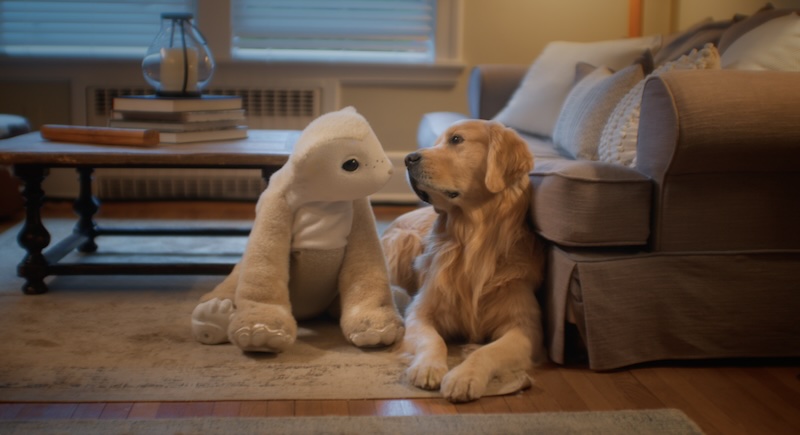
Then the shift. Curious and blinking, a small white creature pokes its head into frame. A look of surprise flashes on the woman’s face, unable to make heads or tails of the presence. She beckons it to her like a household pet, taking its head in her lap.
“This is something that, if you're not motivated to touch and pet it, then boy, we did something wrong,” Colin Angle tells me, after playing the video once through. “This is something that doesn't live in a four-by-four box in front of you. This is something you can take for a walk outside.”
The rest of the spot finds the doe-eyed creature engaged in various domestic scenarios. It sits next to the child’s bed, walks around the kitchen floor wagging a nub of a tail, hangs with the family dog, engages in some light yoga, and, indeed, eventually joins the woman for a walk outside.
The strange little quadruped is a “Familiar,” the first offering from the similarly named startup, Familiar Machines & Magic (FMM). Both take their first public steps on May 4, as Angle reveals what his team has been working on since he stepped away from iRobot’s top spot in early 2024.
“There's never been a consumer robot that was able to do that,” Angle continues. “This actually lives in your space. You get up and you go to the kitchen. It can follow you and hang out with you. No robot has ever been able to do that before. Right? What we're doing is so miles beyond what has gone before.”
Angle is far from the first to lay out such grandiose claims for the infamously fickle world of home robotics. At the very least, however, his track record affords him a unique perspective. For most intents and purposes, no single company has exerted a larger influence on the category than the one he cofounded as a graduate student more than three decades ago. iRobot scored an industry-defining hit with Roomba, capturing a sweet spot between price point and utility that drove mass adoption.
In the decades since, countless companies have attempted to recapture that magic, with little success beyond their take on the robot vacuum. iRobot similarly struggled, as products focused on automating other chores failed to break through. Angle says the new company considered a different value proposition.
“When you go and look at a product for the home, you're competing for wallet share,” he explains. “A family has only so much money it's willing to spend, and it chooses very deliberately how it spends that money. How much do you spend on your cable bill? How much do you spend on your large screen TV? How much do you spend on vacuuming and mopping? The challenge at iRobot was our logical expansions went from vacuuming to mopping to air purification to pool cleaning. There were adjacencies, but each of those adjacencies were cast against what the household spends on these different things. Vacuuming is something people do frequently. They dislike doing it and they spend a lot of money on it. Mopping, people hate doing it so much they actually don't do it very often, which works against you, and they do it with a mop that they're used to spending $8 on.”
FMM has yet to reveal the specifics around cost, they’ve promised a kind of price parity with flesh and blood pets. “One of my go-tos is to build a robot that delivers more value than it costs to create,” says Angle. “I need it to be trustworthy. I need it to deliver long-term engagement. What we're announcing is our first step in delivering a different kind of robot, which we think meets these criteria.”
Putting a finer point on it, Angle calls the Familiar project, “the greatest application of robotics in [his] entire career.” In some respects, it dates back nearly as far. He notes that iRobot’s original name, Artificial Creatures, pointed to a different set of aspirations than the ones that ultimately gave us Roomba.
“This idea that we could use the AI that we were creating way back 35 years ago to try to build the robots they were promised,” Angle explains. A shift toward a more utilitarian model meant focusing on robots that could operate independently of humans in the home. “It was a journey of focus on human connection toward more simpler solutions that required less human connection,” he adds. “Turn it on by pushing the button. And then later years, if this thing is going to take its next step forward, we got to bring the human connection back into the equation.”
Harnessing recent advances in sensors, hardware, and AI, Angle believes a new generation of home robots can build the human connection more strongly than ever before. “No one believed Roomba was gonna work until people tried Roomba,” he says. “We're very confident in the experience that we're creating.”
Association for Advancing Automation
Discover how Association for Advancing Automation can support your automation journey with their complete range of solutions and expertise.
Visit Company Website


Acquisition Completed, iRobot Outlines Plans for US/EU Consumer Data Protections
Emerging from Chapter 11, the company details its future as part of Picea Robotics
How Matic is Reinventing the Robot Vacuum
The Bay Area-based robotics firm is taking on the category with new funding.
Former iRobot CEO Colin Angle Reflects on Chapter 11 News
Colin Angle discusses his journey with the company and what can be done to avoid similar outcomes.