
Industry Insights
Bipedalism's Baby Steps
This story first appeared in A3's new Automated newsletter. Subscribe here.
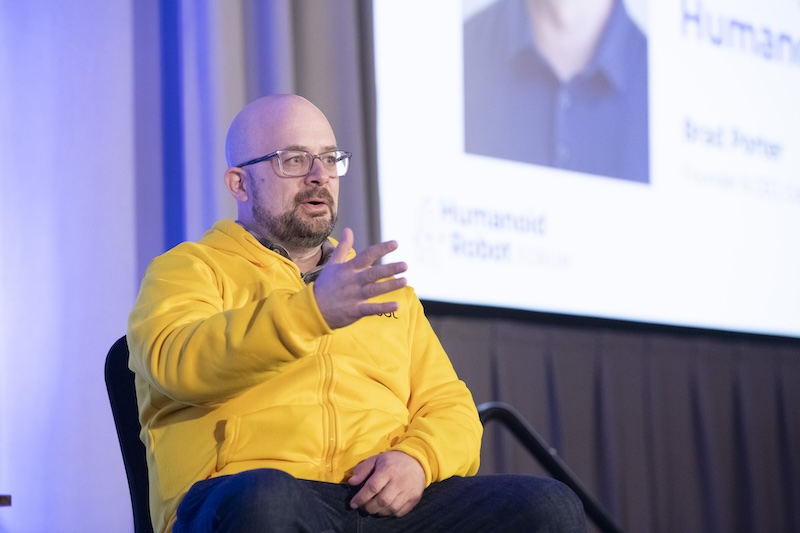
“You don’t go out of your way to be a skeptic,” Brad Porter notes at the beginning of our hour-long podcast chat. It’s not that no one wants to be associated with the s-word, so much as the idea that one needs to get there in good faith. Blindly accepting and rejecting novel concepts out of hand are two sides of the same misguided coin.
This is where past precedent and industry expertise come to bear. The Cobot CEO possesses both in spades, with a track record that includes 13.5 years as an executive at Amazon, co-leading industrial robotics deployment efforts that recently crossed the one million unit milestone.
Porter’s own public skepticism about humanoids is partly a product of his explorations into deploying the form factor in a warehouse setting.
“I felt that it was worth putting out content to explain what I had seen, thinking deeply about humanoids at Amazon,” he tells me. “It was a little bit ahead of the curve, and I thought about this a lot in 2018. I think Agility had shown some really impressive bipedalism. That technology looked like it was starting to be viable. The Humanoid Grand Challenge had just taken place. So, we thought about it a lot.”
Here's a video of me on stage with Agility’s “humanoid” back in mid-2018. Cassie was all-orange, ostrich-inspired legs and hips, the direct result of co-founder Jonathan Hurst’s University of Oregon bipedal research. Digit added arms to the equation two years later, and eventually got a head a few years after that. All of that is to say, one needs to embrace a few logic leaps and squint real hard to make the humanoid label work.
Porter notes that his own early explorations came up short. “We came to the other side of that exercise with the realization that the use cases where a humanoid would be helpful at Amazon, it wasn’t actually the best form factor,” he says. “That led me to realize what we really needed in a commercial environment was really quite different.”
That Cobot’s Proxie has some anthropomorphic characteristics is more along the lines of convergent evolution, as the robot’s form factor has far more in common with warehouse carts than the humans who push them around. Porter notes that borrowing from humans has been helpful in certain aspects of Proxie’s development, including the integration of simple social cues, which foster connection with human coworkers via a tablet “face.”
In 2022, Agility went on to be one of five startups included in the first batch of Amazon’s $1 billion Industrial Innovation Fund. The following year, the retail giant announced that it was experimenting with integrating Digit units into its fulfillment centers. Next week marks two years since the companies revealed a pilot many believed might prove a watershed moment for humanoids in the workplace. The present state and future of the partnership are unclear, as AMRs (autonomous mobile robots) and industrial arms comprise the lion’s share of the company’s automation efforts. Agility, meanwhile, has struck partnerships with other logistics powerhouses, like GXO.
“From my perspective, I started to become disillusioned that [humanoids were] the right solution for a lot of these use cases that Amazon had, that hospitals have, that manufacturing has,” Porter says. “These use cases that are human scale, material movement, moving boxes, totes, and carts around the world, I thought there was a much better form factor.”
Porter left Amazon in August 2020, taking on the CTO role a Scale AI. Two years later, he founded Cobot, where he was able to bring his own ideal form factor to life via Proxie. Amazon, meanwhile, still has skin in the humanoid game. In June, The Information reported that the company was exploring the form factor for delivery operations — much as Ford had in the early days of Digit, before Agility pivoted to more industrial settings.
Amazon also maintains several ongoing research projects related to bipedalism. A recently published paper revealed the existence of Amazon FAR (Frontier AI & Robotics), a lab formed after the company hired much of Covariant AI’s staff. That group is heavily involved in physical AI, training humanoids to execute complex sequences of actions in a variety of settings.
Association for Advancing Automation
Discover how Association for Advancing Automation can support your automation journey with their complete range of solutions and expertise.
Visit Company Website


Don’t Forget to Tip Your Robot Bartender: Rodney Brooks on Humanoids
The legendary roboticist discusses why general purpose humanoids are further out than many believe.
Dobot CRA Series Awarded SGS NA Listed Mark Certification
Dobot is proud to announce that our CRA Series collaborative robots (cobots) have been awarded the SGS North America Listed

Online collaborative robot safety course available to public
Over the past decade, large and dangerous caged robots have given way to smarter counterparts.