
Industry Insights
Ahead of Stock Market Debut, Agility Cofounder Discusses Physical AI and Digit V5
“Look,” Jonathan Hurst gestures toward the stage below. 1X CEO, Bernt Børnich, is up. Behind him a massive screen is splashed with the phrase, “the holy grail of robotics.” The grail in question is an image of 1X’s tendon drive system.
Tendon drives have been a longtime interest for the Agility founder. If you want to write a research paper on the topic, you’ll likely find yourself citing something the Chief Robot Officer has written over the years.
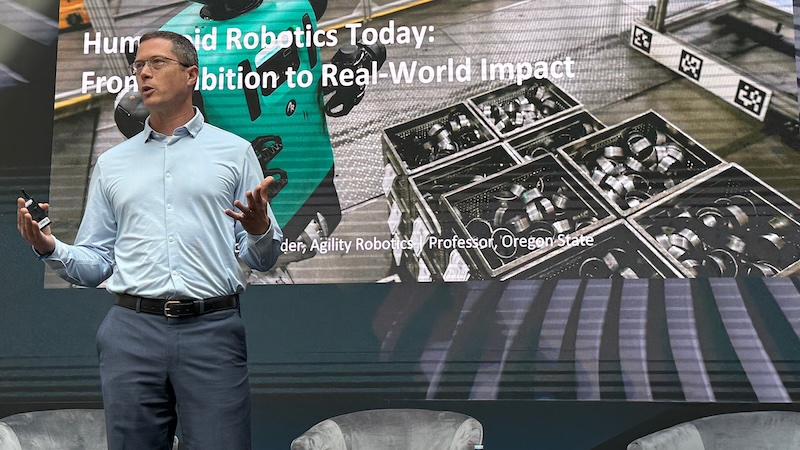
These days, however, Hurst wants to talk physical AI. It was the subject of a panel he and I bookend late last year, that also featured researchers from Physical Intelligence and Dyna Robotics. It was also the focus of the keynote presentation he gave at this week’s Machina Summit titled, “Humanoids Today: From Ambition to Real World Impact.”
When I note that his attention is laser focused on the subject these days, he’s quick to dispel any notion that he hasn’t been into physical AI since before it was cool (my words). Hurst cites attitudes toward his pre-Digit robot’s record breaking run back in late 2022.
“Physical AI is the path forward,” says Hurst. “There's really no other path. And we were very early into that. If you remember Cassie had the 100-meter dash world record, but at the time the reason we had to get the Guinness record folks out to do the world record, because otherwise nobody would have noticed or cared. If we said ‘hey we've put reinforcement learning to control balance on a bipedal robot,' maybe seven people in our community would have cared. It was pretty early.”
That last sentence might as well be Agility’s tagline. Early to legs, humanoids, early to pilots, early to deployment. As for how the Oregon-based firm delineates the latter two, Hurst explains, “A pilot is something that sometimes a lot of times it's with an R&D group at a company. It's also not on the production line. You’re not moving active products. If the robot breaks and fails, it doesn't really affect [production]. It’s very similar to, or a replica of, what the use case would be, and it's usually like a limited amount of time. They'll do it for some number of weeks. Deployment in our case is a long-term contract -- like three years, and the robot is doing work where it's handling product.”
Hurst adds another bit that jumps out at me: “If the robot fails, we then have to make sure that somebody is still moving that product and making that happen.” In most cases, this means swapping in another robot. If things get real dicey, on the other hand, it could see an engineer handling product – anything to ensure the job gets done. It hasn’t come to that, however, as maintenance was a more regular occurrence during early prototype pilots.

Get the Training You Need for a Safer Workplace!
Autonomous mobile robots are one of the fastest-growing segments of the robotics industry. During this live virtual training, you'll be introduced to safety protocols and best practices for working with mobile robots in industrial settings.
Learn more and register now for upcoming training dates.
As for ROI, he says customers should see that return in under two years. They’ll see it a lot sooner in the case of a RaaS model, when charged monthly, instead of outright.
Going public is another likely first for Agility, among American humanoid companies (Unitree is looking more or more ready to beat them to that particular punch by way of the Shanghai stock market). In a surprise move, Agility announced a SPAC merger with Churchill Capital Corp XI during Automate, two weeks back. Going public requires a new level of transparency for any company – one Hurst says Agility welcomes. He adds that it’s been a key to the company since it sprung out of the OSU lab -- a contrast he draws with other unnamed entrants in the space.
“That transparency of being public, it really is it puts us on a different spot,” he says. "We are leading in terms of deploying things in the world. We are leading commercially. And I really want the world to understand that deeply and know that. And nothing says that like going public.”
Hurst believes that such transparency will help Agility stand out amongst the bold claims, big promises, and flashy videos that have come to define the humanoid space.
Last, but not least, one more first: first principles. He points to the philosophy as a kind of guiding light for Agility’s hardware and software decisions. It’s a big part of what has kept Digit’s design fairly minimalist compared to much of the competition. He notes that engineers finally gave in an gave Digit a head for version three – and that was largely to increase the robot’s field of view and improve antenna placement.
Personally, I never referred to the early versions of the robot as a humanoid, owing in part to the initial lack of head (and arms). Even after those elements were introduced, the backward “ostrich” legs inherited from Cassie seemed like another dealbreaker – though we seemed to collectively get over that one as an industry fairly quickly. That element, too, will change with the fifth version of the robot, set to debut toward the end of 2026.
“Digit V5 is going have forward knees like a regular person,” says Hurst. “We tried to avoid that until we understood exactly why. The reason is because when you squat, you use your knee actuators and your hip actuators, you put your center of mass, bisecting your thigh. If you do that with Cassie, the ankles hit the ground, and you can't get down very far. Now digit V5 will be able to squat all the way down and lift very heavy things off the ground.”
Association for Advancing Automation
Discover how Association for Advancing Automation can support your automation journey with their complete range of solutions and expertise.
Visit Company Website


How Humanoids Took Center Stage at CES 2026
How bipedal robots captured the spotlight at the year's largest tech event.
Humanoid Robots Are Evolving
Humanoid robots are still in their early stages, yet evolving fast.
Agility Takes on AI Generalization and Humanoid Safety as it Looks to Go Public
Agility's CTO breaks down the humanoid company's strategy ahead of its SPAC.