
Industry Insights
Agility Takes on AI Generalization and Humanoid Safety as it Looks to Go Public
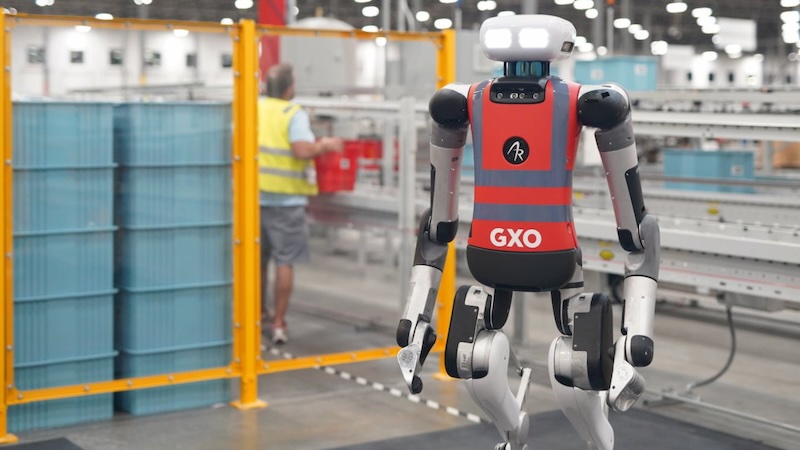
The road to generalization is paved with smaller, simpler tasks. The current generation of humanoid robots, prized for their flexibility, will make their way into factories and warehouses one job at a time. Tote moving is likely the example you’ve most often seen touted — transferring bins from one location to the other.
Is it something most humans can do? Sure. Is it something most humans want to be spending their precious time on Earth doing? Probably not so much. In a conversation shortly after the wrap of our Humanoid Robot Forum, Agility Robotics CTO, Pras Velagapudi, describes this as the sort of in-between pieces of automation.
They’re not particularly stimulating for the humans tasked with staffing them, but robotics hasn’t quite found a way to bridge the pieces.
“There's a lot of utility already in having robots that fill these blue automation roles where they're between inconvenient parts of the process,” says Velagapudi. “They're connecting pieces of automation that don't fit together well. This happens all over manufacturing logistics right now. Someone needs to unload an AMR, someone needs to put totes into a shelf. And it's exactly the sort of use cases the Digits are really good for, when it's, you don't want to modify the infrastructure a lot. They're strenuous, repetitive types of applications.”
Velagapudi’s HRF presentation was sandwiched between two big pieces of news for the Oregon-based humanoid firm. First NVIDIA announced that it had tapped the Oregon-based firm as the first partner for Halos for Robots — of its autonomous driving platform focused on automation safety. After the talk, Agility announced a bigger bombshell — it was set to become the first U.S.-based humanoid firm to go public.
The move, says, Velagapudi, reflects the form factor’s, specifically Digit’s, commercial readiness.
“I think we always have been as a company pragmatic and transparent about what it is we're doing and how we perceive the market,” says Velagapudi. “We've been able to be quite successful with that, with the customers that we're working with, with the technology that we offer. We're able to be clear about what it is we do and honest about what we think is possible. And I think we want to continue that. We want to continue to be bringing that to a new market where we can show and demonstrate that yeah, we're at an inflection point. Humanoid robotics is ready to be out there in the world. It's ready to be commercialized and we're going to demonstrate that.”
Also a bit of a surprise was the method with which Agility was opting to go public. After having a moment during the pandemic, the popularity of SPACs (special-purpose acquisition companies) has died down considerably. The deal finds Agility merging with Churchill Capital Corp. XI, a newly formed blank check company formed from an asset management firm.
The deal gives Agility a $2.5 billion pre-money value and — of more immediate importance — delivers $620 million of expected gross transaction proceeds.
“[The purpose of the SPAC] is to support us in things we're doing,” says Velagapudi. “They understand how to communicate our progress. Because as we're growing, we are going to be strengthening our commercial pace. We're also introducing new technology. It's a lot of we're introducing new features like safety into Digi. and that's a bit different than [a] traditional company [that] might just be putting out quarterly reports of the products. We're doing a lot more than either. And so being able to tell that story effectively and show measurable progress towards our goals, they can help us with that because they've been doing [it] with other companies that are in similar positions and being really innovative.”
Agility prides itself as being a “first mover.” Digit both presaged the current humanoid hype cycle and was the first to begin deployment in real world settings. The company also arrived before the market was entirely focused on notions of “physical AI” and “generalization” as the next step in the evolution of these systems. It’s easy to forget just how massive a sea change we’re talking about over the days of hard coding systems — and even the sort of “app store-style” approach to robotic tasks companies like Boston Dynamics were initially shooting for with products like Spot.
Agility is utilizing existing world models from companies like NVIDIA, which are then trained on real-world data using VR tele-op for a first-person view of how a task is executed.
“Model training seems to be converging,” says Velagapudi. “There's basically building out a really large-scale foundation of just a lot of data of maybe different robot environments or things like that. And that's something that, you know, a company like NVIDIA will release an open-source model, or there's different providers that released open source very basic image models, video. Models, things like that, but they're not necessarily specific to any particular robot, but they're very capable of understanding the world at large. You take one of those models, and then you train it up on your own. That's where having diversity in the different tasks is really valuable because at that phase. You're not trying to get it to learn any one skill, you're trying to get it to learn how your robot works. If you've got that model, you can take it and you can fine-tune it on just the skill that you're trying to learn.”
Association for Advancing Automation
Discover how Association for Advancing Automation can support your automation journey with their complete range of solutions and expertise.
Visit Company Website


Humanoid Pioneer Aldebaran to Auction Off Assets Next Month
The Nao/Pepper maker is selling off assets as it enters liquidation.
Work, Life, Balance: How Humanoid is Approaching the Market
CSO, Alina Kolpakova, discusses the UK startup's approach to locomotion and market fit.
Humanoid robots take to the skies
A team of researchers at IIT have built a humanoid robot with jet engines for hands.