
Case Studies
Slashing Sanding Time by 80% at EsVata Shutters
Wooden plantation shutter manufacturer boosts competitiveness, output, and quality with a combination of Flexiv Rizon robot’s built-in force feedback and the electric OnRobot Sander’s high precision and consistent RPMs.
“If you talk to any woodworking person, I would say 90 percent or more would agree that sanding is one of the least fun things to do,” says Paul Hsieh, founder of EsVata Shutters. “Having a robot doing it is pretty amazing.”
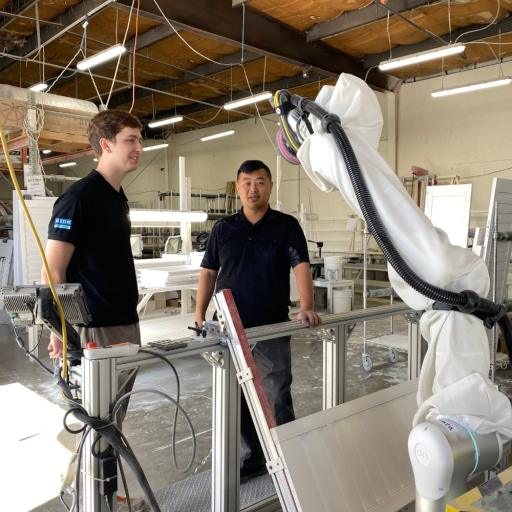 EsVata has been manufacturing wooden custom window shutters since 2019. Because many wooden shutter manufacturers have been in the industry for 10 to 20 years longer than EsVata, Hsieh is looking to automation to boost his competitive position with affordability and quality. He explains, “Automation is one of the key factors for us to survive in this industry, so we use digital stop systems for accurate cuts, robotic arms for painting, and other innovative processes to achieve that goal.”
Hsieh sees EsVata as a pioneer in this approach: “One of the biggest challenges I see in this industry is that a lot of companies are very rudimentary in terms of understanding the technology that's out there. They still do things very traditionally.”
Collaborative automation drives results in productivity and quality
Hsieh recently invested in adaptive automation, using the Flexiv Rizon robot arm equipped with the OnRobot electric Sander as its end-of-arm-tool to sand the shutters. Automating the process is helping the company reduce time and ensure consistent quality. “Production times in the sanding process have improved by more than 80 percent, so that's a huge bump,” Hsieh says. “But by reducing time, we haven't sacrificed quality. Our quality has increased about 20 to 30 percent.”
Because wood is a soft material, any time products are moved from one manufacturing process to the next there is an opportunity for scratching or other blemishes to occur. Sanding and polishing are critical to ensure high quality and customer satisfaction. Typically, this process was done manually, with workers using an orbital sander to sand across the louvers. This is an intricate process, following the different shapes and lengths of shutter louvers that are already mounted into the shutter frame, and consistency was an ongoing issue. “Different employees would use different types of sanders for different reasons. Their hand posture might be different, some might use more pressure than others,” says Hsieh.
Precision electric sander and force-sensing robot meet challenging wood process
Working with wood adds challenges for automation. Hsieh explains, “Certain parts of the wood are softer and other parts are harder, so you can't just use the same force or you’ll get different results.” Hsieh chose the OnRobot electric Sander and Flexiv force control Rizon robot to address these challenges.
“The Flexiv Rizon robot is ideal for surface sanding and polishing with its integrated, low-latency sensors that help it maintain consistent contact between the Sander and the material that it's sanding,” explains Gavin Bomhoff, robotics applications engineer at Flexiv Robotics. To complete the application, Hsieh chose the OnRobot Sander due to its ability to precisely control RPM without dropping power and the consistency of the orbital patterns. “This Rizon seven-axis robot along with the OnRobot Sander all together as a full solution has been amazing,” states Hsieh.
The choice of the OnRobot Sander came down to its reliability, consistency, and the ability to make modifications. “The added feature of controlling the RPM is very precise, at plus or minus ten RPMs,” Hsieh explains. “Adding that onto the 3/16th orbital method for fine sanding, that plays a crucial factor in making sure products are evenly sanded and that's really important for the wood industry.”
Bomhoff says, “We chose the OnRobot Sander because it's a company and a product that we trust. We know we're going to have a high-quality sander. These sanders are very low vibration, which is ideal for a force-control robot because we want to maintain good contact with the surface that we're sanding. These sanders are also very lightweight, which is ideal for our Rizon robot.”
Quick changeovers and no need for supplied air
The OnRobot Sander is connected to the robot using the OnRobot Quick Changer. “That's a big selling point for us because it's an ISO standard flange, so we don't need additional modifications or brackets,” says Bomhoff. “It very easily attaches to our robot and we can get the operation started very quickly.”
An additional advantage of the OnRobot electric Sander is that it doesn’t need a pneumatic hose. That simplifies setup by eliminating the air supply and additional cabling and wire tubing, as well as reducing maintenance costs. The brushless electric motor can run for 30,000 hours. “Based on use on day shift, it'll last ten-plus years, easily. That's pretty unheard-of for sanders,” says Hsieh.
In setting up the system, Bomhoff was able to fully integrate the OnRobot Sander with the user interface that Flexiv designed for the automation cell. The HMI tablet lets the operator select the width, length, and number of louvers for the robot to sand, and the Sander automatically sets the correct RPM that is optimized for the shutter. Operators can easily and efficiently switch between different size shutters.
“The OnRobot Sander also has additional features that we're looking forward to implementing in the future,” says Bomhoff. “OnRobot has an automatic grit replacement for their Sander, so in the future, we're looking forward to integrating that, which is a really critical step in making the entire automation cell fully automated.”
Reduced material costs with no over-sanding
.jpg) By automating the sanding process, errors such as over-sanding or missing areas are no longer an issue, so defect rates have plummeted. Automation has also helped reduce material costs. “With employees hand sanding, the sandpaper might wear out faster. There's not a quantifiable way of figuring out when the sandpaper is due for replacement,” says Hsieh. “With the robot sander and consistent RPMs, we can better calculate based on square footage what we have sanded. That allows us to buy better sandpaper that lasts longer and provides more efficiency and quality.
By automating the sanding process, errors such as over-sanding or missing areas are no longer an issue, so defect rates have plummeted. Automation has also helped reduce material costs. “With employees hand sanding, the sandpaper might wear out faster. There's not a quantifiable way of figuring out when the sandpaper is due for replacement,” says Hsieh. “With the robot sander and consistent RPMs, we can better calculate based on square footage what we have sanded. That allows us to buy better sandpaper that lasts longer and provides more efficiency and quality.
EsVata had four employees dedicated to hand-sanding, which was one of the most labor-intensive parts of the manufacturing process. It was also the most boring, and the most likely to cause repetitive stress injuries. While the goal for automation was to improve consistency, quality, and efficiency, it has also relieved employees from undesirable jobs, allowing them to move to roles the robot can’t do and improving overall employee morale.

OnRobot
OnRobot’s products and solutions are provided through more than 700 distribution and system integration partners, and used in many different industries.
Discover how OnRobot can support your automation journey with their complete range of solutions and expertise.
Visit Company Website
OnRobot’s products and solutions are provided through more than 700 distribution and system integration partners, and used in many different industries.
Innodisk Unveils the New “AI on Dragonwing” Computing Series with the First EXMP-Q911 COM-HPC Mini Module Powered by Qualcomm’s SoC
Innodisk has unveiled its “AI on Dragonwing” computing series, featuring the flagship EXMP-Q911 COM-HPC Mini module powered by Qualcomm.
Yaskawa Motoman Selects Güdel TrackMotion TMO for Great Lakes Regional Center
Yaskawa Motoman’s Great Lakes Regional Center in Rochester Hills, Michigan has added a new Güdel TrackMotion Overhead (TMO).
Custom Deli Streamlines Operations and Cuts Costs with Integrated Temperature Control Solution
Custom Deli partnered with Omron to overcome operational challenges, improve efficiency, and reduce costs.