
Robotics Blog
Robotic Additive Manufacturing: New Technology for New Applications
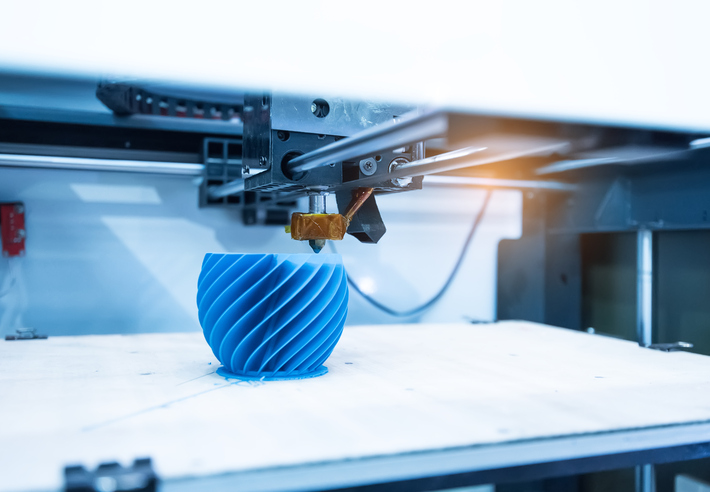 Additive manufacturing (AM) is disrupting the traditional way of manufacturing. AM transforms everything from the assembly line to logistics to the way personnel is trained. Likewise, industrial robotics has had a profound impact on manufacturers, touching nearly every portion of the business.
AM typically excels at small batch production runs while robots are more profitable in high volume environments. When combined, however, additive manufacturing and industrial robotics are a powerful couple. Manufacturers stand to gain major efficiencies from the combination of these technologies.
Real World Examples of New Robotic Additive Manufacturing Applications
GE Aviation recently began leveraging robotic AM processes for freeform fabrication. The purpose of introducing robotic AM for their Advanced Turboprop engine was to reduce waste and reduce the number of parts processed. In the end, GE was able to reduce 855 separate parts down to just 12, with more than a third of the entire engine being produced with robotic AM processes.
ROI Calculator

Discover the potential cost savings of robotic automation over a 20-year system life
This calculator compares your current manual labor costs against the total cost of owning and operating a robotic system over its 20-year lifespan.
These radical results are far from the only success stories of robotic AM. Midwest Engineered Systems Inc. (MWES) is using robotic laser AM to create complicated metal parts. Since implementation, they’ve achieved 99 percent material utilization and only about 5 percent of any part needs to be machined – the rest can be 3D printed.
Additionally, MWES has the ability to create parts with different types of metals – such as a cheap metal coated with an exotic metal for wear resistance – much more economically than ever before.
MWES can produce 32 pounds of stainless steel per hour – and that’s only using a 14-kilowatt laser. Soon they’ll be using a 20-kilowatt laser and production levels will increase even further.
The combination of industrial robotics and AM processes can produce powerful results, especially for high value parts that are difficult to machine. The GE and MWES examples above are just the tip of the iceberg when it comes to robotic AM.
Industrial robotics and additive manufacturing technology are exciting technologies, especially when the best of both technologies are integrated to create entirely new systems.
Recent Posts
- Adaptive Robotics Is Expanding What's Possible in Manufacturing
- Creating a Safety Culture in Your Organization at the International Robot Safety Conference
- 6 Companies Driving Automation in Mexico
- Humanoids on the Horizon: What Hurdles Remain for Widespread Adoption?
- Safety by Design: How Humanoid Robots Must Evolve to Depart the Walled Garden
- Are Robots Really Taking All the Manufacturing Jobs?
- View All Robotics Blogs