
Industry Insights
Researchers Push to Standardize Robotic Stroke Treatment
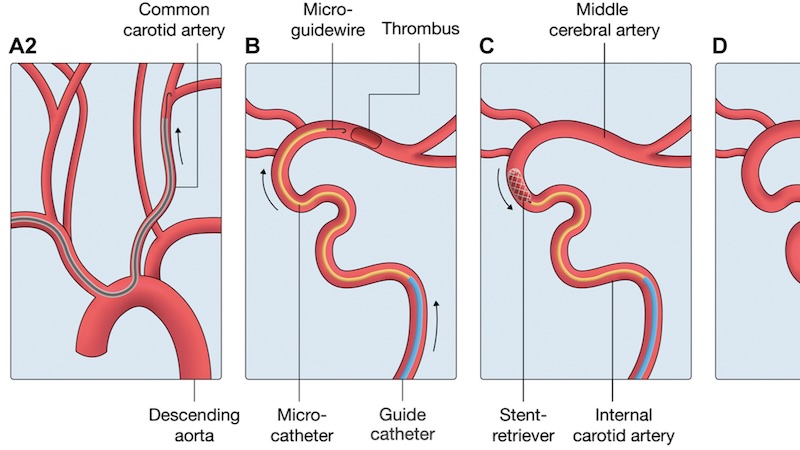
Mechanical thrombectomy (MT) is a life-saving procedure for stroke victims that removes clots from the brain. It is a complex procedure that needs to be performed within hours and requires specialized surgeons.
Robots are being proffered for a range of healthcare and surgical procedures, including MT. However, bringing robots into the hospital to perform the procedure has been slow due to a lack of standardization. Many studies have used robots, but they have all performed different tasks, used different models, and have been measuring different results. It has therefore been impossible to work out what the best clinical approaches are and has even been difficult to compare results across different studies.
Researchers from King’s College London (KCL) have now established the first international consensus on how robotic systems should be designed, tested and evaluated for MT procedures. A new position statement has been published in Journal of the American Heart Association by the researchers that defines the required standards to put patient safety first.
“In 2023, we published a review which examined the field of AI-assisted endovascular interventions, but it was difficult to compare them against each other, and comparing experiments was like comparing apples and oranges,” says Thomas Booth, the leading researcher of the study, “so to move the technology forward and reach the patients who need it the most—as quickly as possible—we wanted to create a consensus from different expert stakeholders in the field regarding what AI-assisted endovascular thrombectomy procedure experiments should measure, what the environments should be, and what type of tasks they should be trying to achieve."
Booth also stated that, “if all research used the same measurements and navigation tasks, then it would be easy to identify what are the most effective approaches. This would allow for work to build on top of each other and increase progress, rather than starting from the beginning each time."
Addressing issues around standardization required bringing many experts together to determine how robotic systems should be evaluated and tested. Booth told A3, "We brought together an international group of experts in interventional neuroradiology [the doctors performing the stroke surgery], robotics, data science, health economics, policy, statistics and patient advocacy to establish consensus frameworks for developing and validating robotic thrombectomy. The resulting position statement sets out, for the first time, what environments should be used, and how their effectiveness should be measured from simulation through to human experiments."
It's hoped that the positioning statement will foster more research using the same processes and evaluation methods to make it easier to directly compare the studies. This will help clinicians to better understand best approaches and what routes can further advance the field.
By using these practical recommendations, it’s hoped that robotic technologies will reach patients quicker and safer, improving the chance of saving people’s lives. However, it will still be some time before we see robots being used for this type of surgery. Booth told A3, “Standard measurements for evaluation of AI-assisted endovascular intervention are now agreed upon but the public is not quite ready for this technology and public engagement by our community is critical to normalize the concepts of robotic treatment and treatment that uses AI-assistance. Additionally, the regulators are not quite ready for this technology either and work needs to be done to ease this transition if we want to leverage this technology for the benefit of patients."
When asked about when we could realistically see these kinds of robots benefiting the public, Booth speculated that, “the technology will likely be fit for purpose within 3-5 years. However, the regulatory framework may take longer than this to develop, and for regulators to approve the technology, high level evidence for benefit will need to be provided through clinical trials which will take a few years. At the same time, health economic data will need to show cost effectiveness of the technology."
Overall, the positioning statement lays a foundation for the future of robotic MT surgery as it defines clear standards to ensure global development and validation are understood. At the same time, the researchers are starting to implement these standards and have recently demonstrated that AI can autonomously perform MT navigation in lab settings.
When asked about what happens next beyond the positioning statement—from a standards perspective—Booth concluded to A3, “through creating this position statement, we have formed the Stakeholder Taskforce for Artificial Intelligence–Assisted Robotic Thrombectomy (START). START will continue to gain consensus across stakeholders in the field regarding the ethical and socially responsible implementation of the technology in the clinic. In our position statement we mention several future directions”.
Association for Advancing Automation
Discover how Association for Advancing Automation can support your automation journey with their complete range of solutions and expertise.
Visit Company Website


Robots and Healthcare Saving Lives Together
Physicians, nurses and technicians are the superheroes of healthcare. But even Captain Marvel needs a trusted sidekick. Enter the robots.

Spindles and their relation to actuator efficiency | Actuator Academy™
Learn about the important features of a spindle, and how the quality, stroke length and spindle pitch influence the performance of a linear lead screw actuator.